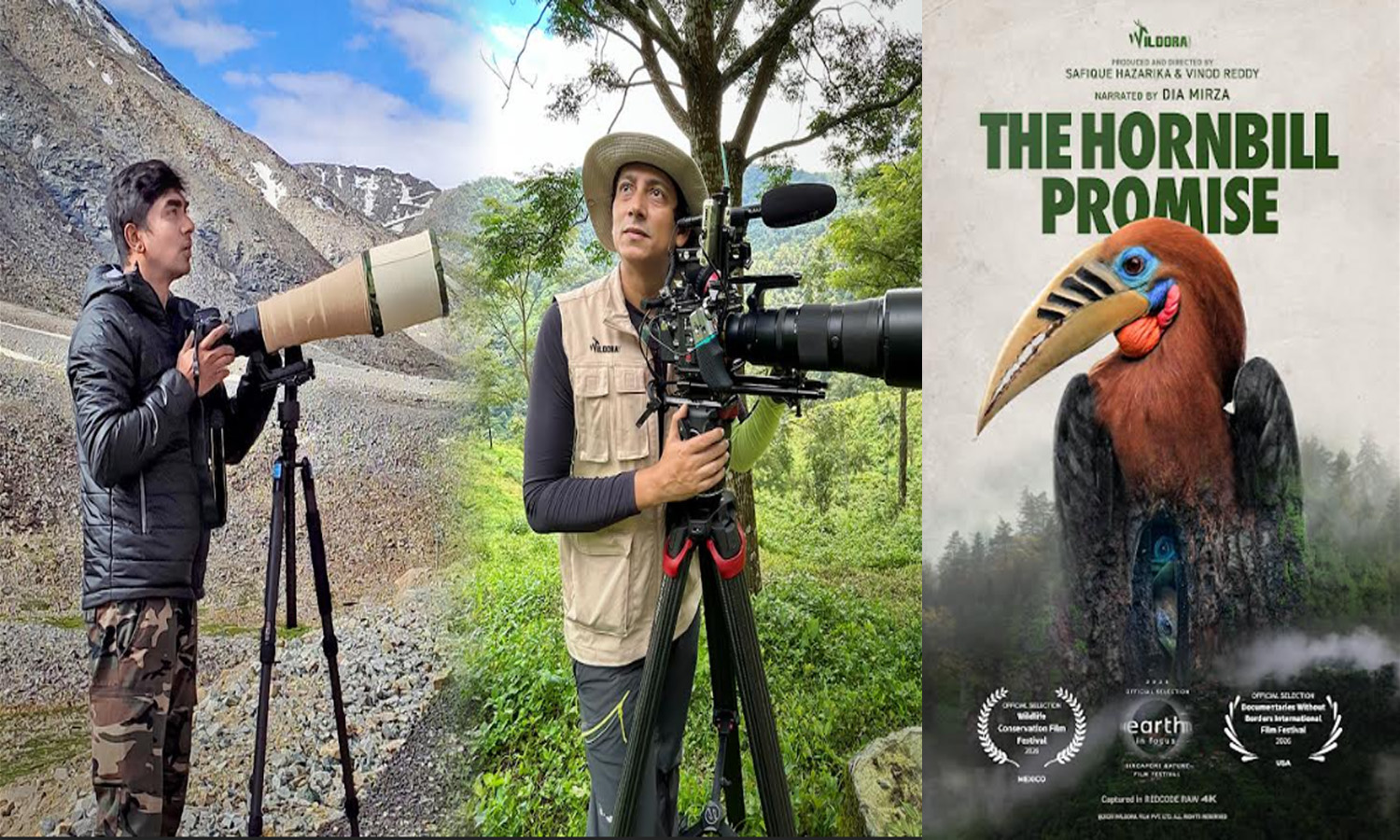
There are wildlife stories that begin with a spectacular image: a rare bird taking flight, a predator closing in, a forest emerging from the mist. And then there are stories that ask us to stay, to watch, wait and understand what happens when the camera is no longer simply looking for an image, but becomes a witness to a life unfolding.
For filmmakers Safique Hazarika and Vinod Reddy, ‘The Hornbill Promise’ became that kind of story.
Set in Latpanchar in the Eastern Himalayas, the documentary follows Tara and Tenzing, a pair of rare Rufous-necked Hornbills, over more than two and a half years. Their nesting journey becomes the centre of a larger story that brings together survival, parenthood, the vulnerability of a species and the unusual relationship between the birds and a Himalayan community that considers them their ancestors.
But it was one seemingly small encounter between the pair that changed the way Hazarika looked at the film.
He had been watching Tenzing repeatedly return to the nest carrying food for Tara. Each time, there was the same ritual. “Every time he arrived at the nest, they would greet each other beak-to-beak before he offered her the fruit. It was incredibly touching to watch,” Hazarika recalls.
Then, one day, the ritual changed.
“On his fourth trip, Tenzing brought fruit again. But Tara suddenly spat it out, and at that Tenzing flew away.” Hazarika kept filming. He was expecting, as he puts it with a touch of humour, a moment of “revenge”.
Instead, Tenzing began eating the fruit himself. “Then, after several pieces, he took out something black from his gular pouch. I zoomed in. It was a crab.”
The bird held the crab for a while, looking towards the nest.
“Then, without hesitation, he flew back, offered the crab to Tara, and she accepted it. They had another beak-to-beak greeting, and Tenzing left again to continue his search.”
For Hazarika, that was the point at which the role of the filmmaker shifted. “That was the moment I stopped thinking like a photographer looking for a story and simply became a witness.”
What he had anticipated through a human lens as frustration or rejection revealed something entirely different: communication and adaptation between two birds responding to each other’s needs.
“I had anticipated a response from my human mind; what I actually saw was communication, adaptation, and an amazing demonstration of partnership,” he says.
Tara needed protein for herself and her new baby, and, in Hazarika’s reading of the moment, that message had somehow reached Tenzing. What began as an attempt to capture a wildlife moment became an encounter that went beyond the frame.
“I went there in order to get a wildlife moment, but what I saw had a much greater impact. It was almost spiritual, and it made me realise that at times nature tells a story which goes well beyond our imaginations.”
That sense of wonder is at the heart of ‘The Hornbill Promise’, but the film is not built around the idea of humans entering an untouched wilderness to save wildlife. In fact, Hazarika believes one of the most important things the filmmakers got right was resisting that familiar narrative.
“I believe that the hornbills will be surprised that we have decided not to follow the common path, i.e., show humans as a disturbance or a threat.”
In Latpanchar, the relationship between the birds and the community is considerably more complicated and more hopeful.
The villagers walk alongside the nest on their way to their orange gardens deep inside the mountain forest. The remarkable thing is that Tara and Tenzing were nesting barely two feet above the ground, yet continued to remain undisturbed by the people passing nearby.
“They had successfully raised their newborn just feet away from a human path,” Hazarika says. To him, the proximity does not represent a clash between humans and wildlife. “That, to me, is not a story of conflict. It is a story of trust.”
That trust works in both directions. The community’s belief system helps protect the hornbills, while the birds have, over time, learned that the people around them do not mean them harm. “The villagers’ belief system protects the hornbills, while the hornbills, in turn, have learned that these humans mean them no harm,” Hazarika says. “That mutual trust has created something increasingly rare, a space where wildlife and people can share the same forest without fear.”
It is this relationship that gives the film its larger significance. Rather than presenting conservation as a one-way act of humans protecting animals, ‘The Hornbill Promise’ looks at what happens when a community and a species have learnt to inhabit the same landscape without fear.
“Perhaps that is what we got surprisingly right: we didn’t tell a story about how humans must save wildlife. We presented a story about how humans and wildlife can learn to trust each other.” But documenting that trust came with its own responsibility.
For Hazarika and his team, the presence of a camera could never be allowed to alter the behaviour they had come to observe. The filmmakers knew that the relationship between the villagers and the hornbills had been established over generations. They, however, were outsiders.
“The trust Tara and Tenzing had with the villagers was already established over generations, but they didn’t know us. So we had to work to win their trust without disturbing their natural behaviour.”
That meant accepting that the most spectacular image might sometimes be the one they would never capture. “We were extremely conscious of our presence around the nest,” he says.
They maintained their distance, using camouflage and the natural cover of trees, and relied on long lenses rather than moving closer. They also made a rule of leaving the forest before sunset.
Perhaps the most important decision was what they chose not to do. “Most important of all, we decided not to put a camera into the nest. We wanted to see their story from the outside rather than interfere with it.”
The decision came at a physical cost. The filmmakers walked four to five kilometres through the mountains almost every day, sometimes spending several hours on the journey, knowing that the distance would inevitably mean missing some extraordinary shots. “But we gained something far more valuable than a ‘wow’ shot: their trust.”
The real confirmation came the following year, when Tara and Tenzing returned to the same nest. “The real validation came the following year. Tara and Tenzing returned to the same nest, completely at ease with our presence, and successfully raised two healthy chicks.”
For Hazarika, that mattered more than any image. “That told me we had made the right choice. For us, the best shot was never the one that came at the cost of the story or the birds.”
For producer and director Vinod Reddy, the decision to remain with the uncertainty and vulnerability of the birds was equally deliberate. Wildlife films can often be shaped around triumph, the successful hunt, the birth, the return, the survival. But Reddy believes the struggle that precedes those moments is where the deeper story lies.
“What is a victory worth if we don’t understand the journey that led to it?” he asks. “It is the vulnerability, uncertainty and struggle that truly weave the web of life. I felt that these stories deserved to be told too,” he adds..
For Reddy, understanding that fragility is also a way of changing how audiences perceive conservation. “When we understand how fragile a species’ existence can be, we don’t just admire it, we begin to value it deeply, and that understanding can become the foundation for meaningful protection and conservation.”
That approach also shapes the film’s emotional centre. The story is not asking audiences to care about two birds simply because they are rare. It is asking them to recognise something familiar in their lives.
“I wouldn’t look at these as separate stories,” Reddy says. The birds’ search for a home, their attempt to protect their young, their dependence on one another and their confrontation with uncertainty are, he believes, recognisably human experiences. “The birds’ struggles, finding a home, protecting their young, facing uncertainty and depending on each other, are not so different from our own,” he reflects.
Once an audience becomes invested in Tara and Tenzing, he says, the distinction between their story and ours begins to disappear. “Once you become invested in the lives of these two birds, you realise that you are not just watching a story about hornbills; you are watching our own story, that is ‘about survival, family, resilience and vulnerability’.”
And that is where ‘The Hornbill Promise’ moves beyond being simply a film about a species. “Somewhere along the way, you begin to understand that their world is very connected to ours.”
The connection is also visible in the physical landscape the birds inhabit. The loss of suitable large nesting trees has forced Tara and Tenzing into an unusual and potentially more vulnerable nesting situation, bringing their nest much closer to the ground and exposing them to a different set of challenges.
It raises an uncomfortable question about what coexistence actually means. Reddy hopes the film does not leave viewers with easy answers. “I hope the question is: how much space are we truly willing to leave for wildlife to exist on its own terms?”
The phrase “coexistence” is often used to suggest that nature can be accommodated within human life. But, Reddy argues, the idea demands something more difficult from people. “We often speak about coexistence as though it simply means making room for nature within our lives. But perhaps coexistence asks something more of us. It asks what we are willing to give up, change or leave untouched.”
The hornbills, in that sense, become more than subjects of observation. Their survival becomes a measure of the space humans are prepared to leave for another species. “The hornbills make us confront that uncomfortable truth: their survival depends not just on our affection for them, but on whether we are willing to respect the space, forests and ways of life they/we need to survive.”
That idea sits quietly beneath the film’s more intimate moments: Tenzing searching for food, Tara communicating what she needs, the two birds greeting each other at the nest, villagers walking along a forest path without disturbing them, and filmmakers choosing to remain at a distance even when getting closer might have produced a more dramatic image.
There is something almost counterintuitive about the story. The closer Hazarika and Reddy came to understanding the birds, the more important distance became. The camera had to observe without intruding. The filmmakers had to wait rather than force a moment. And the most powerful encounters were not necessarily the most spectacular ones.
The result is a wildlife story that finds its emotional weight not in turning nature into spectacle, but in allowing behaviour, vulnerability and relationships to unfold on their own terms.
At its centre are Tara and Tenzing. Around them is a forest, a community and a fragile understanding that has taken generations to form. And behind the camera are two filmmakers who began by looking for a story and, over two and a half years, found themselves witnessing something much harder to manufacture: trust.
Perhaps that is the promise at the heart of ‘The Hornbill Promise’. Not that humans can save wildlife, but that, if given the space and the chance, humans and wildlife can learn to share a world without fear.
Disclaimer : This story is auto aggregated by a computer programme and has not been created or edited by DOWNTHENEWS. Publisher: deccanchronicle.com