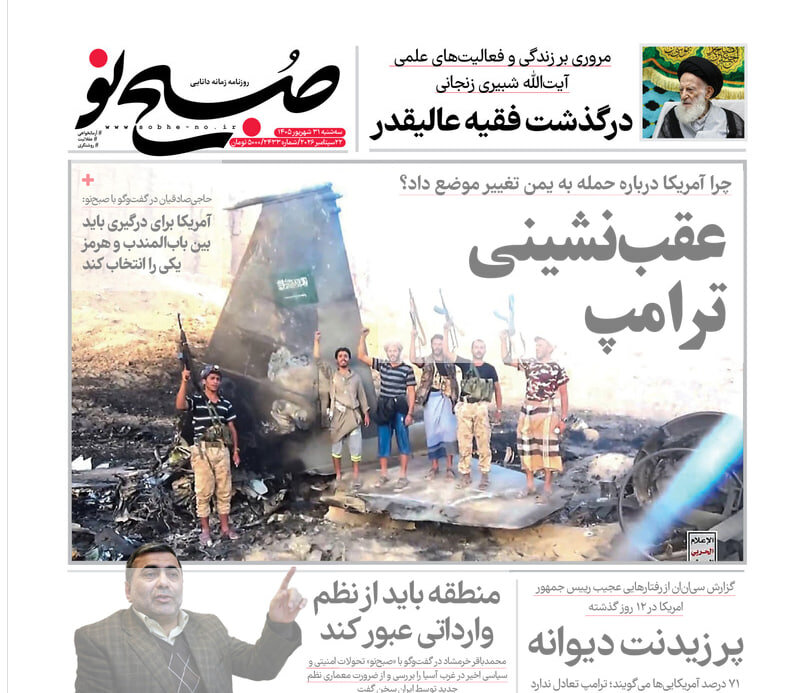
Sobh-e-No emphasized the necessity of diplomacy backed by military power. Unfortunately, after the third (round of) imposed war, a false binary of war or negotiation has taken hold in Iran’s domestic political discourse. Some view negotiation as contradicting resistance, while others see war as an obstacle to diplomacy. Diplomacy without military backing does not work, and military power itself is inseparable from diplomacy.
In other words, it is the battlefield that gives diplomacy credibility; without military strength, diplomacy turns into surrender. Today, Iran has managed to challenge the American-led regional order, but through diplomacy it can shape the foundations of a new order based on its own interests. Smart governance in today’s turbulent world is the art of managing this synergy so that diplomacy can turn battlefield achievements into lasting political gains.
Donya-e-Eqtesad: The emergence of a different bottleneck
Donya-e-Eqtesad examined a new challenge beyond the oil market, writing that the global energy market is now grappling not with a shortage of oil, but with a shortage of ships—a crucial shift that could reshape many traditional dynamics of the energy market. The significance of this development is not limited to the war with Iran or disruptions in maritime routes. The war is more an accelerator than the root cause of the crisis. Even before the first shot was fired in the Strait of Hormuz, the oil shipping market showed signs of structural strain; the Persian Gulf war merely deepened that gap. Until now, the oil market viewed chokepoints like Hormuz, Bab al‑Mandab, and the Suez Canal as sensitive geopolitical nodes. Now a different bottleneck is emerging: fleet capacity and the pricing power of tanker owners. This is where the “hidden empire of the sea” takes shape—power that lies neither in oil fields nor in trading rooms, but in the ability to move barrels between the two.
Resalat: The new doctrine of the US–Israeli coalition
Resalat analyzed the new doctrine of the US–Israeli coalition. The coalition’s current goal is not necessarily the destruction of infrastructure or ticking off military targets. The adversary knows well that any large-scale military confrontation with Iran would impose an irreparable cost on its regional interests. Therefore, it seeks to implement a doctrine of military pressure for political surrender. The aim is to disrupt Iran’s decision‑making machinery and public perception by casting a shadow of war and applying intermittent pressure. The coalition’s ultimate objectives are, at the public level, to inject fear, despair, and insecurity so that the system’s popular support erodes. At the governance level, to overshadow the resolve of decision‑makers and push Iran toward retreat, abandoning red lines, and accepting dictated conditions. They want to use a display of military power to implant a sense of defeat in the minds of Iranians—achieving surrender without needing a full-scale, prolonged war.
Ettelaat: Analysis of Trump’s proposal for talks with Pezeshkian at UN
Ettelaat covered Trump’s openness to meeting Pezeshkian on the sidelines of the UN General Assembly. Supporters argue that such a meeting would not be a friendly encounter but a direct, unmediated negotiation with the highest US authority to defend Iran’s interests. The meeting would not imply agreement or endorsement; rather, it would be a negotiation aimed at securing benefits. It is not a sign of weakness but of capability—using all tools, from war to diplomacy, to achieve national goals. Opponents ask why Pezeshkian should meet Trump when there is no guarantee of success. Trump is highly instinctive and emotional. This situation, however, creates an opportunity for Iran to convert military victories into political‑economic gains and to move the country out of a war posture with the US, opening a new chapter in Tehran–Washington relations. This new chapter does not mean turning Iran and the US into political allies or security partners, but rather exiting the abnormal, tense, warlike state.
Hamshahri: Trump should not be given space
Hamshahri, a newspaper run by the Municipality of Tehran, said reports circulated that Trump cut short his weekend vacation at Camp David retreat and returned to the White House. His early return comes as he reviews next steps in the dispute with Iran. He had spoken of an imminent decision—either destroying Iran’s government or continuing diplomacy. Targeted speculation also claimed he returned to order a strike on Yemen to reopen Bab al‑Mandab to restore Saudi oil exports. The main purpose of such narratives is to disrupt the resolve of Iran and Yemen and prevent increased pressure on the US to break the maritime blockade. The paper argues that Iran must not allow a desperate and criminal Trump administration to use diplomatic games to “negotiate‑therapy” its way out of self‑inflicted economic‑political suffocation. The US can end the blockade if it wants, but it seeks to use Iran’s leverage instead. Such trickery must not be allowed.
Disclaimer : This story is auto aggregated by a computer programme and has not been created or edited by DOWNTHENEWS. Publisher: tehrantimes.com