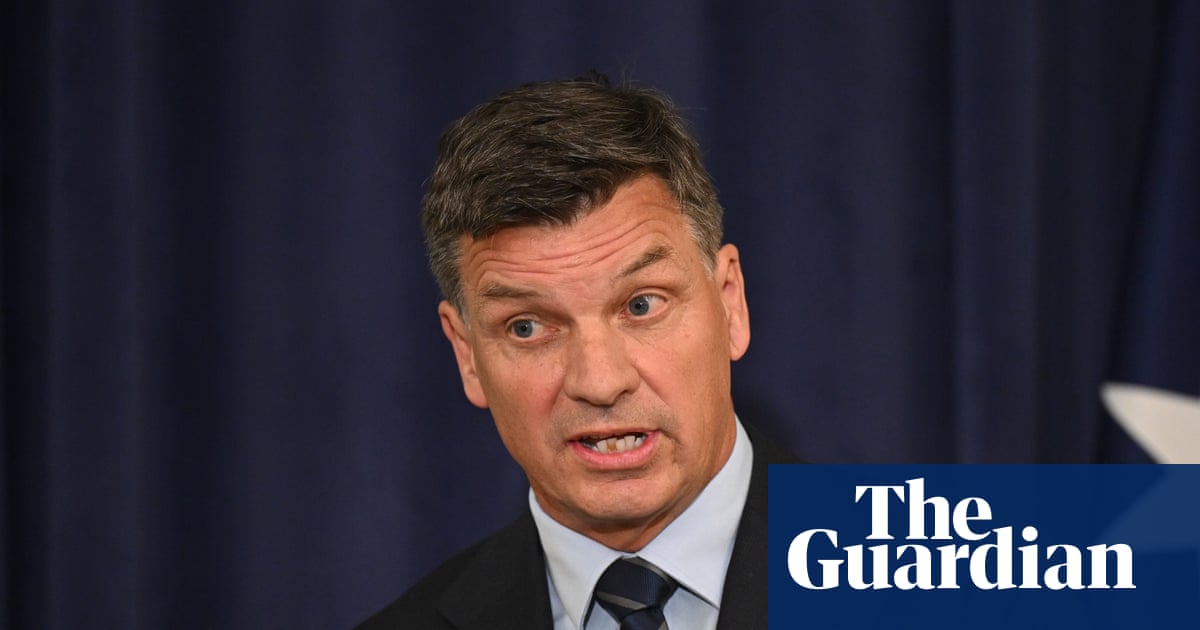
Angus Taylor has immediately distanced himself from the latest policy proposal from Liberal frontbencher Andrew Bragg that would let first home buyers use their superannuation savings as collateral for a loan.
Bragg, the shadow housing minister, floated “a range of ways” on Tuesday that Australians’ retirement savings could be used to help more people into home ownership.
“You could keep the money in the system and it could operate as collateral or an offset,” he said on ABC radio. “You could take it out to pay off a mortgage or to pull together a first home loan.”
Bragg was asked on ABC’s Radio National on Wednesday morning about Taylor distancing the party from the idea, responding that it wasn’t “controversial” to have “big debates” about housing.
“We’re a great country, and we should be able to have big debates, as we had in the 80s and 90s about national savings and housing and the like, which led, in fact, to the super guarantee.”
As Richard Marles, the acting prime minister, accused the Coalition of a “wholesale attack” on the compulsory super system, Taylor emphasised that no policy had been finalised.
When asked about the idea of using super to increase a would-be homeowner’s borrowing capacity, Taylor said “the proposal you’re talking about there is not our policy”.
“We’ll say more about housing policy more generally over the next little while,” he said.
Bragg has become an outspoken advocate across a range of issues, including in a recent National Press Club address where he suggested cutting net overseas migration to below 180,000 a year.
That intervention on 15 August triggered a rebuke from the opposition leader, and split the party, which has yet to finalise its policy.
Marles hailed the $4.8tn compulsory super system as “profoundly important” for Australians’ security in retirement, a day after the latest intergenerational report highlighted the long-term challenges of paying for the needs of a rapidly ageing population.
“What you’ve seen from Coalition governments, and indeed One Nation, is a wholesale attack on superannuation,” he said.
Peter Tulip, the chief economist at the Centre for Independent Studies, said using super as collateral for a home loan was a better approach than the existing first home guarantee scheme, which allows first home buyers to borrow to buy a home with a deposit worth as little as 5% of the value of the home.
Tulip said it was preferable that people risked their own super savings, rather than taxpayer money, when buying a home, as it would help reduce more reckless borrowing.
That said, neither approach – the super for housing idea or the existing first home guarantee scheme – would help in the current situation where demand for homes outstripped supply, he said.
“Both these policies have the huge problem that they boost housing demand. And while I think super for housing is a good idea, my support is qualified because in the current situation it will make prices go up and worsen affordability.”
Matthew Bowes, a senior associate at the Grattan Institute, said it was not clear that the super for housing policy would help those most struggling to buy homes.
“The fundamental issue with using super to help stop the decline in home ownership is that it [the decline] has been strongest among young Australians on low incomes – and they are the group least likely to have substantial amounts of superannuation,” Bowes said.
“Clearly there are some people with super who would be better off. But they already have a lot of subsidies thrown their way and that doesn’t solve the underlying issue, which is a lack of supply of affordable first homes in places where people want to live.”
In a speech to the Financial Service Council, Bragg further qualified his earlier comments by saying “to be clear, none of these ideas are our policy but we are keeping an open mind and they are options worthy of a debate in a country like Australia”.
Disclaimer : This story is auto aggregated by a computer programme and has not been created or edited by DOWNTHENEWS. Publisher: theguardian.com