
The moon fits perfectly between the vaulted arches of l’Abbaye des Vaux de Cernay, as though it were built for this purpose. The Cistercian monks who raised these walls in 1118 understood light as a theological matter: where it fell, at what angle and through which opening. They spent their lives exploiting the powerful relationship between stone and sky and designed accordingly.
Nine centuries later, standing in the courtyard on a clear night watching the moon settle into exactly the gap the monks left for it, one grasps something about this place that the brochure cannot quite convey: that what looks like a hotel now is, in fact, a generations-long conversation between architecture and time. It’s a conversation that is still ongoing, and the people who keep that conversation alive are, in the end, the whole reason it works.
For many years the Abbey functioned as a self-sufficient community of prayer and labour until the 1789 French Revolution. An era later, Baroness Charlotte de Rothschild rebuilt it as a home for her loved ones. A fervent devotee of the arts, she turned entire rooms into backdrops to the works of musicians, sculptors, and painters – with many regal portraits still hanging in the corridors today. Her spirit has not left the hotel – and can be felt in everything from the bars named after her family to her early editions of Dumas WORDS: MARIE MEYER HAUTE L’Abbaye des Vaux de Cernay offers an elegant way to reconnect, with family, with nature and with oneself and Voltaire found lined up on the library’s shelves. The domaine inevitably raised investors’ interest and the Paris Society group, arriving with the ambition to make this a hotel in 2023, had the wisdom to realise that the Baroness had already written the ideal brief for a welcoming hideaway. What remained was to find the people equal to honouring it.
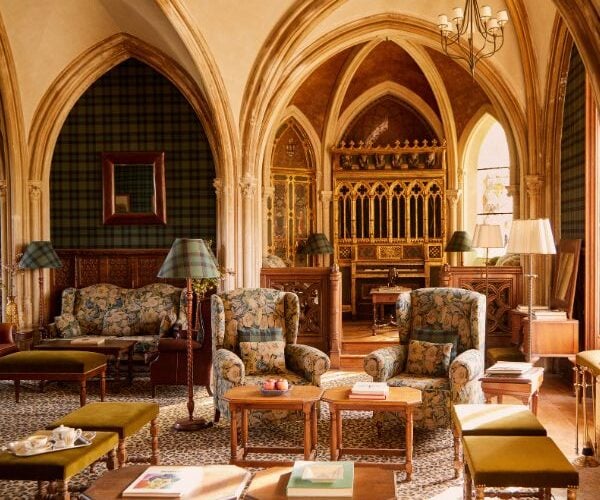
Arriving by car, train, or – when the occasion calls for it – helicopter, the estate reveals itself slowly. The main building rises out of the treeline, the stone worn to that particular grey that only age, weather, and moss can produce when they all work together. Walking in for the first time, the unique energy of the hotel is unmistakable, with the gothic romantic decor emanating secrets and tasteful renovations.

The rooms in Le Pavillon des Chasses, the most storied address on the property and the one housed within the abbey’s original corpus, carry decades of history without making a performance of them. Original woodwork is preserved where it counts, and the antique, custom-designed furniture was chosen by Cordélia de Castellane, artistic director of Dior Maison and Dior Baby.
The 145 bedrooms and suites in the hotel are each so distinct that committing to just one feels almost like a missed opportunity. Beyond the main building, the estate continues to reveal itself at its own rhythm. The lakeside pavilion offers the seclusion that honeymoons are made of.
The former horse stables, now home to the spa, will suit anyone whose plans are purely restorative. The farm buildings, warm and unhurried, are exactly right for families whose children need room to run in directions nobody curated. Each address has its own answer to the question of what a stay here is actually for.

The property shows a different face depending on how it’s approached. A bike ride exploration of the 185 acres of land will have visitors discovering trails that wind through the forest, linking every part of the grounds – the round pool, the floating padel court, the cinema and arcade – before circling back to where they began. It’s a lively journey punctuated now and then by the animals that claim the route as their own, like the alpacas that stand watch at the gates and the geese that trail cyclists along the lake’s edge, hissing as they go. There, barques and pedal boats are offered for guests to use as they please, while dragonflies and butterflies patrol the water with territorial assurance.
Inside, the property holds onto a handful of things no hotel strictly requires, though it’s hard to imagine it without them: a billiards room and an arcade living above a stone-walled chamber that once served a far graver purpose – somehow the mismatch comes across as right rather than odd. The farm, meanwhile, swallows up any children on site for far longer than their parents expect: goats, rabbits, the low hum of small chaos seeming to hold their attention more than the lake, the karaoke, or anything else proposed. And the spa, designed in partnership with Tata Harper, makes its case entirely through stillness. Nothing here is trying to impress. Most of it does regardless.
What builds up, over the duration of a stay, is a slow unclenching of whatever weeks of excess had lodged in the body, mostly thanks to the gentle attention of the unobtrusive staff. A door held open just before it’s needed. A path cleared without any sign of who cleared it. A short word with a driver near the gate. Small gestures, costing nothing, that mean everything. The same attentiveness runs through to the service of the restaurants. Le Réfectoire des Moines ranks among the most extraordinary rooms to eat in. A vaulted ceiling lined with candles floats above the morning light that filters just enough through the ancient windows. Working on a buffet-and-order logic, the staff let guests enjoy the delicacies at their own pace, whether tucked into the alcoves or settled on the terrace – dressed in pink cushions and white parasols and offering the whole estate in one sweeping view. The afternoon goûter is served here too: macarons, fresh fruit, infused waters, and the ice creams of the Emki Pop brand.

La Trattoria del Bambini, a kilometre away through the forest, is even more relaxed in its proposition. Sun-warmed and unbothered, in keeping with the trail that leads there, the wide stone vaulted room is decorated with wicker baskets, turned chandeliers and elongated wood tables. Chloé, the restaurant’s manager, is as solicitous as it gets – making perfect recommendations after just a few words exchanged on preferences and ensuring everything is as cosy as it can possibly be. Every address on the property has found its own register, but the cumulative effect isn’t of departments within one hotel so much as facets of a single personality.
It is at Les Chasses, though, that one can appreciate exactly how rich that personality is. The flagship restaurant of the Abbaye offers the finest seasonal French products, handled with respect and creativity – the simplest definition of good cooking. Served on a sun-kissed terrace where a faint trace of citronella keeps the insects at a diplomatic distance, it is the team that transforms dinner into an experience. The chasseurs, named in keeping with the house’s own vocabulary, are attentive in the rarest way. Thomas, chef de rang, embodies the quality expected: present without hovering, a step ahead of the question before it’s fully asked, possessed of the singular gift of making any table feel like the only one in the room.
Pressed on what distinguishes this dining room from others he could be working in, he doesn’t reach for the obvious answer about scenery. He talks instead about the guests – about the relationship that forms with them, about having the time to actually watch and listen to people, to sense what they want before they’ve had to say it. A service that only cares about the rhythm of courses, he says in his own way, misses the point of a house like this one – it is a different discipline, less about speed and more about perceptiveness to people, one that, to his own surprise, became the thing he values most about the job. What holds constant across every register – the measured precision of the front desk, the warmth of Les Chasses, the languid ease of the Trattoria – is the greeting. Every member of staff acknowledges every guest who crosses their path. It creates an odd, rather lovely effect: the sense of belonging briefly to an enormous, extremely well-mannered family, without ever losing the respectful distance that keeps a luxury hotel from accidentally becoming someone’s actual living room. It is a difficult line to walk. Here it looks effortless, which is usually the surest sign that it isn’t. For the length of a stay, everyone is treated as the only guest in the house. It’s what happens when the people around you respect and understand that it matters.
On the last night, the moon finds its gap in the arches again, exactly where the monks left room for it nine hundred years ago. They never met the people who’d be standing here to see it centuries later. They built it anyway, on faith that someone eventually would, and would care enough to look up at the right moment and feel a profound connection to this place. The Paris Society group didn’t have to keep that promise when they turned this magical place into a hotel, but they did regardless, in stone and in staff alike. And while the moon might forever remain indifferent, those who have the privilege to stay at this hotel will leave it feeling anything but.
– For more on luxury lifestyle, news, fashion, and beauty, follow Emirates Woman on Facebook and Instagram.
Images: Supplied
Disclaimer : This story is auto aggregated by a computer programme and has not been created or edited by DOWNTHENEWS. Publisher: emirateswoman.com




