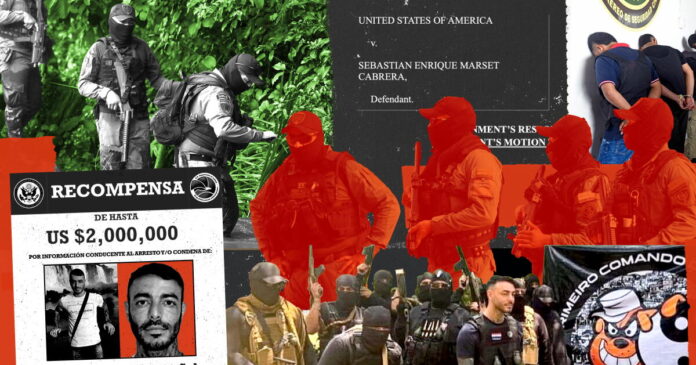
Prior to his capture this year, Sebastian Marset was reputed to be one of the world’s most prolific drug traffickers, allegedly sending mountains of cocaine — 10 tons or more per shipment — from South America to Europe.
A native of Uruguay, where authorities say he proclaimed himself “King of the South” and led a criminal network dubbed “Primer Cartel Uruguayo,” or the first Uruguayan cartel, Marset, 35, has been described in some media reports as his country’s version of Pablo Escobar.
But unlike the infamous Colombian kingpin, who flooded American cities with cocaine in the 1970s and ‘80s, there is little evidence to show Marset ever moved any product to the United States.
And yet for six months, Marset has been jailed in Alexandria, Va., facing a list of federal charges that has grown longer since his arrival. Initially indicted only for alleged money laundering, he has since been accused by federal prosecutors of conspiring to smuggle cocaine on the high seas and narco-terrorism.
The case, Marset’s lawyers and some legal experts say, reflects the degree to which the Trump administration has stretched the purview of the Department of Justice when fighting its war on drugs.
Beyond blowing up dozens of boats suspected of carrying cocaine — a campaign critics denounce as both cruel and ineffective at staunching the flow of drugs — the White House has taken to labeling cartels as terrorist organizations and pushed countries to hand over suspected traffickers without going through the standard extradition process.
Marset’s prosecution offers a new twist, with the U.S. attorney’s office in the Eastern District of Virginia pursuing charges against him despite few indications his alleged criminal activities had any impact on Americans.
Marset’s lawyers have pointed out in court filings that he is not “alleged to have ever sent even a gram of cocaine to the United States,” arguing there is no jurisdiction to prosecute him in Virginia.
Even the charge that he laundered money through the U.S. financial system, his lawyers say, is flimsy, hanging on a single transaction — out of more than 200 identified by prosecutors — that the feds say was routed through a bank server in Richmond, Va.
In a phone call with The Times from jail, his first interview since his arrest, Marset fumed about the case.
“I don’t owe the United States anything,” he said in Spanish. “I still don’t know what I’m doing here.”
It was around 3 a.m. on March 13 when Bolivian intelligence agents came for Marset.
He claims they stormed his residence with guns blazing, firing indiscriminately into the room where he lay sleeping with his partner and their children.
“They dragged me out naked because I was in bed,” he said. “They rushed me into a vehicle and took me straight to the airport.”
For years, Marset had slipped through the fingers of law enforcement in multiple countries. He was jailed for a time in Dubai, but managed to secure his release and vanish just as authorities resumed their manhunt for him.
To build his trafficking network, U.S. prosecutors charge that Marset partnered with the Primeiro Comando da Capital, Brazil’s largest criminal organization, and the Clan del Golfo, a paramilitary group that controls cocaine production and smuggling routes in Colombia. Both were recently designated by the Trump administration as foreign terrorist organizations.
He amassed a fortune, much of it held in cryptocurrency, U.S. court records show, and lived a life of luxury while on the run, sometimes hiding in plain sight. Lanky, with sleeves of tattoos that extend to his neck and wrists, he cuts a striking figure. He allegedly used his illicit wealth to fulfill his dreams of playing professional soccer, buying himself a spot in the starting lineup for teams he bankrolled.
He’s also been accused of ruthless violence, including allegations — which Marset denies — that he ordered the detonation of a grenade at the headquarters of Uruguay’s federal anti-narcotics police, killed members of his organization he suspected of betrayal, and directed the assassination of a Paraguayan prosecutor who was gunned down while on his honeymoon at a private beach resort in Colombia.
His pursuers managed to track Marset to Santa Cruz de la Sierra, Bolivia’s economic hub, by planting a GPS tracker in his girlfriend’s luggage as she traveled through Brazil, according to U.S. court filings.
The Bolivians promptly handed Marset over to agents from the U.S Drug Enforcement Administration, who flew him to Peru and then Washington.
The justification for prosecuting Marset in Virginia is that one wire transfer for $31,800, sent from a bank in Portugal to a bank in China on Feb. 18, 2021, allegedly passed through a Bank of America computer server.
Marset, his attorneys maintain in court filings, “did not personally take any action to conduct the wire transfer,” adding that there’s evidence it actually occurred in Pennsylvania, not Virginia. The transaction’s link to the United States, they say, was both “ephemeral and unforeseeable.”
Even if Marset was smuggling drugs as prosecutors allege, his attorneys argue that his “conduct had no connection to this country whatsoever.”
After Marset’s lawyers pointed out that the charging documents allege he only smuggled drugs to Europe, prosecutors filed a response that said if the case went to trial, they would introduce evidence that he did, in fact, send cocaine shipments to the United States. They have offered no explanation as to why Marset is not already charged with that crime. The U.S. attorney’s office in the Eastern District of Virginia did not respond to questions about the case.
The government’s resources, Marset’s legal team asserts, would have been better spent pursuing other targets.
In his phone call from jail, Marset echoed that sentiment. “I never even talked about the United States,” he said. “I didn’t even want to know where on the map it was. I wasn’t interested in the United States at all.”
Marset hails from a neighborhood on the outskirts of Uruguay’s capital, Montevideo.
His father worked for a factory that manufactured plastics — “trays, bags, and all that kind of stuff,” he said — and as a truck driver. His parents split up when Marset was 8, leaving him to be raised by his mother.
“It’s been a hard life,” he said. “I grew up very humbly.” His first serious run-in with the law came in 2012, when he was reportedly caught receiving a large shipment of marijuana. Marset was imprisoned from 2013 to 2018 in Uruguay, but maintains there was never any hard proof of his involvement in the drug trade.
“To this day, all they’ve done is call me a suspected drug trafficker,” Marset said. “Because no country has been able to prove the drug trafficking everyone’s talking about.”
Despite his efforts to avoid incurring the wrath of Uncle Sam, Marset eventually came into the crosshairs of the DEA.
On March 27, 2025, according to court filings, DEA agent Michael Greisen tried a direct approach: He messaged Marset on WhatsApp, warning that he was under indictment and should turn himself in.
“We wanted to inform you and explain how you could resolve your issues with the United States discreetly and professionally,” Greisen wrote, according to a translation provided by prosecutors. “You have the chance to set things right. Otherwise, you are simply waiting for the day of your imminent capture.”
Marset did not take kindly to the admonition.
“Justice doesn’t exist,” he responded in one message, according to U.S. prosecutors.
“I am smarter than the entire DEA put together,” he allegedly said in another.
Marset’s lawyers claim the exchange so enraged the DEA that it set out to capture and prosecute him by any means necessary. They assert that the DEA orchestrated the raid on Marset’s home in Bolivia, arranging for him to be turned over immediately to avoid the usual extradition process.
Federal prosecutors said in court filings that, although DEA agents were “briefed on the operation before and after it occurred,” they were “not involved” in planning or executing the raid. They dispute that the Bolivian agents shot up Marset’s home, stating he was “arrested without incident.”
The DEA’s handling of Marset after he arrived in the U.S. has also been a point of contention.
While being transported from the airport to jail, Marset’s lawyers say, the DEA agents asked him to “donate” $4 million in cryptocurrency that was held in various accounts.
Marset, his attorneys say, “believed that the request for a ‘donation’ was the equivalent of an extortion attempt.”
“In every country, it’s become clear to me that all they want is my money,” Marset told The Times. “I thought it wouldn’t be like that in the United States.”
Prosecutors said the agents never asked for a “donation” from Marset and allege that he has sought to “intentionally mischaracterize as unscrupulous what are in fact standard law enforcement practices.”
Some former federal prosecutors said the government may have overplayed its hand with the case. They questioned why the narco-terrorism charges against Marset were added only after he began fighting his case.
“This is a reach, so far as I can tell,” said Bonnie Klapper, a former federal narcotics prosecutor in the Eastern District of New York. “They’re really trying to bootstrap one statute on top of another.”
David Weinstein, a defense attorney not involved in Marset’s case, who previously worked as a narcotics prosecutor in Miami, echoed that assessment. He suggested the narco-terrorism charges were probably brought to ramp up the pressure on Marset to make a plea deal.
“It gives a more salacious nature to what was originally just a money laundering conspiracy case,” he said.
The judge presiding over the case ordered a hearing on Wednesday, where both sides will argue why the charges should stand or be dismissed.
Meanwhile, Marset has been biding his time in jail. He said he passes the days by watching soccer on TV, though he has been unable to play since suffering a knee injury prior to his capture.
He called the narco-terrorism charge against him “absolutely ridiculous” and claimed that his efforts to combat the charges had made things personal with the U.S. attorney’s office.
“The justice system today, worldwide, is rotten to the core,” he said. “The prosecutor doesn’t want to do justice. The prosecutor wants to beat me.”
More to Read
Disclaimer : This story is auto aggregated by a computer programme and has not been created or edited by DOWNTHENEWS. Publisher: latimes.com