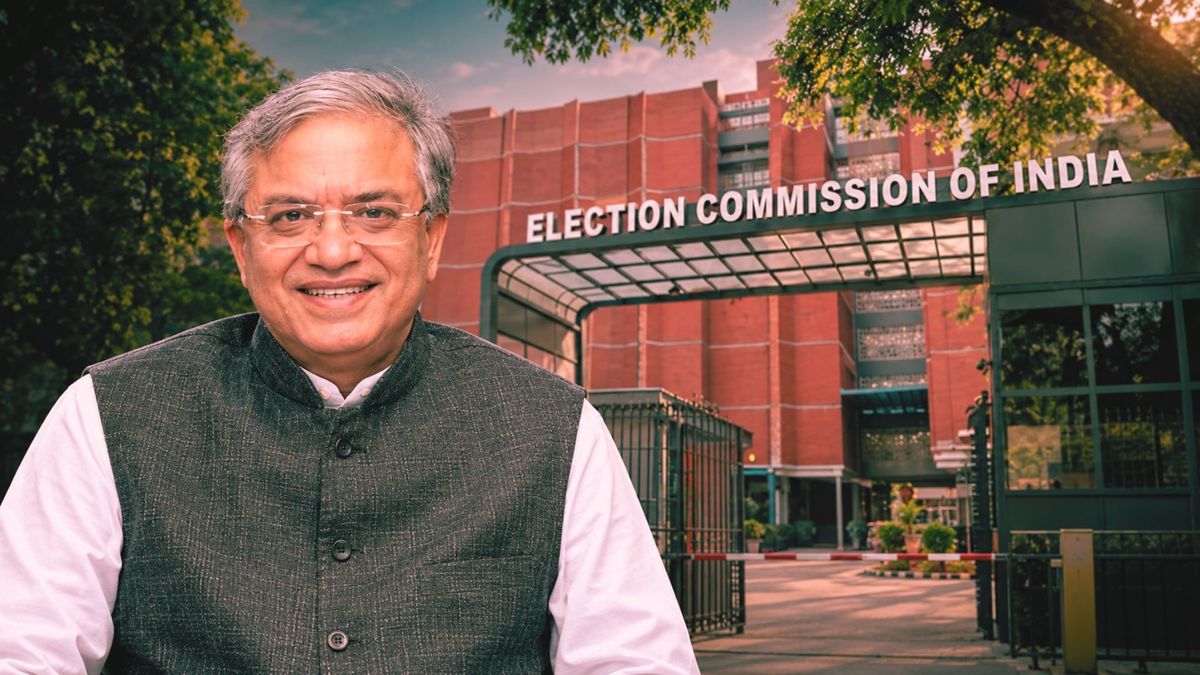
For more than a year, the Election Commission of India has answered every question about the Special Intensive Revision of electoral rolls in the same way: the process is lawful, decentralised and beyond politics. On Wednesday, that answer was contradicted from inside the Commission itself.
An investigation by Ritika Chopra in The Indian Express found that two of the Commission’s three members, Election Commissioners Sukhbir Singh Sandhu and Vivek Joshi, formally objected on record at least 14 times over ten months to decisions and orders they say were issued without their knowledge. Four of those objections were made on a single day. Several were copied to Chief Election Commissioner Gyanesh Kumar, and two went outside the Commission altogether, to the Cabinet Secretary.
Within hours, much of the national press and a wide range of digital outlets had followed the story, and the Opposition had turned it into a demand. Leaders of the Congress, CPI(M), Trinamool Congress, RJD, DMK and AAP called for the CEC’s removal. Trinamool’s Derek O’Brien urged Parliament to take up a removal notice that more than 60 Rajya Sabha MPs had submitted earlier this year.
Calls for Gyanesh Kumar to step aside are growing. What sets this moment apart from earlier controversies is where the challenge comes from: this time it is being made from within the Commission, in writing, by the two people who sit beside him.
Also Read:Election Commission of India Says No Information on Returning Officers
What the Files Show
The SIR began in Bihar in June 2025 and has since removed more than 13 crore names from draft electoral rolls across 30 states and Union Territories. The objections raised by Sandhu and Joshi go to the core of that exercise: who can register as a new voter, how names are deleted and restored, who files appeals in the Commission’s name, and who controls the electoral roll itself.
Take Form 6, the form every citizen fills to enrol as a voter. In May, Joshi warned on file that it could not be changed without the government amending the Registration of Electors Rules, 1960, and Sandhu agreed. In July the form was changed anyway, adding a question on whether the applicant, a parent or a grandparent appeared on the roll of the “last SIR“. In August, Sandhu recorded that the change was “unauthorised and illegal” and should be withdrawn immediately. According to the Express, the question was still on the form until Monday morning.
In West Bengal, the Commission told the Supreme Court last week that 38 lakh appeals were pending before tribunals of retired High Court judges. Of these, 16.10 lakh sought the deletion of voters whom judicial officers had included in the rolls. The Commission did not say who filed them. In August, Sandhu asked the same question in writing, and recorded that neither he, nor Joshi, nor the state’s Chief Electoral Officer had been told how or why the appeals were filed.
There are also notes about how the Commission itself is run. Joshi recorded that for over a year he had received no agenda before Commission meetings and no minutes afterwards. The Express reports that the CEC and both Election Commissioners met in full on September 9, their first such meeting in four months.
Also Read: West Bengal Voter Deletion: How Elections Are Won Before Polling Day
The Question of Control
The most consequential thread in the story concerns the software on which India’s voter lists are kept. For decades, the ECI’s defence against allegations of roll manipulation has rested on decentralisation. Each constituency’s roll is prepared and controlled by its Electoral Registration Officer, a statutory authority on the ground, usually the Sub-Divisional Magistrate. No one in Delhi, the argument goes, can quietly alter a constituency’s list.
The two Commissioners say that safeguard is being eroded. In May, Joshi warned of the “gradual centralisation” of the electoral roll database and proposed an audit to certify that only statutory authorities held the credentials to change voter records. In August, Sandhu recorded that state officials said they lacked full access to ERONet, and that the Commission’s Director General of IT, Seema Khanna, had no legal authority to restrict the access the law gives statutory officers. The Representation of the People Act, 1950 gives the power to prepare and revise rolls to Electoral Registration Officers, not to the Commission’s IT division.
Goa shows what this means in practice. After the Supreme Court ordered on January 29 that voters flagged for “logical discrepancies” be heard, Goa’s EROs examined the cases and found 97 voters eligible. The software offered no way to record that decision. Between February 11 and 17, the state CEO’s office wrote eight times to Senior Deputy Election Commissioner Gyanesh Bharti, copying Khanna each time, seeking a rollback option. It was not enabled in time, and the 97 were left off the final roll. The number is small; the principle is not. A lawful decision, taken in compliance with a Supreme Court order, was overridden by a system controlled from Delhi.
Neither Khanna nor Bharti has commented publicly, and nothing in the record shows on whose instructions either acted. The two Election Commissioners say it was not on theirs. That leaves one person who can answer the question: the CEC.
A Constitutional Problem, Not an Administrative One
Article 324 of the Constitution vests the superintendence, direction and control of the preparation of electoral rolls, and of elections, in the Election Commission, not in the Chief Election Commissioner alone. When the government made the Commission a permanent multi-member body in 1993, T.N. Seshan challenged the change. In 1995, the Supreme Court upheld it and observed that no one can be above the institution he is supposed to serve. The CEC is first among equals. He does not decide on his colleagues’ behalf.
If orders affecting the voting rights of crores of citizens were issued without the Commission’s approval, their legal footing is uncertain. That has consequences well beyond the Commission’s internal workings. It opens SIR decisions to challenge, and it bears directly on the right to vote under Article 326. An institution whose authority rests on public trust cannot afford doubt over whether its own orders were validly made.
Also Read: SIR and Citizenship: ‘You Are a Foreigner Until Proven Otherwise’
What Section 18 Says
The law on this point is plain. Section 18 of the Chief Election Commissioner and Other Election Commissioners Act, 2023 says the Commission’s business shall, as far as possible, be transacted unanimously. Where the CEC and the Election Commissioners differ, the majority view prevails. The same section allows the Commission to settle its procedure and the division of its work, but only by unanimous decision.
Measured against that standard, the record is difficult to reconcile. On Form 6, two of three members objected before the change was made, and it went ahead. The reallocation of IT work in July, which the two Commissioners say removed a layer of oversight over the roll’s technical backbone, was made without their knowledge, although the Act allows changes to the division of work only by unanimous decision. Sandhu and Joshi struck it down on July 30. In April, Sandhu wrote to senior officers citing the 2023 Act, and Joshi followed eight days later citing Article 324 as well. Both reminded the officers that communications issued in the ECI’s name require the Commission’s approval.
A fair reading must also note what the two Commissioners have not done. As former IAS officer KBS Sidhu has pointed out, a majority can move resolutions and publish the vote, and there is no public record that they have done so. The reason may lie in the Constitution itself: under Article 324(5), an Election Commissioner can be removed only on the recommendation of the Chief Election Commissioner. The members recording dissent are the ones with the least protection. Even so, the central point stands. On the questions they raised, Gyanesh Kumar did not command a majority of his own Commission.
What the Commission’s Response Leaves Out
The ECI replied the same day with a press note. It describes the objections as routine: written notes, suggestions and “internal checks-and-balances” raised at “draft stages”. It says all decisions were the “unanimous decisions of the full Commission” in the past year, and that every officer of the Commission is entitled to offer suggestions.
The record does not support this. Sandhu’s August objection to Form 6 came after the change was already live, so it was not a draft-stage suggestion. The July 30 order striking down the IT reallocation was the Commission’s majority reversing an action already taken. A claim of full-Commission unanimity is hard to sustain when one Commissioner says he received no agenda or minutes for more than a year, and when the three members did not meet in full for four months. Placing two constitutional office-holders alongside “every officer” misreads Article 324.
The note says EROs function as per their statutory powers. In Goa, they did, and the software set their decision aside. The note does not say who filed the Bengal appeals, does not explain why Form 6 stayed unchanged for weeks after being called illegal, and does not mention the letters to the Cabinet Secretary. Most notably, it does not deny that any of the 14 objections were made.
The Appointment Question Returns to Court
The episode also lands in the middle of a wider dispute over how the Commission is chosen. In March 2023, a Constitution Bench in Anoop Baranwal directed that, until Parliament legislated, the CEC and Election Commissioners be selected by a panel of the Prime Minister, the Leader of the Opposition and the Chief Justice of India. Parliament then passed the 2023 Act, which replaced the Chief Justice with a Union Cabinet minister nominated by the Prime Minister. Adhir Ranjan Chowdhury recorded his dissent when Gyanesh Kumar and Sandhu were appointed in 2024, and Rahul Gandhi did the same when Kumar was elevated and Joshi appointed in 2025.
On the same day as the Express report, a two-judge Supreme Court bench split on the Centre’s plea to refer the challenge to the Act to a larger bench. Justice Dipankar Datta held that the Centre’s demand for a larger-bench reference was unwarranted and questioned, prima facie, whether the Act ensures an independent appointment process. Justice Satish Chandra Sharma held that the reference was justified. In view of the split, the bench directed that the matter be placed before the Chief Justice of India for the constitution of a Constitution Bench. All three Commissioners were chosen under the process now in question, and two of them say they were bypassed. The court’s question about independence is no longer abstract.
What Must Come Next
Gyanesh Kumar has not been found to have broken the law, and the ECI denies any irregularity. But the office of CEC depends on credibility as much as on legality. At a minimum, the Commission should publish the 14 notes and the decisions they concern, and release the minutes of its meetings. It should withdraw the Form 6 change, disclose who authorised the Bengal appeals, and commission the independent audit of roll access that Joshi proposed in May. Parliament, too, has a duty to examine the record rather than leave it to press notes.
If Gyanesh Kumar cannot show that the Commission’s majority stood behind the decisions taken in its name, the case for him to remain as CEC will be difficult to sustain. An election body can withstand criticism from political parties. It is far harder to withstand the objections of its own members.
Disclaimer : This story is auto aggregated by a computer programme and has not been created or edited by DOWNTHENEWS. Publisher: theprobe.in