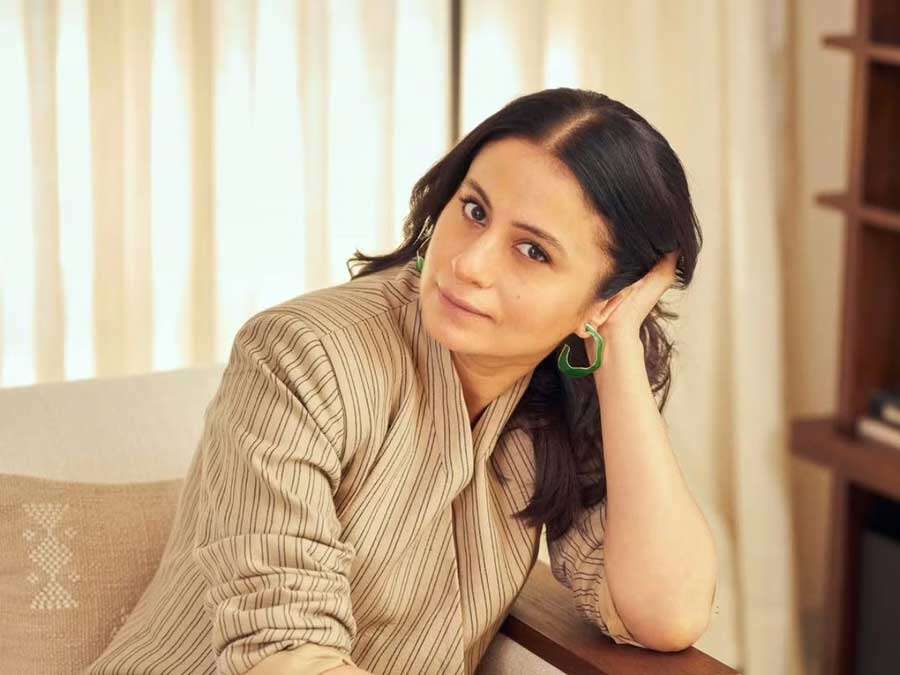
Eyes darkened by kohl and desire. Her tresses falling in ‘untamed’ waves much like her unrestrained sexuality. Copious sindoor incompatible with her infidel instinct. Draped in demure tradition, the much-younger wife of mafia don, Akhandanand ‘Kaleen Bhaiya’ Tripathi, in the series Mirzapur is a discreet dissenter. Her goal – the decimation of the Tripathi family that violated her vulnerability. Rasika Dugal as the diabolic Beena Tripathi has become part of pop culture inspiring memes and gifs, her badass persona controlling the badlands of Purvanchal, Uttar Pradesh. In a world driven by drugs and revenge, warped father-son dynamics and lust – for both flesh and power… she rolls the dice.
But now her sensuality’s splashed across a wider canvas. Her Machiavellian prowess has acquired a sharper edge. As part of Excel Entertainment’s Mirzapur: The Movie, a standalone companion film, the actor goes all out to ‘smash the patriarchy’ that threatens her existence. The Tripathi bahu, an unsuspecting mole, plots the purging of the clan that humiliates her in cahoots with their adversaries. She weaponises her sexuality to leave the men unarmed and ambushed. Her systemic manipulation prevails over the machismo. The FTII graduate, who impressed with her craft in Delhi Crime, Manto, Qissa, Chutney… has now become the showstopper in the crime narrative and will long be remembered as the Queen of Mirzapur, the real Kingmaker….
How different has it been doing Mirzapur: The Movie after the overwhelming response to the similarly titled series?
Doing the film Mirzapur (directed by Gurmeet Singh and produced by Ritesh Sidhwani and Farhan Akhtar) has been fascinating. It’s set approximately between episode six and seven of Season 1. We’ve already done three seasons of the show. As performers, we had to go back to being what our characters were in Season I. That’s a challenge because you’re put back into a timeline. I revisited Season 1 before I started filming. My character Beena Tripathi is such a cued in person. She knows exactly about the insecurities of each character and how that can be played to her advantage.
You described your character as the ‘ultimate puppeteer’. Why?
Beena Tripathi pulls the strings. It comes from a need to survive in the testosterone-driven world. It also comes from ambition. She wants control and power. Generally, that’s not considered something women should possess. Above all, the humiliation that she feels by the way she’s been treated by the men around her, adds a layer of revenge to her goal.
In Season 2, she has a child. Then it’s more about realising her ambitions through the child. She’s been privy to enough conversations to know how the men can be played around and against each other.
What scene describes Beena Tripathi best?
Season 1 ends with her being sexually violated by her father-in-law Satyanand ‘Bauji’ Tripathi (Kulbhushan Kharbanda). At the beginning of Season 2, she realises she’s pregnant (there’s ambiguity about the baby’s paternity which could belong to husband Kaleen Bhaiya, Bauji, or domestic staff Raja) and uses it as a shield to secure her safety.
Season 2 is primarily about her reclaiming her agency and avenging her humiliation. Before that she’d lost all sense of self. When she goes to her father-in-law’s room he holds her hand roughly. That moment the memory of abuse returns. She decides that she’s going to play along and eventually give him what he deserves. When she walks out of the room she speaks to her unborn child saying, ‘This way I will survive and so will you.’ That sums up what she does and why she does it.
Interestingly, Beena’s physical appearance is conventional but conceals a rebel of a woman.
While designing her look, we realised that plain-coloured saris and bindis would work best for her. The sindoor and bindi are traditional symbols of marriage. I wanted her to have untamed hair. That visual has an aura of sensuality and a sense of being unapologetic. Playing Beena makes me feel sexy. Most women in a patriarchal society are taught not to be too conspicuous. No matter how progressive the household that you’ve grown up in, society urges a woman to be self-conscious. Being inconspicuous is associated with being virtuous. These are patriarchy coded ideas. While for men it’s normal to live with abandon.
I’ve always been in awe of and secretly admired women, who can be sensuous. Women who have an unapologetic body language. We’re all sexual, sensual beings full of desire. But that’s the side of myself I’ve never comfortably expressed. When I’m being Beena, I can be that. That was so freeing and liberating.
How much did ‘intimacy coaching’ help you with the bold scenes?
Very much! An intimacy scene is like any other scene that needs to be choreographed. An intimacy coordinator is equipped to take care of what you’re comfortable with. He finds a way to achieve what the story needs without anyone being made to feel uncomfortable.
What compliments has your character fetched?
There have been plenty. But I recall a lady, who shook my hand and said, ‘You’ve played a brave role’. Some say ‘You’re such a cool woman’. In cinema it’s common to show women being morally upright or single-mindedly trying to exact revenge. To have someone who’s flawed and devious is interesting. Beena is greedy and ambitious, which is so lovely. A male colleague, who I assumed to be conservative said, ‘I’m so proud of the role you’ve done.’ I feared he’d be taken aback by the content.
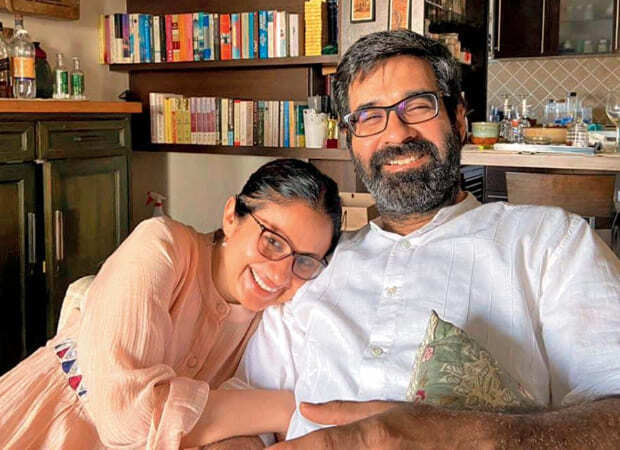
A compliment I hold close to my heart was from writer Puneet Krishna. After Season 1, he said, ‘You’ve played Beena Tripathi with so much dignity.’ I’ve not forgotten that phone call since. My husband (actor/writer Mukul Chadda) believes it’s one of my best performances more so because it’s completely different from me. And he’s not as scared of me as Akhandanand ‘Kaleen Bhaiya’ Tripathi (Pankaj Tripathi) is of Beena. Akhandanand becomes a bheegi billi (timid cat) in her presence. The whole of Mizrapur is trying to appease Kaleen Bhaiya but he only wants to placate his wife.
Tell us something about Pankaj Tripathi as a co-actor.
Pankajji underplays beautifully. He’s a delight to work with and a treat to watch. I don’t even realise how many nuances he adds when we’re doing a scene. When I watch it later, I’m like, ‘Oh my God, I noticed 20 things he did but there are 200 more! He brings in so much to every moment. He’s so emotionally intelligent. As a co-actor, he’s attentive. It’s wonderful to have that exchange with him.
As a woman what does power mean to you?
The ability to choose! If you feel empowered enough to be able to make your choices and be independent… that is power.
You debuted with a small role in Anwar (2007). What kept you going through the two decades?
The continuity of significant work started happening around 2016 (including Chutney), which was already 10 years of acting. Sometimes rejection was hard to handle. It was about taking one day at a time and celebrating every small achievement. Consistency kept me going. I was genuinely excited about whatever came my way. I did 14 films where I had small parts. I had a two-scene role in Anurag Kashyap’s No Smoking (2007). But I was so excited to work with such a talented filmmaker. I was fortunate to have other colleagues from the FTII with me. So, I didn’t feel alone in my struggle. We went for innumerable auditions together. So used to auditions were we that we’d joke saying if called for a shoot, we’ll say, ‘No, we have to attend the audition!’ We developed a sense of humour about it. That helped.
Also Read: Rasika Dugal Reveals Why Saanson Ki Mala Is So Powerful for Beena in Mirzapur: The Movie
Disclaimer : This story is auto aggregated by a computer programme and has not been created or edited by DOWNTHENEWS. Publisher: filmfare.com