
New York: Iranian President Masoud Pezeshkian declared his country would not be cowed into surrender in a defiant address to the United Nations that came a day after US President Donald Trump used the same stage to renew his threat to “annihilate” Iran.
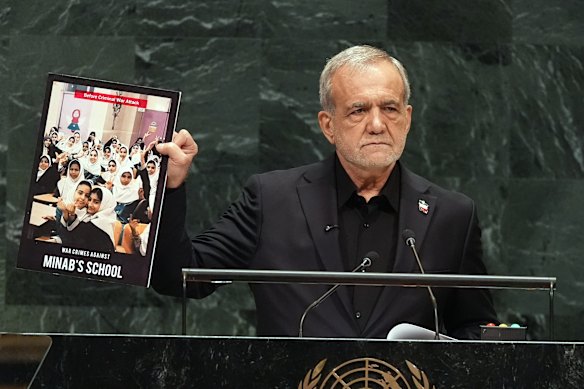
Pezeshkian’s speech marked the first time in the UN’s 81-year history that a foreign leader at war with the US addressed the body at its New York headquarters. The Iranian president held up pictures of the assassinated supreme leader Ali Khamenei and children killed by missiles in the war that began nearly seven months ago.
“I come from an Iran where, in truth, they bombed a school,” he said. “You see these children? These children perished under bombs, with weapons used by the United States and Israel. They were innocent.”
The US has never publicly acknowledged that it was responsible for the missile strike on an Iranian girls’ school on the first day of the war, killing about 120 children and dozens more adults. That is despite multiple reports from US news outlets about the findings of internal investigations which confirmed US responsibility.
Pezeshkian claimed Iran was ready to resume talks and find a diplomatic solution to the war – an outcome that has eluded negotiators so far, despite a short-lived memorandum of understanding signed with the US in June.
But his speech projected resistance to any notion that Iran could be bombed into subjugation, as Trump had countenanced from the podium 24 hours earlier.
“They have learned that Iran cannot be made to surrender,” Pezeshkian said. “He [Trump] must know that the resistance of the Iranian people will only increase in the face of sanctions, increased pressure, increased bullying. We will never bow our head or bend at the knee.”
A lone American delegate walked out of the UN General Assembly shortly after Pezeshkian’s speech began. An Iranian delegation including Foreign Minister Abbas Araghchi were authorised by the US to attend, although some members of the proposed delegation were refused visas.
Pezeshkian also argued Iran must be allowed to develop a civilian nuclear program, insisting – as Tehran always has – that the Islamic Republic does not wish to develop nuclear weapons. However, Iran has a long history of building secret nuclear sites and uranium enrichment facilities, and barring weapons inspectors.
Pezeshkian said it was Israel that should face scrutiny, not Iran. “Israel targets any neighbourhood in any city in any province – commits assassinations like a true terrorist,” he said.
“They are committing genocide by using the so-called technologies they have at their disposal – then they label others as terrorists.
“The nuclear weapon is in Israel, but the inspector is in Iran. Israel kills, but Iran is subject to sanctions. This is a true tragedy.”
Israeli Prime Minister Benjamin Netanyahu is due to land in New York on Thursday (US time) to address the UN, before immediately flying home.
New York mayor Zohran Mamdani has dropped his threat to arrest the Israeli leader based on an outstanding International Criminal Court warrant, saying the city did not have the jurisdiction.
On the Strait of Hormuz, the crucial shipping passage between Iran and the Arabian Peninsula, Pezeshkian told the UN that Iran would continue to lay a claim over the waterway.
“We cannot let some have free access and gain their interest from a waterway while at the same time using that waterway to impose their aggression upon us,” he said. “They close access for us to our own waterway … we will not succumb to that.”
While threatening annihilation of Iran – which he has done before – Trump also predicted there would be a deal after the US midterm elections, arguing the Iranians were dragging it out to inflict political pain upon him via higher oil and petrol prices.
The Iran-backed Houthi rebels in Yemen have recently targeted Saudi Arabian energy infrastructure and the Strait of Bab al-Mandab, another crucial oil shipping route between Yemen and Africa. This has contributed to the latest spike in oil prices, just as the Russia-Ukraine war is causing the price of diesel to rise.
But Trump has continued to project that he is in no rush to solve the issue. Helima Croft, managing director and global head of commodity strategy at RBC Capital Markets, said on Wednesday (US time) there was an “urgency deficit” in the Trump administration because prices were not yet that high.
Brent crude, the international oil benchmark, was trading just above $US100 ($142) a barrel on Wednesday.
“Prices are not $US150,” Croft told an event hosted by the Carnegie Endowment for International Peace “If you can keep West Texas International prices below $US100 or below $90, you may think time is on your side, that you can let the blockade do its work. Essentially, let Iran have to deal with a lack of essential goods, soaring inflation, the rial crashing.
“I think that’s a theory that many in the administration are now operating under – that they have time on their side.”
Get a note directly from our foreign correspondents on what’s making headlines around the world. Sign up for our weekly What in the World newsletter.
 Michael Koziol is the North America correspondent for The Age and Sydney Morning Herald. He is a former Sydney editor, Sun-Herald deputy editor and a federal political reporter in Canberra.Connect via X or email.
From our partners
Disclaimer : This story is auto aggregated by a computer programme and has not been created or edited by DOWNTHENEWS. Publisher: www.smh.com.au