- Government warns against unlawful protests, citing past violence.
Edited by: Wesley Rahn
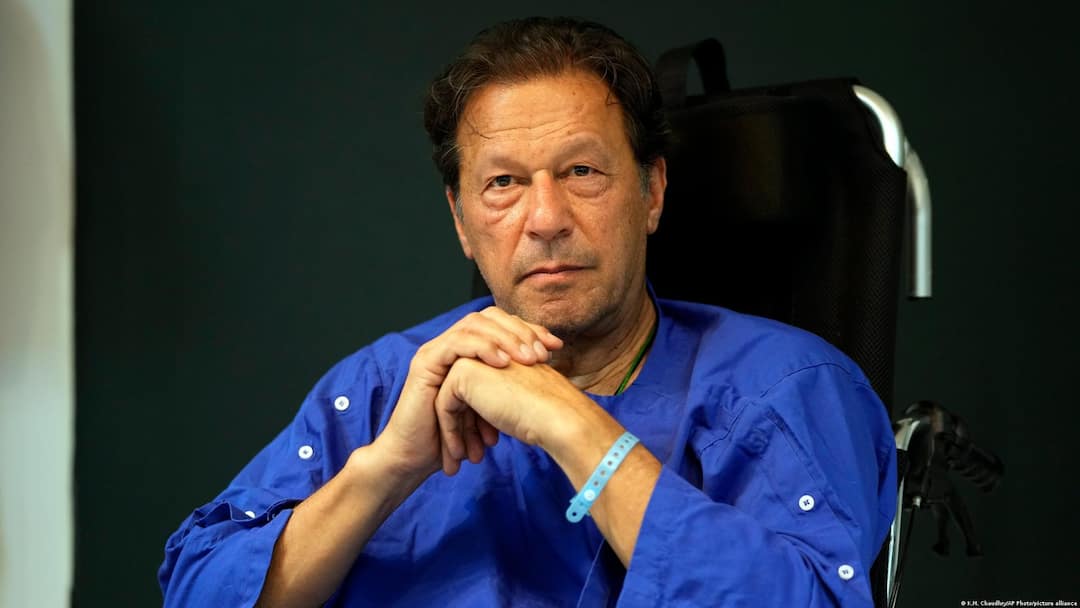
Family members of Pakistan’s former Prime Minister Imran Khan are concerned about the 73-year-old’s health in a Rawalpindi prison, accusing authorities of preventing him from accessing appropriate medical care.
Khan’s London-based sons, Sulaiman and Kasim Khan, told DW they have received “little to no information” about their father’s health condition.
“When we last spoke to him on the phone back in March, he said that he had lost 85% of the vision in his right eye and that despite his complaints, it was neglected for months,” they said.
The brothers added that their father was being held in a tiny cell and has been allowed outside for only one or two hours a day. They also allege that the elder Khan was kept in isolation from family, lawyers, and a personal physician for 10 months before he was briefly allowed to see two of his sisters.
This comes amid the opposition Pakistan Tehreek-e-Insaf (PTI) party’s planned protest march on September 27 to exert pressure on Prime Minister Shehbaz Sharif’s government for Khan’s release.
Sons demand family access and medical care for Khan
Khan’s sons are urging authorities to allow their father to receive an independent medical assessment and restore regular access to his family and medical team.
“We are asking the Pakistani authorities to obey the Supreme Court orders immediately and shift our father to Shifa International Hospital so that he can be assessed by independent doctors,” they said.
They also called for Khan to be allowed his mandated family visits, phone calls with his sons, and access to a personal physician.
Khan’s sisters detained as PTI plans new protests
Despite being in jail, Khan remains at the center of Pakistan’s political confrontation between the PTI and the country’s powerful military. He also remains a popular political figure in Pakistan, despite being ousted from office in 2022 in a parliamentary no-confidence vote.
Amid plans for a PTI protest march set for this weekend, Khan’s three sisters were detained in the Punjab capital of Lahore on Monday.
The detention orders cited concerns that the sisters were a threat to public safety and maintenance of public order. All three were ordered to be held for 30 days under a public order ordinance.
Khan’s sons told DW the arrests were intended to intimidate their family and supporters before the planned protest rally.
“Our family members who have been arbitrarily taken into custody must be released immediately,” they said. “The abductions of our family members in the middle of the night, with no reason given, were purely to intimidate them,” they added.
Khan was ousted as prime minister in 2022 and jailed the following year on what he says are politically motivated corruption charges. Khan’s family members, and his PTI opposition party, have faced an ongoing government crackdown.
Pakistan government calls for ‘order’
Pakistan’s government has rejected the PTI’s characterization of the crackdown and says its priority is to maintain public order during the planned protest.
Talal Chaudhary, Pakistan’s minister of state for interior, has warned that the government will not tolerate unlawful activity or actions threatening lives and property.
“If you are a peaceful citizen, come to Islamabad from any route, come 100 times,” Chaudhary told DW.
“But if you come as terrorists, we will not let you leave,” he added.
In 2024, pro-Khan protests on the streets of Islamabad turned violent. Demonstrators breached high security zones and clashes with security forces, leaving six dead. When Khan was first arrested in May 2023, nationwide PTI support rallies also led to violence, with military and government buildings suffering damage. Several people were killed and hundreds injured.
Chaudhary said the government would not tolerate unlawful activity or actions threatening lives and property.
“The right to protest does not give the right to attack,” he said.
Authorities have stepped up security preparations in Islamabad and Rawalpindi ahead of the protest, including the deployment of thousands of police personnel and the placement of shipping containers and other barriers at key entry points.
Arrests could ‘galvanize’ PTI supporters
The PTI has said the September 27 protest will demand Khan’s release and push for what the opposition describes as respect for constitutional and political rights.
Michael Kugelman, a South Asia analyst at the Washington-based Woodrow Wilson International Center for Scholars, told DW the arrests will likely further energize Khan’s supporters ahead of the planned protest.
“The arrests will galvanize what is already an angry and anxious Khan support base,” Kugelman said.
The detention of Khan’s sisters, who Kugelman said are “prominent advocates” of Khan’s cause, has also placed his family increasingly at the center of the confrontation between the government and the PTI.
Khan’s base is “concerned about the state of his health, and for his sister to be detained will increase the chance that protesters take to the streets on the 27th,” he added.
Zulfi Bukhari, a senior PTI leader and close aide to Khan, said the arrests were meant to create fear but will not prevent the party from mobilizing its supporters across the country.
“What they don’t realize is all they are doing is creating more hatred for themselves among the public,” Bukhari told DW, referring to the government.
Bukhari described the current crackdown as the most severe the PTI has faced. “This crackdown seems the more brutal,” he said, adding that the government was acting out of frustration.
“They are fueling a fire that will soon be out of their control,” asserted Bukhari. “They can keep attacking us, and we will continue to resist. This protest will go on, and many more after it,” he added.
As Pakistan’s government is dealing with several challenges, including economic malaise, conflict with the Afghan Taliban, and fallout from the Iran war, further domestic unrest would be an unwelcome complication.
(Disclaimer: This report first appeared on Deutsche Welle, and has been republished on ABP Live as part of a special arrangement. Apart from the headline, no changes have been made in the report by ABP Live.)
Disclaimer : This story is auto aggregated by a computer programme and has not been created or edited by DOWNTHENEWS. Publisher: abplive.com