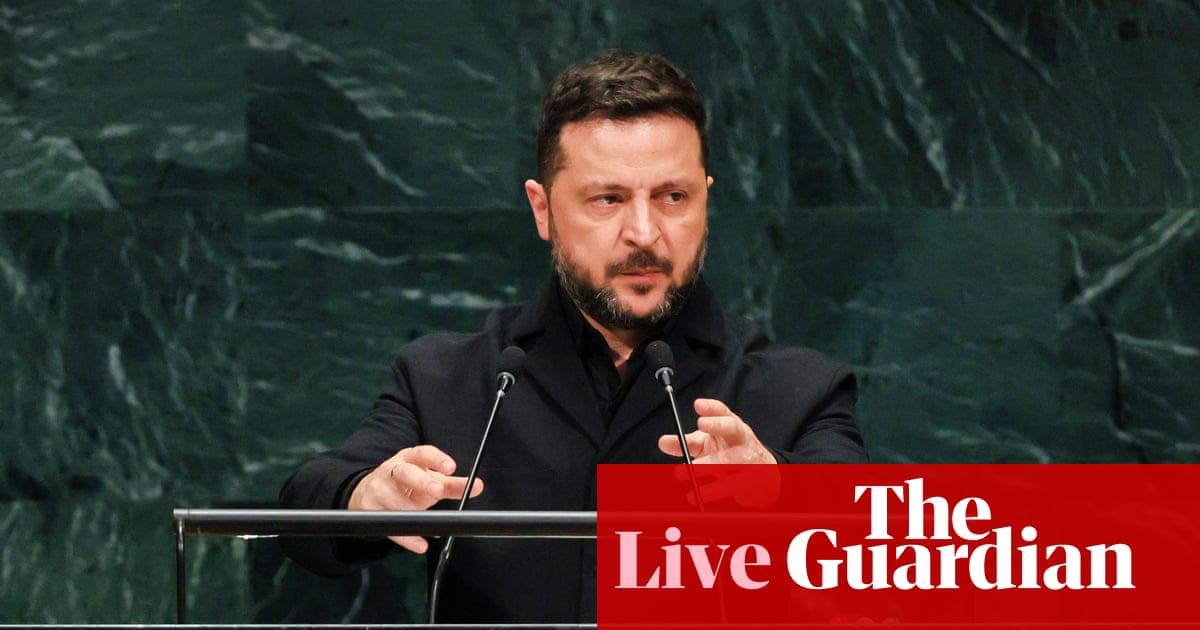
Zelenskyy is using his appearance at the UN General Assembly to remind delegates of the scale and impact of the war on Ukraine, claiming that even a partial victory would not be enough for Vladimir Putin.
Putin will claim Donetsk isn’t enough for him, and will come for other Ukrainian cities, Zelenskyy says.
“Russia has used over 2,100 missiles against us. More than 950 of them were ballistic missiles.”
“They launch jet-powered Shahed [missiles] every hour… We are fighting them 24/7”.
He says this is “to make life harder for the economy and to disrupt our lives. They disrupt children at school. Would your country survive something like this?”
“Ukraine did not choose this war,” Zelensky adds.
Earlier, Panama’s president, José Raúl Mulino, also called for for the Latin America and Caribbean region to have a permanent seat on the UN security council.
I wish to reiterate before this general assembly the need for Latin America and the Caribbean to hold positions with greater decision-making power on the security council, specifically a permanent position, as a permanent member of this organization’s security council.
We are a leading region in food, minerals, biodiversity, and [have] a deep commitment to peace and integration.
He urged the UN to address urgent issues including migration and the climate crisis, adding:
We must acknowledge that citizens do not believe these kinds of gatherings benefit them. Herein lies one of the reasons why trust must be restored.
Our conclusion is unequivocal: the world does not need less United Nations; it needs a United Nations that works better.
Polish president Karol Nawrocki spoke of the grave importance of accountability if there is to be lasting peace and “if international law is to be anything other than a declaration without any real power”.
“Russia is destablising the situation in Europe through open aggression, hybrid operations, acts of subversion and sabotage, and by ignoring successive resolutions of this assembly,” he told member nations.
Contempt for international law must not become the norm.
As a country that neighbours Russia, he said he wanted to make it clear on behalf of Poland that “we are not the ones seeking confrontation”.
Our goal is deterrence and defence.
Nato remains the “guarantor of transatlantic security”, he said.
“Russia is carrying out actions aimed at undermining the foundations of international stability,” Nawrocki went on.
If aggression is not met with an adequate response, it becomes an invitation to repeat it.
Russian presidential envoy Kirill Dmitriev is heading to the United States on Wednesday, where he will meet with Trump administration representatives Steve Witkoff, Jared Kushner and others, two sources familiar with preparations for the talks have told Reuters.
The sources said that Dmitriev’s visit to the US, which was agreed upon with Vladimir Putin, will take place in New York on the sidelines of the UN general assembly and will follow up on a meeting between Putin and US representatives at the Kremlin earlier this month.
One source told Reuters that the aim of the visit is to keep the Russia-US dialogue and the peace-making effort going.
President of Panama José Raúl Mulino is now up. He kicks off by applauding multiculturalism and the role of the UN in a world of “such volatility”, but calls for greater leadership.
“We must restore trust,” he says, warning that illegal people trafficking was taking a heavy toll on the country socially and economically, but also on some sensitive natural environments in Panama.
“We must make headway together on the key issues,” he says. This includes world trade, with Panama’s canal playing a key global role, but he warns it is increasingly at risk from heavy rain and flooding which is worsening due to the climate crisis, despite Panama being a carbon negative country.
President of the Central African Republic, Faustin-Archange Touadéra, is now on the podium, speaking about the country’s ongoing sectarian conflict and political instability.
“A fragile country needs security for development,” he says, calling for international support. “Peace cannot be decreed, it must be built day after day through dialogue, justice and shared development.”
“Holding out your hand to yesterday’s opponent is not a sign of weakness”, he says.
He also warns about the worsening impacts due to the global climate crisis and calls for a greater role for women in public life to help end instability in the country.
Zelenskyy ends by describing Russia’s continued war as “madness”, urging global action to secure peace.
“Please, everyone here, don’t be the last to join those who defend life. Be the first to say ‘we guarantee security’. Thank you to everyone who helps and everyone who stands with us – with our people, with our children.”
Zelenskyy urges leaders to keep choking Russia’s revenues and impede its war efforts, telling the UN General Assembly that “Russia’s revenues must remain a target.”
“When someone gives Russia more money through trade, they give this war more time. And that is exactly why we insist on limiting trade with the aggressor, and why we are burning Russia’s revenues ourselves,” he says.
Zelenskyy warns that continued Russian attacks on Ukraine’s energy system would result in retaliation in kind.
“Ukrainians understand that this winter could be very hard for us. But in response we will have no choice but to make it painful for Russia too.”
Zelenskyy is using his appearance at the UN General Assembly to remind delegates of the scale and impact of the war on Ukraine, claiming that even a partial victory would not be enough for Vladimir Putin.
Putin will claim Donetsk isn’t enough for him, and will come for other Ukrainian cities, Zelenskyy says.
“Russia has used over 2,100 missiles against us. More than 950 of them were ballistic missiles.”
“They launch jet-powered Shahed [missiles] every hour… We are fighting them 24/7”.
He says this is “to make life harder for the economy and to disrupt our lives. They disrupt children at school. Would your country survive something like this?”
“Ukraine did not choose this war,” Zelensky adds.
A reminder that Zelenskyy’s speech comes after he met with Donald Trump on the sidelines of the gathering in New York yesterday, after the US president insisted he was working with both sides to end the war, despite little evidence of Vladimir Putin being open to any settlement.
“It’s going to happen, I think, more quickly than people understand,” Trump said in his UN speech.
But Washington has since held separate talks with Moscow – and today said it had invited Putin to the G20 summit in Miami later this year.
Ukrainian president Volodymyr Zelenskyy is speaking now. We’ll bring you all the key lines here.
Israel’s ambassador to the UN, Danny Danon, reasserted Israel’s claim to the occupied Golan Heights, in response to Syria’s interm president Ahmed al-Sharaa’s address to member nations earlier.
“But no speech will change reality, al-Jolani: the Golan Heights will always be part of Israel,” Danon wrote on X, using the nom de guerre al-Sharaa went by when he was HTS leader.
Al-Sharaa harshly criticized Israel’s occupation of southern Syria and said the Golan Heights is an inseparable part of his country.
In his speech, he said that Israel has carried out more than 500 air and artillery strikes on Syria since he took power nearly two years ago. Israel has also carried out 1,200 land incursions and detained nearly 300 people, he said.
He also repeatedly invoked UN security council resolution 497, adopted in 1981, which declared Israel’s annexation of the Golan Heights “null and void and without international legal effect”.
Most of the Golan Heights plateau has been occupied by Israel since 1967. It was fully annexed in 1981, a move not recognised by most of the international community.
Nikos Christodoulides, president of the Republic of Cyprus, told member nations:
The international order is not simply changing. It is being tested in an unprecedented way.
But it is in such times of uncertainty that the fundamental values of multilateralism must be protected:
International law. The charter of the United Nations. Respect for sovereignty and territorial integrity. The peaceful resolution of disputes. Respect for human rights. The equality of states.
In these rapidly changing times, he said, “the credibility of the UN must be preserved. And credibility requires consistency in the application of international law.”
Christodoulides said that 52 years since the illegal Turkish invasion of Cyprus:
-
More than a third of the territory of the Republic of Cyprus remains under Turkish occupation
-
Tens of thousands of displaced people and their descendants have been prevented from returning to their homes
-
Varosha has remained sealed off, with Turkey still defying its clear and specific obligations set out in the relevant UN security council resolutions
-
And “we have been experiencing violations of fundamental human rights, the destruction of religious and cultural heritage, and the organized transfer of settlers that constitutes demographic alteration”
“Respect for sovereignty and territorial integrity are not rhetorical figures,” he said. “Nor should they be applied selectively, depending on who the perpetrator is.”
UN Resolutions cannot be applied in one case and ignored in another.
And the sovereignty and territorial integrity of a state cannot depend on its size, its strength, or the passage of time.
This is not just an issue that concerns Cyprus.
It concerns the credibility of the international system itself.
Christodoulides said he listened carefully to Turkish president Recep Tayyip Erdoğan’s speech yesterday in which he spoke of international law, and respect for the sovereignty and territorial integrity of all states, the illegal occupation, the refugees (in relation to Israel and Palestine).
“However, in relation to Cyprus, Turkey is doing the exact opposite. Maximum hypocrisy,” Christodoulides said.
Mr Erdoğan, if you wish to invoke the charter, you must first implement it.
I remain fully committed to achieving a comprehensive solution.
I am ready to resume negotiations from where they were interrupted in 2017, building on the substantial work that has already been accomplished, within the agreed United Nations framework.
He called on Erdoğan “to allow meaningful negotiations within the framework agreed upon by the UN” to find a solution “that will allow Greek Cypriots, Turkish Cypriots, Maronites, Armenians and Latins to live together in peace, security and prosperity.”
For my part, let me repeat, I am absolutely committed.
Because partition will not be accepted. This cannot and will not be the future of my homeland and my people. Never. Our determination to reunite our island is unwavering.
-
Iran’s president said his country’s people had been the “victims of terrorism” by the United States. Delivering a rare wartime speech at the UN General Assembly, Pezeshkian displayed images of the late supreme leader Ali Khamenei and more than 150 schoolchildren killed in the opening days of the conflict.
-
“We have only defended ourselves. We are not terrorists,” Pezeshkian said at the General Assembly. “Our innocent people have been the targets of cowardly attacks and aggressions imposed upon our country. And we defended ourselves with utmost strength. America and Israel attacked us.”
-
On the strait of Hormuz, Pezeshkian said: “We cannot let some have free access and gain their interest from a waterway, while at the same time using that waterway to impose their aggressions upon us, to impose insecurity upon us, to forbid us access to our own waterways.” He also warns that any “expansion of warfare will not result in security.”
-
Argentine president Javier Milei attacked the UN in a speech to the world body, calling it a “useless organization” filled with “arrogant parasites.” The firebrand Milei, one of US president Donald Trump’s closest Latin American allies, has repeatedly used the UN platform to criticise global governance and its “woke” agenda.
-
Milei accused the United Nations of having failed in its duty to guarantee collective security and human rights, saying it had instead allowed “chaos, violence and international terrorism” to flourish. The UN, he said, “has become a useless organization, serving only to feed a caste of fatally arrogant parasites disguised as well-intentioned bureaucrats.”
-
The United States has invited Russian president Vladimir Putin to attend the G20 summit of world leaders being held in Miami in December, US secretary of state Marco Rubio said. “In order to solve problems, you have to meet with the people that you disagree with or the people that you might have some issues with, so we’ve invited president Putin to the G20.
-
US secretary of state Marco Rubio said after meeting with Russia’s Sergei Lavrov that both Russia and Ukraine had expressed interest in a limited ceasefire involving grain and energy. “We would be open to playing a constructive role in making that happen,” he said, quoted by Reuters.
-
Paraguay’s president Santiago Pena called for Venezuela’s reintegration into the South American trade bloc Mercosur, speaking to world leaders at the UN General Assembly earlier today. Venezuela has been indefinitely suspended as a member of Mercosur, which comprises some of South America’s biggest economies, including Brazil, Argentina, Paraguay and Uruguay.
-
Syria’s interim president harshly criticized Israel’s occupation of southern Syria and said the Golan Heights is an inseparable part of his country. In a speech to the UN General Assembly, Ahmad al-Sharaa said that Israel has carried out more than 500 air and artillery strikes on the country since he took power nearly two years ago. Israel has also carried out 1,200 land incursions and detained nearly 300 people, he said.
-
The Kremlin has responded to Andy Burnham’s speech at the UN general assembly, accusing the UK prime minister of “stoking anti-Russian sentiment”. Burnham told the UN yesterday that his government would set up a new national centre to tackle information attacks by foreign powers and singled out Russia over what he described as the spread of disinformation.
The United States has invited Russian president Vladimir Putin to attend the G20 summit of world leaders being held in Miami in December, US secretary of state Marco Rubio said.
“In order to solve problems, you have to meet with the people that you disagree with or the people that you might have some issues with, so we’ve invited president Putin to the G20.
“We think it’s an opportunity for him to engage not just with the president but with other world leaders. We hope that’s an invitation he’ll accept,” Rubio said.
Disclaimer : This story is auto aggregated by a computer programme and has not been created or edited by DOWNTHENEWS. Publisher: theguardian.com