It was a sunny Saturday morning in Bhavani, where Varsha Sivakumar and her weavers work, and an even sunnier one in Chennai, where I sat in on a call with them.
Varsha, 26, welcomed me virtually into the scene, mid-motion as usual: coordinating new design orders, directing weavers on colour combinations, sweat trickling down as the looms clattered around her.
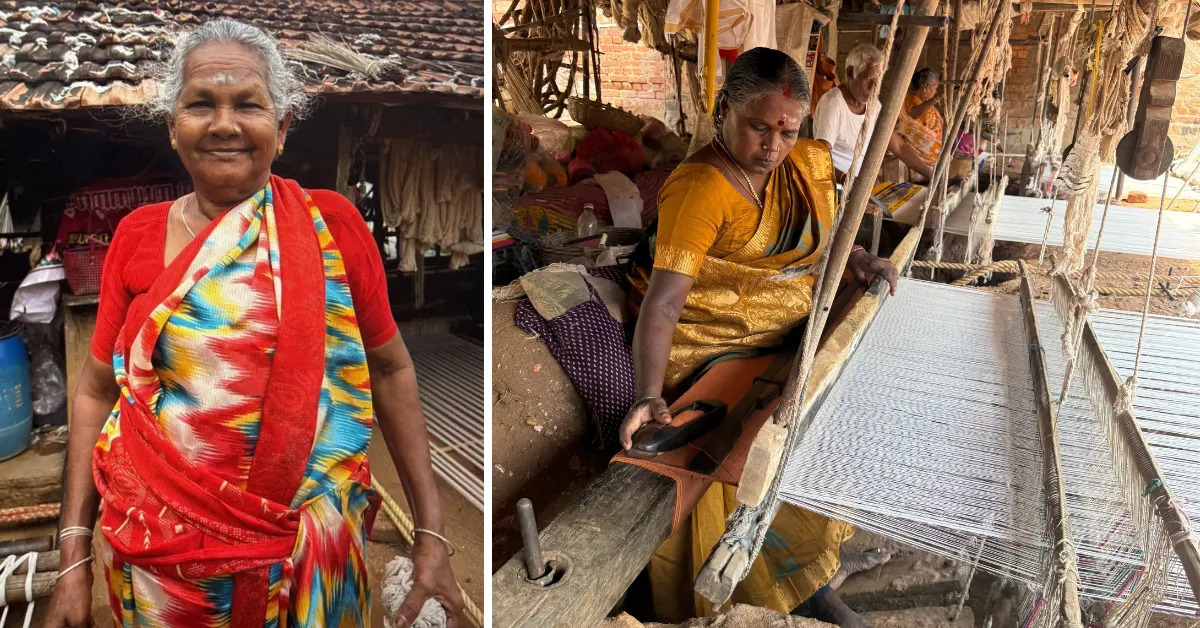
Amid the heat and hard work, 56-year-old Agilandam akka (elder sister) chimed in, delighted simply to be asked how she was doing and whether she’d had lunch. What she really wanted to talk about, though, was the multi-coloured carpet taking shape under her hands, woven using a method passed down for centuries.
“The heat matters less to me than getting the mix of reds, purples, blues and yellows just right, so that Varsha and I are both satisfied with the work,” she said, beaming with pride as she threaded another strand of yarn into the tapestry like it was second nature.
Agilandam’s loom is one of roughly 30 in this cluster in Bhavani, with pits sunk low into the floor, almost like wells. Seven looms to a row, four rows running at a time, all clattering in rhythm. It looks and sounds like a craft in full health.
It isn’t.
A 300-year-old craft, running out of buyers
Bhavani and neighbouring Kumarapalayam, two weaving towns strung along the Cauvery’s plains in Tamil Nadu, have made the Jamakkalam, a thick, striped cotton weave, for almost three centuries.
Woven first by a community called the Jangamars, at a time when local weavers needed something distinctly their own to compete with British mill textiles, the craft went on to earn a Geographical Indication (GI) tag in 2005-06 and a place in nearly every Tamil household, from wedding trousseaus to temple courtyards.
By Varsha’s own account, weaving touched nearly every household in town in the early 2000s. The trade was thriving, and families worked their looms together as a matter of course, one generation teaching the next.
That hum has since thinned. Government cooperative orders, once the backbone of the trade, dropped sharply, leaving looms idle and weavers looking elsewhere for income. Cooperative stockrooms, weavers say, are piling up with unsold pieces, approved and re-approved, but never bought.
/filters:format(webp)/english-betterindia/media/media_files/2026/09/23/5-2026-09-23-19-16-29.png)
For Mariyamma, one of the weavers in the cluster, weaving is something she has returned to rather than never left. She worked these looms when she was young, then married and moved to another cluster. It was only after her husband passed away that she came back to Bhavani, drawn by the comfort of familiar work and familiar faces.
“This work and this cluster give me a sense of comfort. I’ve found it easy to adapt to Varsha’s designs, and I earn anywhere between Rs 2,000 and Rs 6,000 a month. I buy whatever I want and live my life without seeking help from others. I also feel a real sense of community with the women here,” she said.
Agilandam knows the toll too. Sitting for hours at a pit loom takes a toll on the body over time. Her two sons are well settled elsewhere; now it is just her and her ageing husband, whose health has begun to fail. “Weaving isn’t easy, given the health issues involved, but this income has given me independence and helped me pay for my husband’s medicines,” she says.
/filters:format(webp)/english-betterindia/media/media_files/2026/09/23/3-2026-09-23-19-17-03.png)
But soon after, in her indomitable spirit, she laughs and explains: “We sit at pit looms and my back hurts, but that pain fades away when I sit with other women. We all talk, share our problems, and help each other by listening, eating and laughing together.”
That is what was at stake as the orders dried up: an ancient weave, and the only livelihood and community many of these women had left.
A journey back to her roots
Varsha grew up among these very looms; her connection to Jamakkalam had always been there. But it took someone else’s eyes for her to actually see it.
In 2017, she was studying at the National Institute of Fashion Technology when a guest lecturer, during her orientation days, someone with no particular ties to Bhavani or Kumarapalayam, presented a project on Jamakkalam handloom weaving.
/filters:format(webp)/english-betterindia/media/media_files/2026/09/23/10-2026-09-23-19-18-15.png)
“I remember watching, unsettled by a strange kind of dissonance,” she recalled. “Here was a craft I’d grown up around, always in the background, being unpacked with real curiosity by someone who’d never even visited the towns where it was made.”
“If a stranger to the region could see this much in Jamakkalam, what did it say that I, someone who’d grown up inside it, had never really looked closely?” she said. “That thought stayed with me long after the class. Once I understood what my region’s craft and its weavers were truly worth, I knew what I wanted to do.”
Varsha’s decision to stay was itself unusual. Across Bhavani and Kumarapalayam, weaving has been shedding its youngest hands for years, with families steering their children towards better-paying labour work, and towards better education where possible.
Industry estimates suggest the number of active weavers in the Bhavani cluster has fallen from roughly 20,000 two decades ago to around 3,000 today. Varsha, in her mid-twenties, is the only one of her generation still choosing to build a life around the craft, let alone try to save it.
/filters:format(webp)/english-betterindia/media/media_files/2026/09/23/9-2026-09-23-19-18-51.png)
When she was still a student, she began returning to Bhavani and Kumarapalayam, sitting for hours with artisans and documenting whatever they were willing to show her, in details specific enough that they’d never made it onto paper. Almost none of the craft, she found, had ever been properly recorded.
What she found unsettled her. Some 200 to 300 weavers were surviving almost entirely on state cooperative orders for a product that had gone out of fashion, earning anywhere between Rs 2,000 and Rs 15,000 a month and going without work for months at a stretch. The project stopped being academic.
Rather than designing standalone products, she wanted to build something that could hold up the whole cluster around her, not just the weavers she happened to be working with that week. That thinking would come to define what she built next.
“The smallest of nudges”
In 2026, that thinking became the House of Jamakkalam (HOJ), an initiative built on a simple refusal: it would not treat the craft as something to be rescued from outside, but as something to be continued from within.
/filters:format(webp)/english-betterindia/media/media_files/2026/09/23/6-2026-09-23-19-19-51.png)
Design at HOJ starts with the cluster’s own archive rather than a blank page. “The instinct isn’t to invent a new visual language for Jamakkalam, but to notice what’s already sitting inside the old one and bring it forward with only the smallest of nudges, like colours and proportions, to make it feel more contemporary,” Varsha explained. “We don’t want to break from what made the pattern recognisable in the first place.”
HOJ’s best-known product proves the point. The Smiling Pouch borrows directly from the Pallu Mutham, a traditional stripe arrangement whose name translates to “pearl-like teeth,” in which the geometry of the stripes has always resembled a woven grin.
“Nobody at HOJ designed a smile into the fabric,” Varsha said. “It was already there, on looms across Bhavani, long before anyone thought to put it on a pouch. The job was simply recognising it.”
The bigger shift, though, was financial. Standard yarn in the cluster costs roughly Rs 60 to 70 a kilogram. HOJ sources and dyes its own separately, at anywhere from Rs 206 to Rs 550 a kilogram, absorbing that cost itself rather than passing it on to weavers.
/filters:format(webp)/english-betterindia/media/media_files/2026/09/23/8-2026-09-23-19-20-15.png)
Traditional Jamakkalam yarn is coarse by necessity: cheap, durable and limiting. Its thickness is what has kept most patterns to stripes and simple geometry for centuries.
HOJ’s finer, better-dyed yarn opens up sharper detail and truer colour without asking the weave to abandon what makes it recognisably Jamakkalam. It’s less a new technique than a new material vocabulary, laid over an old one.
That gap between what the trade traditionally paid and what it actually cost to live is the one HOJ was built to close. Weavers elsewhere in the cluster typically earn Rs 200 to Rs 350 a day when work is available, a rate that has barely moved in years even as costs have risen around it.
HOJ pays upfront in cash, with premiums of 30 to 35 per cent on complex orders, designed specifically to sit above that floor rather than at it. If a piece comes out flawed, HOJ still buys it at full price.
/filters:format(webp)/english-betterindia/media/media_files/2026/09/23/3-2026-09-23-19-21-03.png)
“You can’t take all the profit out of a product as sustainable business doesn’t work that way,” Varsha says. “HOJ keeps a minimum, reasonable profit spread thin across many products, a structure built to keep pricing accessible while orders stay steady.”
At the top end, HOJ takes on fully customised pieces, made to a client’s own dimensions, colourway or occasion, sometimes with names or motifs worked directly into the weave. These run from around Rs 10,000 to over Rs 30,000 depending on size and complexity, and even the smallest custom piece takes two weavers four full days to complete.
“It’s slow work by design: every custom order is still built stripe by stripe on the same pit looms, in the same rhythm this cluster has kept for generations, just aimed now at a buyer who asked for it by name,” Varsha explains.
Weavers who found their footing again
It is older weavers, in fact, who have taken to reinvention with the most ease, an openness that runs against the easy assumption that age makes artisans resistant to change. Much of that, weavers say, comes down to how the change was introduced: Varsha sits alongside them for the full duration of a piece, offering real-time input rather than instructions from a distance.
/filters:format(webp)/english-betterindia/media/media_files/2026/09/23/7-2026-09-23-19-21-29.png)
For Agilandam, best known in the cluster for her mastery of a demanding 27-foot design called “Nimhans,” the independence the work now offers has come to matter as much as the craft itself.
For Mariyamma, it’s simpler still. She speaks of the women around her as family, some of whom she has known for decades, and of a sense of belonging that would be hard to replace.
“This is the only job I know. My husband was also in this line of business and so am I. We don’t have other means but that has given me expertise. Today if suddenly I am asked to do something new, I can do it and I feel that whether it is a big or small order, I need to do it to the best of my ability because Varsha trusts us. At the same time, I feel orders have been reducing and we need more support too,” Mariyamma explains.
A weave that’s finding a home overseas
Today, HOJ works with around 30 to 35 weavers depending on the scale of orders, roughly the same cluster gathered around Agilandam and Mariyamma’s loom. Much of the growth, unexpectedly, has come through Instagram.
“A lot of these good things happened because of Instagram, I think,” Varsha said, describing a platform that has connected the cluster to buyers far beyond what word of mouth alone could reach.
/filters:format(webp)/english-betterindia/media/media_files/2026/09/23/2-2026-09-23-19-22-20.png)
There was personal news too, shared over text with the same excitement. “I recently got my weaver’s card from the Central government,” she said, a recognition that makes her the only next-generation weaver the community has seen.
One audience has proven especially devoted: the Sri Lankan Tamil diaspora, whose textile traditions remain closely tied to Tamil Nadu’s own. For many of these clients, a Jamakkalam piece isn’t decor; it’s a stand-in for a home some no longer have. One recent piece was made for a Sri Lankan wedding, at the couple’s specific request.
“I’m seeing this a lot with Sri Lankan people,” Varsha said. “They know the value of their roots. It isn’t always tied to happy memories, sadly, but they hold it very close to their heart.”
HOJ’s goals for the year ahead are regular, committed monthly orders for every loom in the cluster and a presence in two to three countries by the end of 2026.
Back in Bhavani, the pit looms keep their rhythm, seven to a row, thirty in all, the same design vocabulary passed down for almost three centuries now folded into new colours and new customers. Varsha is careful about how she describes what’s happening.
/filters:format(webp)/english-betterindia/media/media_files/2026/09/23/11-2026-09-23-19-22-55.png)
She resists the word “revival” altogether. What she describes instead is continuation: the craft passed on by the same hands that have always carried it, moving from the loom straight into daily life.
If you’d like to know more about House of Jamakkalam (HOJ) or place an order, do reach out to them on WhatsApp at +91 77083 73775, visit their website, or follow them on Instagram/@hoj_india. Your support goes a long way in helping them continue this work
Disclaimer : This story is auto aggregated by a computer programme and has not been created or edited by DOWNTHENEWS. Publisher: thebetterindia.com