
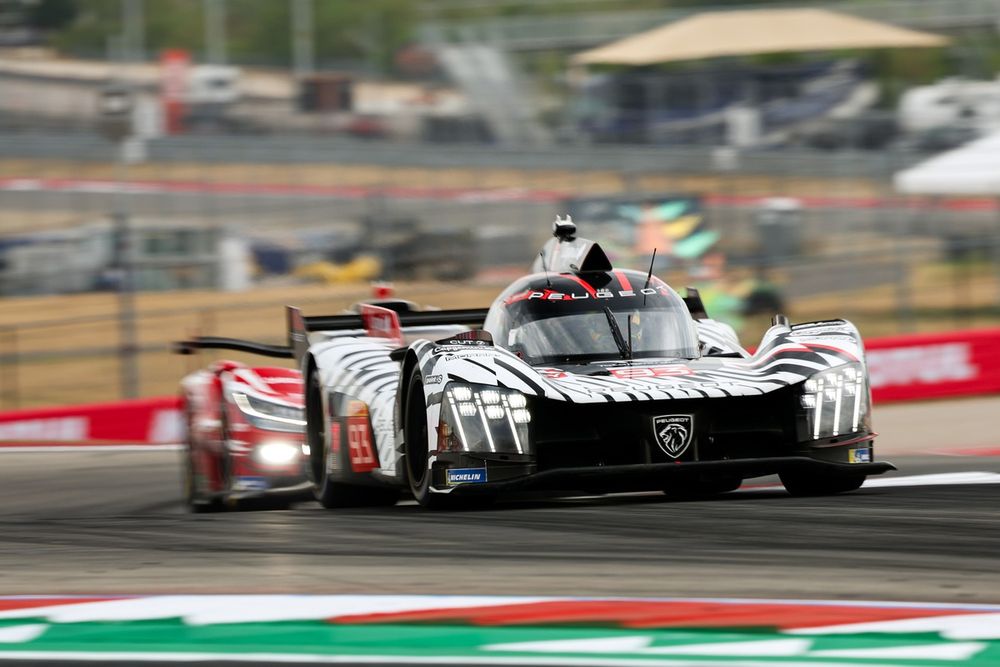
Peugeot says it is “reasonably confident” that it can become a competitive force in Hypercar when it introduces the latest evolution of the 9X8 in the 2027 World Endurance Championship.
The French manufacturer is working on a heavily-revised version of its V6-powered Le Mans Hypercar for next year, with changes extending well beyond the usual aerodynamic improvements.
It marks the biggest upgrade to the 9X8 since 2024, when Peugeot abandoned its original philosophy in favour of a more conventional car featuring a rear wing.
But while the 2024 update failed to yield the desired results, there is optimism within the camp that the latest evolution will help address the design compromises it made when the original LMH regulations were altered to allow for a convergence with IMSA’s LMDh formula.
“Between the moment the concept was launched and today, there were quite some important changes in the technical regulations, which made our package not fit perfectly with how the regulations progressed,” Peugeot team principal Emmanuel Esnault told the media including Motorsport.com.
“At the moment, from what we have seen on track, on data, from the drivers’ feedback, it’s looking positive. We don’t want to be over-optimistic. We do not take anything for granted, but it’s a good base to work and to develop.
“It’s a work in progress. They are very complex cars. It does require a big investment, lots of time in terms of aerodynamic study, simulation and testing campaigns on the track.
#94 Peugeot Totalenergies Peugeot 9X8: Loic Duval, Malthe Jakobsen, Theo Pourchaire
Photo by: Jakob Ebrey / LAT Images via Getty Images
“So, we are reasonably confident. But based on the four past years we had, we know that we have to not underestimate the level of competition and how strong the championship is.”
Asked if the 2027 update will help it finally solve its long-standing woes at the Le Mans 24 Hours, which has always been the Achilles’ heel of the 9X8, Esnault said: “If I answer no, we are not doing our job. It’s what we consider as a technical answer to what we have experienced this year.”
As has already been well documented, the 9X8 was conceived around the original LMH regulations that mandated equal-sized 31-inch tyres. Subsequent changes made to the rulebook to align the formula with LMDh heavily compromised the car, which relied heavily on ground-effects to produce downforce.
A major update to the 9X8 in 2024, which saw Peugeot move away from ground-effects and a rear wing, failed to alleviate the team’s fortunes in Hypercar.
After considering an all-new design to replace the 9X8, Peugeot decided to overhaul its existing contender instead, taking advantage of a new rule that grants additional evo jokers to struggling manufacturers. It currently sits seventh in the manufacturers’ standings, only ahead of newcomer Genesis, with a best finish of seventh in the opening five races of the season.
Testing underway
Peugeot’s updated car hit the track for the first time at Paul Ricard in July, at around the same time Ferrari began testing its own evo version of the 499P LMH. A more comprehensive 24-hour simulation followed earlier this month, offering Peugeot a chance to iron out any major reliability problems early into the test programme.
Another major test is planned at Paul Ricard, where Peugeot will evaluate the 2027 upgrade with the current model, before testing moves to Silverstone later in the year.

#94 Peugeot Totalenergies Peugeot 9X8: Theo Pourchaire
Photo by: FIA WEC / DPPI
In terms of mileage, Peugeot has already logged nearly 3600km of running with the updated car, with newly-signed Robert Shwartzman having also sampled the updated car.
The exact specification of the 2027 model remains subject to approval from the FIA and the ACO, but Peugeot has focused on several areas of improvement.
Asked which areas had particularly impressed the drivers during the early tests, Esnault said: “It’s ability to absorb bumps and curbs, and aerodynamic consistency and stability.
“If you look at the championship and the homologation process, it’s an aero car championship. Aero is one of the main focuses, considering the speed you are reaching. It’s a key element.”
We want your opinion!
What would you like to see on Motorsport.com?
– The Motorsport.com Team
Disclaimer : This story is auto aggregated by a computer programme and has not been created or edited by DOWNTHENEWS. Publisher: motorsport.com








