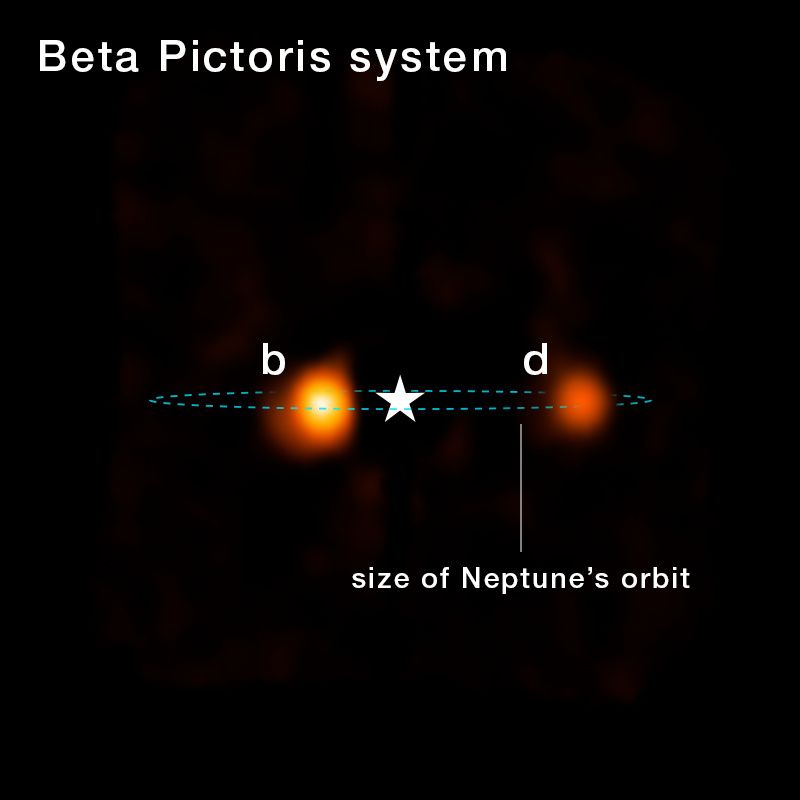
Approximately 63 light-years from Earth lies a planetary system so young that its less than 1 percent as old as our solar system. It is called Beta Pictoris, and—as far as astronomers have confirmed—it consists of a star more massive than the sun, three giant planets, and a huge disk of dust and debris.
The middle planet in the system, Beta Pictoris b, is a gas giant several times more massive than Jupiter. Being a gas giant, it likely does not have a solid surface on which to “land,” and at just a few tens of millions of years old, it can be considered a newborn planet in astronomical terms. It’s also one of the most extensively studied exoplanets through direct observation. Its youth keeps it hot and bright, and its distance from the star—similar to that between our sun and Saturn—makes it possible to distinguish from the star with sufficiently powerful telescopes.
Now, a new study from researchers at Harvard and the University of Oregon claims that Beta Pictoris b is the source of something that has never before been unequivocally detected on another world: radio emissions.
Recorded by the MeerKAT radio telescope in South Africa, the signal is likely of natural origin, as in no, it’s not aliens. The authors are quick to note this from the outset of their preprint. And while the study has not yet been peer-reviewed, the authors present sizable evidence to support their interpretation that the source of the broadcast is intense magnetic activity.
The characteristics of the radio waves match theoretical predictions for magnetic fields generated by young, massive planets. Charged particles can become trapped in the planet’s powerful magnetic field, and as the planet rotates, these particles can accelerate and release energy in the form of radio waves. In a sense, this phenomenon—known as an auroral radio emission—is the planet’s magnetosphere “shouting” into space.
The team detected several of these calls and, for the first time, managed to pinpoint their origin directly to an exoplanet—something scientists have been trying to achieve for years.

Astronomers have come close to this achievement a few times in recent years, such as in 2023, when bursts of radio waves were detected in YZ Ceti system. The signals appeared to repeat in sync with one planet’s orbit. However, researchers could not rule out the possibility that those emissions were simply caused by the star’s magnetic activity.
The Beta Pictoris system also holds a special place in the history of astronomy. In 1984, Beta Pictoris became the first star around which a disk of dust and debris was directly photographed. That image suggested planet-forming processes might be taking place there, though at that time astronomers were unable to confirm the existence of any planets.
This story originally appeared on WIRED en Español and has been translated from Spanish.
Disclaimer : This story is auto aggregated by a computer programme and has not been created or edited by DOWNTHENEWS. Publisher: wired.com