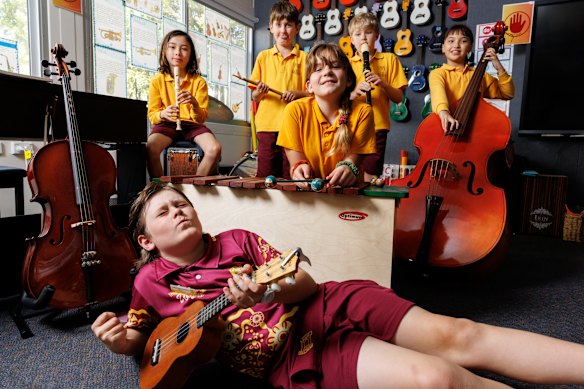

Musicians, tutors and industry experts will be sent into NSW public primary school classrooms under a 10-year plan to give every child the opportunity to learn a musical instrument.
Teachers will be provided support to boost their own musical skills and confidence, and students will receive 30 minutes a week of high-quality music lessons over the school year under the program called Time for Music.
It comes after a NSW parliamentary inquiry heard principals prioritised NAPLAN when allocating school resources, which often resulted in music and arts being “chopped off” the curriculum.
The inquiry also detailed the wide disparity between private and public schools when it came to music education and how private tuition was “prohibitively” expensive.
It said many schools operated a “user pays” model which effectively excluded large cohorts of students from learning an instrument.
Education Minister Prue Car said the government wants every student to have access to a high-quality music education, no matter where they live.
“That’s why we’re backing teachers with practical teaching resources and professional learning so they can confidently deliver music education and provide opportunities for students beyond the classroom,” she said.
The government has not said how much the program will cost. Schools’ capacity to teach music is expected to grow over the coming decade. There will be professional learning, dedicated tools and resources for music lessons and a music education framework.
According to research released last year, 32 per cent of NSW primary teachers regularly teach music, while 17 per cent have a specialist teacher.
The program is expected to utilise the expertise of teachers such as Kane Wheatly from Glebe Public, who delivers music education to students from kindergarten to year 6, and previously helped teachers at Vaucluse Public improve their music education.
“I went in and did a lesson with them where we just we sang, and we played on some buckets, and we just did some movement,” he said.
“And to see this shift of terror to absolute buy-in and commitment from these teachers was phenomenal.”
At Glebe Public, kindergarten students start with dancing, moving and listening to music before experimenting with sounds such as a triangle. This year, students will learn the recorder from years 1 and 2. There are lessons covering notation, semiquavers, melody and rhythm.
“I’ve got a treasure hunt where they have to go around and find different rhythms and match them up and write them down,” he said.
Year 5 student Phoebe Connolly-Raymond enjoyed studying music at school because when she listened to others play, she could “imagine what’s going on inside their minds and what they want to share with you in the piece”.
Year 6 student Francis Csanyi-O’Donnell said he enjoyed the creativity and the accomplishment of taking “stray notes” and turning them into a song. He has had piano lessons outside of school and has taught himself on the harmonica.
“Learning a new instrument is like learning a new language,” he said.
Start the day with a summary of the day’s most important and interesting stories, analysis and insights. Sign up for our Morning Edition newsletter.
From our partners
Disclaimer : This story is auto aggregated by a computer programme and has not been created or edited by DOWNTHENEWS. Publisher: www.smh.com.au