If you found a cowrie shell in a necklace, you might imagine it came from somewhere near the sea.
But what if that necklace belonged to a community living high in the hills of Northeast India?
Or imagine an ornament made with boar tusks, cane, conch shell and carnelian. Elsewhere, in Odisha’s Niyamgiri hills, brass anklets and neckbands once moved between communities in exchange for ragi, maize, turmeric and vegetables.
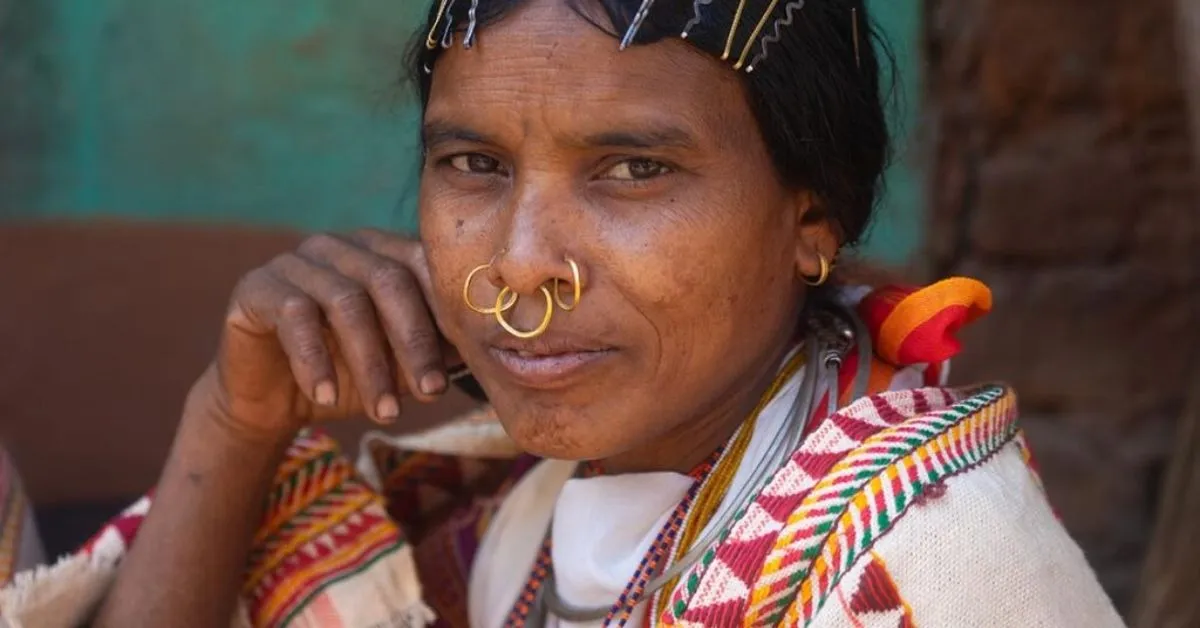
Look closely at traditional jewellery across India’s tribal communities and these unexpected combinations appear again and again.
Shells, tusks, beads, bone, feathers and metals become necklaces, anklets, hairpins and arm ornaments. But the materials are only the beginning of the story. They can tell us where things travelled from, who made them, what people exchanged for them and what an ornament could mean to the person wearing it.
Here are some fascinating examples.
1. A necklace made with boar tusks
Among the Sumi Nagas, the Aminihu is difficult to overlook.
Traditionally, the necklace brings together pairs of boar tusks bound with cane, beneath a large conch-shell button and a carnelian bead.
To us, that combination may seem unusual. Historically, however, such materials could carry meanings beyond their appearance.
Anthropologist Alok Kumar Kanungo, who has documented ornaments among several Naga communities, records the Aminihu’s historical association with warrior status and particular achievements.
Other Naga ornaments bring together equally varied materials. The Angami Tsubo, for example, has been made using carnelian and glass beads with ivory or bone spacers.
One necklace could therefore hold materials from an animal, stones and objects acquired through exchange, all brought together by the craft and traditions of a community.
And shells tell perhaps an even more intriguing story.
2. How did seashells reach the hills?
Among the Tangkhul Nagas, ornaments such as the Kongsang and Huishon have been documented using cowries, sea shells and conch shells.
The Kongsang can contain several rows of glass beads, cowries, conch and stones, arranged into its distinctive form.
What makes those shells especially interesting is where they ended up.
The Tangkhul homeland lies far from the coast. Yet materials that originated in the sea became part of jewellery worn in the hills.
‘Kongsang’ is one of the precious traditional ornaments for the Tangkhul Naga. It is uniquely made with cowries, conch shells and precious stones. The Nagas lives in a lush green mountainous landscape where there is no seashells and conch.#MHIcarespic.twitter.com/TvI1JMdySV
— My Home India (@MyHomeIndia) June 17, 2020
Their presence is a reminder that communities were never necessarily isolated within the landscapes we associate them with today. Materials could travel through networks of trade and exchange before finally being transformed into something deeply local.
That tradition continues to evolve. Tangkhul craftspeople and designers today adapt elements of the Kongsang into smaller necklaces, chokers, earrings, bracelets and headpieces.
But not every relationship between jewellery and nature begins with a shell, tusk or feather.
Sometimes, the story lies in what people grew.
3. When grain could become a brass anklet
In Odisha’s Niyamgiri hills, the Dongria Kondh are known for a distinctive tradition of dress and adornment.
Government documentation records aluminium neck rings, bead and coin necklaces, finger rings, bangles and anklets. The Odisha State Tribal Museum also documents ornaments such as Kagudika, a brass or aluminium neckband; Sipna, a ceremonial hairpin; and Andu, a brass anklet worn by Dongria Kondh women.
At first glance, metal may seem to sit strangely in a story about nature.
But look at how these ornaments were made and exchanged.
The Dongria Kondh have historically shared a relationship with Ghasi metalworkers, who produced Dhokra ornaments and other objects for their households. In some cases, money was not what changed hands.
Ragi, maize, turmeric and vegetables could be exchanged for the objects the artisans made.
Suddenly, a brass anklet carries traces of much more than metal. Behind it are crops from the hills, the skill of another community and a relationship sustained through exchange.
When every part of the body has an ornament
Elsewhere, the connection between jewellery and everyday life becomes visible through language itself.
Traditional ornaments documented in Chhattisgarh have different names depending on where they are worn.
Suta is worn around the neck. Phuli adorns the nose. Ainthi sits on the forearm, Kardhani around the waist, Pounchhi on the upper arm and Bicchiya on the toes.
/filters:format(webp)/english-betterindia/media/media_files/2026/09/24/bihar-4-2026-09-24-17-25-29.jpg)
The names hint at how deeply jewellery can be woven into dress and identity. And while silver has an important place in these traditions, ornaments have also incorporated beads, cowries and feathers.
By this point, a pattern begins to emerge. A shell does not remain simply a shell. A tusk does not remain simply a tusk. Metal is not merely metal.
Once people begin shaping, exchanging and wearing these materials, they gather stories. A conch shell can travel from the coast to the hills. A boar tusk can become part of an ornament associated with status. Crops grown in Niyamgiri can be exchanged for jewellery fashioned by a metalworker.
Perhaps that is what makes these ornaments so striking.
The natural world may provide some of their materials. But communities give those materials meaning, turning them into objects that can carry identity, memory, relationships and history.
Sometimes, all of that can fit inside a single necklace.
Sources:
‘Tribes Of Odisha-Dongria Kandha’: By Odisha State Tribal Museum
‘Naga Ornaments And The Indian Ocean’: By Alok Kumar Kanungo, Published On 12 March 2007
‘Craft of India – Chhattishgath-BASTAR WOODCRAFT’: By youngintach
‘Traditional Ornaments of Chhattisgarh’: By Mushtaq Khan, Publsihed in 2024
Disclaimer : This story is auto aggregated by a computer programme and has not been created or edited by DOWNTHENEWS. Publisher: thebetterindia.com