News24’s new star
The rise of media outlet “merch” is one of the stranger trends of 2026. How those outlets design them says even more. The Age and The SMH have fairly simple tote bags and mugs. News24, formerly known as Sky News, launched its merch store with a set of MAGA-inspired swag.
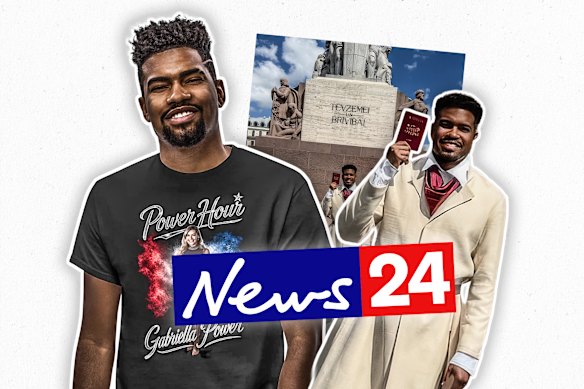
One item caught our eye here at On Background. That would be a T-shirt to support presenter Gabriella Power’s digital-only show The Power Hour. It’s not the lovely looking T-shirt, so much as the handsome stock image chap pictured wearing it on the News24 store.
It turns out the gentleman News24 have superimposed its merch over appears to be a former Brazilian footballer named Felipe Gabriel Dos Santos Xavier, who became an online influencer in Latvia after retiring from the beautiful game. With an Instagram following of 279,000 in a country of less than 2 million people and a starring role in a 2020 Latvian comedy film, Xavier has become a pretty big deal in the small Baltic country.
But News24’s man has been at the centre of an even bigger story this year in his adopted country. Xavier has lived in Latvia for 10 years, but local law meant he couldn’t become a permanent resident until 2030 or citizen until 2035. That meant he risked deportation. So what did the Latvian government do? It granted him special citizenship, which caused a stir over why he was allowed to bypass Latvian naturalisation laws.
We know immigration is key topic for News24 locally, but overseas issues get serious air time as well, with hosts such as Rowan Dean raising the overheated prospect of a “civil war” over migrants in Europe. The EU’s “migrant crisis” has been a particular favourite on Power’s program too. Latvia is, of course, a member of that very bloc.
In 2020, Xavier posted a video to his YouTube channel saying he wanted to be an example for people of colour or foreigners who wanted to live in Latvia and addressing racism in the country.
“For example, two years ago and also last year when I was looking for an apartment all the time there was a situation where, if you’re from India or Uzbekistan, you had to pay a six month deposit rather than one month which is the standard in Latvia,” he said, according to a translation. “And that’s racism, it’s also illegal.”
Against that backdrop, it’s great to see News24 choosing to inject some balance by choosing a man whose life story shows the value of migration to be a face of the channel.
Advocacy for me, but not thee?
Latika Bourke, the London-based host of the ABC’s popular geopolitics podcast Global Roaming and a writer-at-large for the Stokes family’s news site The Nightly, caused quite the stir this week while following Prime Minister Anthony Albanese on his press tour around the United States.
Bourke, who is a former reporter for this masthead, lobbed up one heck of a loaded question to the PM as he prepared to receive a prize from an American international affairs think tank called the Atlantic Council.
“Don’t you feel like a bit of a fraud accepting this award when, at home, you screwed up the response to the worst massacre since Port Arthur?” Bourke asked.
Albo’s one word response of “no” did nothing to tone down The Nightly’s subsequent coverage. The outlet instead plastered a picture of their star reporter and her “fraud” line on the front page of their daily PDF newspaper.
Bourke is no stranger to combining her journalism with a spot of activism, though. The part-time ABC host appeared at Albo’s presser wearing a baseball cap emblazoned with the Ukrainian coat of arms and its distinctive trident.
Just last month she celebrated 35 years of Ukrainian independence, capping off a social media post with “Slava Ukraini”, which loosely translates to “Glory to Ukraine”.
Last year, three months before the ABC appointed Bourke to her co-hosting role, she was advertising her very own fundraising campaign for Ukrainian Action, a charity/activist group supporting the beleaguered nation against Russia’s barbarous invasion.
This isn’t apples for apples, but how would the ABC’s head honchos respond if Bourke’s global roaming co-hosts Hamish Macdonald or Waleed Aly were to post “free Palestine” or “glory to Israel”? Given the trio and Geraldine Doogue regularly discuss Russia and the war, her views are highly relevant.
It’s a tricky question for the ABC, which has spent years drawing the line between what staff can and cannot say as part of their employment at the public broadcaster. That challenge is particularly acute when it comes to staff like Bourke, who wear multiple hats by working for multiple outlets and plying their trade in part as journalists and partly as commentators.
The ABC overhauled its public comment guidelines for staff and contractors last year after the Antoinette Lattouf saga, who was employed for five days as a casual, during which time she was sacked for reposting a Human Rights Watch post. Then-chair Ita Buttrose later dubbed Lattouf an “activist” in court over her past posts on the Israel-Hamas conflict. Lattouf won that case, and a hefty pay-out.
An ABC spokesperson said Bourke has a significant public profile outside the ABC, due to her other work, working for The Nightly and publishing a self-titled podcast.
“ABC workers are members of the communities they serve and the ABC does not wish to unnecessarily curtail their engagement in civic life, including by expressing personal views outside of work,” the spokesperson said.
How did that work for Lattouf?
Trusted bots
News bosses around the country are facing a tricky balancing act. On one hand, they are trying to assure journalists their jobs will not be replaced by AI, secure compensation from AI companies and tell the public that human-produced material is better than slop. On the other hand, they are adopting AI themselves and figuring out how to use it in news production.
Just this week, News Corp Australia boss Michael Miller delivered a major speech at a Macquarie University event outlining why AI was a valuable tool for journalists’ work and not a substitute for it.
“Our journalists operate as accountable, identifiable figures, not automated feeds. Readers see their bylines, their credentials, and can contact them directly,” Miller said.
We couldn’t agree more.
The only issue with these comments, is that last week this masthead revealed that The Herald Sun was using AI to write local and regional news articles, with no bylines visible at all.
News Corp assured us “any story created with the assistance of verified AI is edited and approved for publication by an editor”. But this begs the question, who is accountable?
There is no editor’s name listed on the AI pieces for a reader to email, though they could contact the paper itself. Predictably, several of the articles published by the Herald Sun using AI contained major errors, as Media Watch later pointed out.
While News claims to have launched its AI project in hopes of servicing long-under served communities, one of the reasons they are underserved is because that same company shut down some of the papers serving them years ago. Of course, the company is still one of the nation’s largest media employers, and other companies, including Nine, have sold off or shut down regional outlets that are increasingly hard to make viable.
On Background’s view is that it appears a bid to drive subscriptions in areas like Monash and Moonee Valley without having to deploy staff and resources into those areas to actually serve them. One News Corp staffer pointed out that while the stories disclose they are generated with AI at the bottom of each piece, that is not made public when they are promoted on social media or to a user who is yet to subscribe, and therefore cannot read the whole piece.
An AI-generated article regarding the Monash aquatic centre did, in fact, lead to a subscription, the source said. But would that reader have still signed up, knowing the piece was an AI-wrap of a council meeting one month earlier? We doubt it.
A News Corp spokesman said subscribers were signing up to an entire masthead, not just one story. “We are trying to solve a fundamental problem facing journalism around the world: how to address the decline of local news coverage because we believe Victorians deserve a better deal than to accept they should be deprived of this vital information,” he said.
The Business Briefing newsletter delivers major stories, exclusive coverage and expert opinion. Sign up to get it every weekday morning.
 Calum Jaspan is a media writer for The Sydney Morning Herald and The Age, based in Melbourne. Reach him securely on Signal @calumjaspan.10Connect via X or email.
From our partners
Disclaimer : This story is auto aggregated by a computer programme and has not been created or edited by DOWNTHENEWS. Publisher: www.smh.com.au