
Consider the professional competitive surfer, living the dream. They travel to their contest but don’t know when it will start. Surfing is, unlike any sport, at the mercy of the elements. The uncertainty about waves and conditions means the next heat could be tomorrow morning, the next afternoon, or a week away. All competitors and their entourages are crammed together into a hothouse of waiting.
Then, the heat itself is an excruciating tick-ticking half-hour of more unknowns. Will a wave come? Which wave to choose and what to do with it? What’s the rival doing, what’s the scoreboard saying? Piled on top of that stress are the vagaries of subjective judging and the microscopic margins between success and the scrapheap. The tension of this high-stakes competition is inimical to why anyone would surf in the first place. You have the dream job, but you wish you were with those others over there, down the beach, just surfing.
And if that isn’t enough, along comes the great white shark.
Pro surfing is complicated. World champions from Kelly Slater and John John Florence to Stephanie Gilmore and Carissa Moore and the Brazilians Gabriel Medina and Filipe Toledo have quit the sport to escape the stress. Some come back, unable to resist their competitive urges; others go into the lucrative world of paid magazine shoots in remote locations; most just chuck it in, go home and surf again. Not compete, not deal with the nerve-shredding tension, just to reconnect with something they’re meant to love.
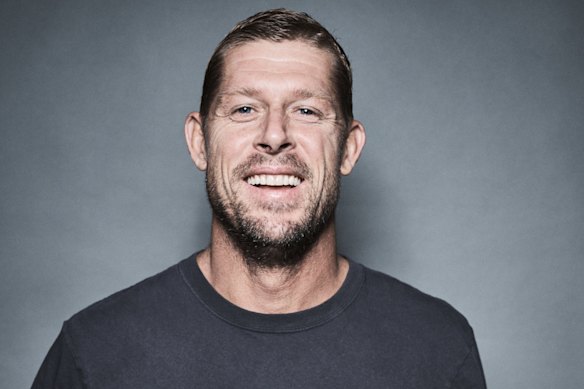
Mick Fanning kept a lid on this tug-of-war during his 15-year career as a three-time world champion. He grew up knowing working-class adversity. His father, an earthmover, left his mother, a nurse, to raise five children of whom Mick was the youngest. Mick’s brother and closest friend, Sean, died in a car accident at 20. Mick grew up between contradictory emotions: the joy of being so good at surfing that he could honour the life Sean didn’t get, and the inner knowledge that much of the professional life left him anxious and depressed. He couldn’t admit that, though. He had friends and dependants to represent. He was a rainbow-kissed kid from Penrith. He owed it to everyone to be happy to be living their dream.
Success came when he managed to quarantine the obsessive, process-driven professional “Mick” from the off-the-clock alter ego, the drunken liar “Eugene”. But with the world titles came more loss. One of his closest surfing friends, Hawaiian world champion Andy Irons, died at 32. Mick’s eldest brother Peter died at 43. His last brother, Ed, would die at 48. In 2015, Mick’s first marriage was failing. Then he paddled out for the final at Jeffreys Bay in South Africa.
Live on television, a great white shark came at Fanning. It is still chilling to remember the horror of that moment, when you saw the fin, the splash, and for eight seconds the surfer disappearing behind a wave. Fanning thrashed around and the shark swam away.
The incident turned Fanning from a surfer into a global celebrity. He hated the attention and, to his credit, in this book he deals with the event in a way that doesn’t define his story. He pays most credit to Julian Wilson, his competitor, who paddled towards him. He downplays the punch he threw at the shark. “I wasn’t heroic that day, just lucky.” More revealing are the ongoing night terrors. His marriage collapsed, he came back to the J-Bay Open and won, but he finally admitted that he didn’t enjoy competitive surfing enough to keep slogging away.
Fanning is not the only sportsperson to say their favourite book is Andre Agassi’s confessional Open, the most celebrated line of which is “I hate tennis”. Fanning’s book has a kinship with Agassi’s in playing out this ambivalence about the thing that rewards you with trophies and wealth. He definitely doesn’t want to whinge, but he can’t keep bottling it up either.
A singular Australian personality, tough and brave but also bearing his raw emotional scars honestly, Fanning contributes far beyond his own story. Young (and old) men are said to be wrenched between two poles of modern masculinity: the sensitive, feminised, “woke” new age man and the rugged, nostalgic model sold by the “manosphere”. Fanning shows a natural middle way, a both/and. He is strong and tender, tough as an old guard dog and gentle as a puppy. “Born in 1981,” he writes, “I grew up on the fault line between the hard-knocks bloke culture that came before me and a time when men were starting to get a bit better at talking about what was really going on.”
In this book, he grows out of one and becomes the other, melding both. I cannot speak highly enough of the good that his openness can do. Today, when it seems newly urgent, Fanning’s story can be an inspiration and a model for every man and for every person.
All Heart by Mick Fanning is published by Simon & Schuster ($37)
The Booklist is a weekly newsletter for book lovers from Jason Steger. Get it delivered every Friday.
 Malcolm Knox is a journalist, author and columnist for The Sydney Morning Herald.
From our partners
Disclaimer : This story is auto aggregated by a computer programme and has not been created or edited by DOWNTHENEWS. Publisher: www.smh.com.au