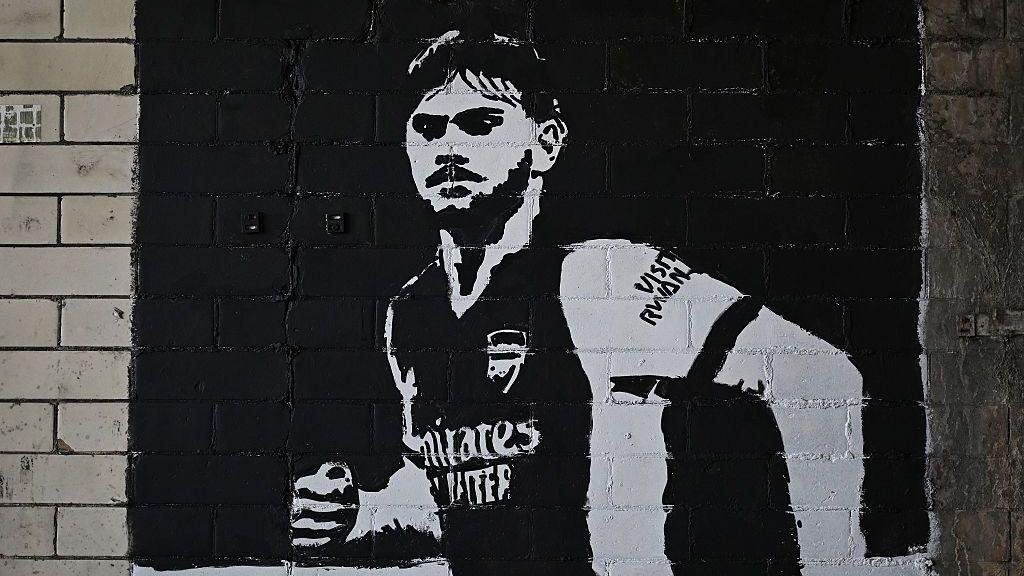
Our son’s death could have been prevented by FA – Billy Vigar’s parents
To play this video you need to enable JavaScript in your browser.
This video can not be played
-
Published
“You swing from sadness to anger because you just feel it could have been prevented.”
That is the view of Camilla Vigar, whose son Billy, a former Arsenal academy player, died a year ago today from a “significant brain injury”, five days after colliding with a concrete wall surrounding a pitch.
The 21-year-old striker was playing for Chichester City at Wingate and Finchley FC in north London.
In their first broadcast interview since their son’s passing, the Vigar family accuse the Football Association of doing “nothing” after previous similar incidents.
“[Billy] had his whole life ahead of him. He was 21 years old and he lost it playing football when he didn’t need to,” she told BBC Sport.
“I personally feel that the FA could have stopped Billy losing his life because they had so many warnings.”
They give the example of amateur footballer Ben Hiscox, who died in 2015 after colliding with a clubhouse near Bristol.
After the coroner warned the FA about the risk of future deaths, padding was added to Stoke Gifford United’s clubhouse and the run-off between it and the pitch was increased.
The Vigars also point to the life-changing injuries sustained by Alex Fletcher in 2022.
Fletcher fractured his skull when colliding with concrete barriers next to the pitch at Bath City’s ground, and was forced to retire in 2024.
The FA conducted a review of clubs after that incident.
“As far as I’m aware, nothing was done with that information and it just sat there. One of the clubs as far as I’m aware that was highlighted as being one of the high-risk clubs was Wingate [and Finchley], where Billy then lost his life,” said Camilla Vigar.
When asked by the BBC what was done with the information it had gathered, the FA provided no comment.
Changes needed at 169 clubs
At the time of Vigar’s accident, the FA’s stadium accreditation criteria, which applies to the National League System in men’s football and the Women’s National League, said clubs needed to have a “permanent” barrier around the pitch “of sound construction (eg concrete and steel)”.
In light of what happened to Vigar, the FA launched a safety review of more than 900 clubs, which was conducted by independent experts.
As a result, the stadium criteria was updated last month and “no longer permits solid brick, breeze block or concrete barriers around pitches”.
The BBC has been told 169 clubs in the men’s National League System and women’s National League were notified they would need to make changes “as soon as is reasonably practicable”.
Where walls are structural, they must be “covered with suitable protection”, such as padding.
The FA said: “This important work is under way, and we will continue to fully support the clubs involved.”
Funding is being provided by the FA and the Premier League.
BBC Sport approached hundreds of affected clubs in an effort to gauge their views on the changes and understand the status of their remedial work.
Bromsgrove Sporting near Birmingham, which has a concrete wall surrounding its pitch, told BBC Sport the changes were “completely understandable and long overdue”. It added: “We are fully supportive of this and are grateful for the 100% funding from the FA.”
The club said it had been given a deadline of the end of this season but “being high risk it would be good to complete this side of Christmas”.
 Image source, Sheppey United FC
Meanwhile, Sheppey United, in Kent, has a concrete supporting wall around two sides of its 3G pitch, which will be covered in padding.
Asked for their thoughts on the changes, the club said: “There is always an element of risk in all sports and they can’t all be mitigated, unfortunately in this instance the remedial works are more a reactive response rather than a proactive one. If the funding wasn’t in place I think it would make it difficult for some clubs to fund this.”
Bath City, where Fletcher’s incident happened, has solid perimeter walls on all sides of its pitch.
The club told BBC Sport: “We welcome the ruling as it seeks to improve player safety and recognises that funding needs to be available to support clubs to implement this fundamental change to the ground grading regulations.”
Keith Vigar, Billy’s father, said: “I work in the health and safety industry, and the main thing is you don’t go to work and expect to get injured, let alone even die at work in the workplace.”
The Vigars want the regulations extended above and below the National League.
“It needs to change basically at all levels, not just at the levels that have changed,” said Keith Vigar.
That is a view shared by Fletcher, who said the FA had “ignored” his years of campaigning on the issue of pitch perimeter safety.
“It wasn’t until Billy’s passing that [the FA] came to the table on this issue,” he said.
“So for me, that is a complete dereliction of duty on their part, and there should be accountability for that failing.”
Fletcher also said he is worried the ban on concrete, breeze block and brick walls does not cover all levels of the game and wants that explored urgently by the authorities.
“There could be still situations where football is being played at some level, to some degree, organised football in this country, with these unsafe pitch perimeters. I would like to see that guidance, or the regulation, extended to consider all of football.”
 Image source, Getty Images
Billy was ‘something different’
Compared to many youngsters, Billy Vigar joined the football system late – and yet his talent was still recognised.
He was scouted by Arsenal while playing for local club Hove Rivervale in Sussex, and joined the Premier League side’s academy.
“It was just an amazing feeling,” said his father.
“Sort of like your son’s been chosen. And I’d always promised him a decent pair of football boots if he joined an academy. So yeah, since then it’s cost me a fortune.
“He was something different, Billy. I think most, even at Arsenal, they saw something different in him. He was a great athlete, basically. And that started from an early age with his brother, who quickly learned there’s not much point trying to challenge him because he wanted to win.”
Injuries followed, and Vigar was recuperating from one such setback while playing for Chichester City FC, where he had made an instant impression.
Darin Kilpatrick, the club’s first-team manager, said: “He was so coachable, he would run in behind, he would drop in short. His hold-up play was excellent and obviously he had an eye for a goal which all strikers have to have.
“To be fair, the way Bills was playing in his last couple of games that we had him, we would probably have only been able to keep him another six months before we moved him on into the higher levels where he belonged.”
Asked what level he was aiming for with Billy, Kilpatrick said: “He would have gone into the National League or [English] Football League, without a doubt.”
Watching football again has been difficult for Keith Vigar.
“It did become less important, far less important to start with, the struggle to get back into it,” he said. “When we went to see Chichester in that sense, first off, it’s hard because you’re just thinking, ‘Billy should be out there, Billy should be playing’ and that sort of thing. That’s been hard.”
The Vigars said Chichester FC have been “amazing” during the past year, including designing a kit that makes moving but subtle references to their son.
They want accountability and answers. They are awaiting the inquest, which is likely to take place next year.
But today, as they mark the one-year anniversary of their son’s tragic accident, they will pour all their focus into climbing Snowdon with their children Phoebe and Ollie, and the family of Billy’s girlfriend Lois.
“I think it just gives us something to focus on and gives us a challenge to do,” Keith Vigar said. “And I know he’d have liked to do that. I’m sure he will be with us somewhere, looking over us in some way or form, having a laugh at us, no doubt, in the rain.”
-
-
Published29 September 2025

-
Disclaimer : This story is auto aggregated by a computer programme and has not been created or edited by DOWNTHENEWS. Publisher: BBC