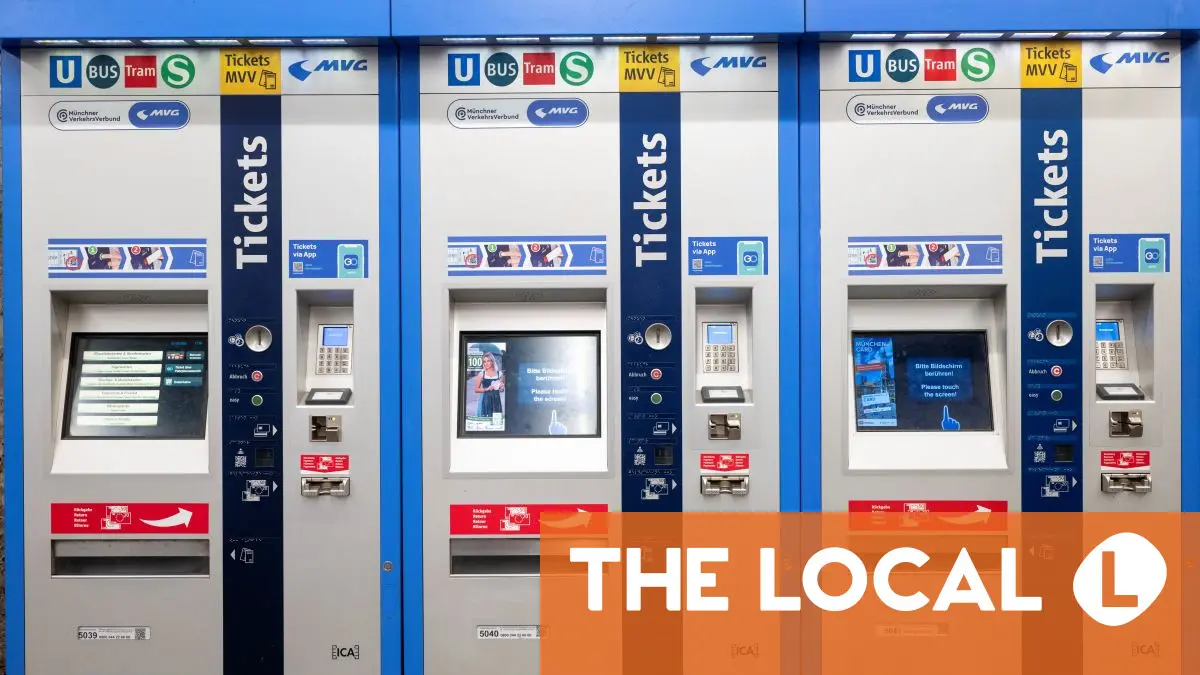
Millions of passengers in Germany are facing higher public transport costs in 2027. Berlin, Munich and Hamburg have already announced fare changes, with at least one region holding prices steady.
Public transport users across Germany are beginning to get a clearer picture of what they’ll be paying for buses, trams and local trains next year.
While several major transport authorities are still finalising their fare decisions for 2027, some of the country’s biggest networks, including those serving Berlin, Munich, Hamburg and Bremen, have already announced price increases.
Most operators say rising energy, fuel and staffing costs are behind the hikes, but not every region is following the same path. The Rhine-Main Transport Association (RMV), which covers Frankfurt and surrounding areas, has announced a rare fare freeze while it prepares a major overhaul of its ticket system.
Meanwhile, millions of Deutschlandticket holders are also likely to face another increase, with current estimates suggesting the nationwide pass could become slightly more expensive from January.
Berlin and Brandenburg
The Berlin-Brandenburg Transport Association (VBB) will raise fares by an average of 3.72 percent from January 1st, 2027.
The good news for occasional travellers in the capital is that the standard Berlin AB single-ride ticket will remain unchanged at €4.00.
That means passengers travelling entirely within Berlin’s most commonly used fare zone will not see a further increase after the ticket price rose from €3.80 to €4.00 at the start of 2026.
Several other tickets, however, are becoming more expensive. The Berlin AB four-trip ticket will increase from €12.40 to €13.20, while the short-distance ticket will rise from €2.80 to €2.90.
Travellers heading to BER Airport or destinations in the wider Berlin-Brandenburg region will also notice a change. The Berlin ABC single ticket is increasing from €5.00 to €5.20.
According to the VBB, the increase is needed because inflation, higher operating costs and ongoing investment in vehicles and infrastructure continue to put pressure on public transport finances.
READ ALSO: The app helping Berliners track ticket inspections on public transport
Munich
Passengers in and around Munich will see one of the larger increases announced so far.
The Munich Transport and Fare Association (MVV) says fares will rise by an average of 4.9 percent from January 1st, largely because of higher energy and fuel costs.
Like Berlin, the MVV has chosen to protect some of its most frequently used tickets. The short-distance ticket and the standard single ticket for Munich’s central Zone M will remain unchanged.
Other fares are rising. A day ticket for Zone M will increase to €10.80, while the multi-trip ticket will cost €21.00, or €19.50 when purchased digitally.
Weekly passes are also becoming more expensive. A weekly pass for Zone M or two zones will cost €25.80, while a pass covering Zones M to 5 will rise to €87.30.
Monthly pass prices will increase by an average of 4.8 percent.
The MVV is also simplifying its ticket range, with more than a quarter of current ticket types being discontinued due to changing travel patterns. These include the 9am monthly pass (9 Uhr Monatskarte) and the transfer/extension ticket (Anschlussticket)
READ ALSO: Six things to do on a rainy day in Munich
Hamburg
Hamburg’s transport association HVV is raising fares from 2027, though some of its most popular tickets will remain unchanged.
Passengers travelling within the central Hamburg AB area will continue to pay €4.10 for a single ticket and €8.20 for a day ticket.
But one change that could catch passengers off guard is the end of HVV’s seven-percent online booking discount
While the official fare remains unchanged at €4.10 and €8.20, passengers who previously bought tickets through the HVV app will lose the existing seven percent online discount and therefore pay more.
The transport authority says the discount was introduced to encourage digital ticket sales but is no longer necessary because more than half of all tickets are now sold digitally.
Short-distance tickets will increase by 10 cents to €2.20. Children’s tickets are also becoming more expensive, rising to €1.70 for a single journey and €3.40 for a day ticket.
Travellers using three-zone tickets will see a larger jump, with the price increasing from €7.00 to €7.40. HVV says the fare increases are needed because of rising personnel and energy costs.
Finally, due to the popularity of the Deutschlandticket, the weekly ticket will no longer be offered in future.
Bremen and Lower Saxony
The Bremen/Lower Saxony transport association (VBN), which includes Bremen’s BSAG and Bremerhaven Bus, will increase fares by an average of 3.5 percent from January.
In Bremerhaven, for example, a standard single ticket will rise from €3.00 to €3.10.
Season tickets and other passes will also become more expensive, although exact increases vary depending on the ticket type.
The VBN says the rise reflects continuing increases in energy and staffing costs. It also points to changing passenger behaviour since the introduction of the Deutschlandticket. As a result, some less popular season-ticket products are being withdrawn because of reduced demand.
READ ALSO: The app that wants to help you avoid Deutsche Bahn delays
Frankfurt region
While most transport authorities are increasing fares, the RMV is taking a different approach.
The organisation, which covers Frankfurt and much of the wider Rhine-Main region, has confirmed that ticket prices will remain unchanged at the start of 2027.
The move comes as the RMV prepares a major fare reform that is expected to be introduced during 2027. The overhaul aims to simplify what many passengers see as an overly complex system of fares and ticket options.
Why haven’t all transport authorities announced their fares yet?
If your city is missing from this list, there’s a simple explanation.
Many German transport authorities do not approve new fares until supervisory boards meet between September and November. As a result, major networks such as those covering Stuttgart and the Ruhr region haven’t announced their 2027 prices yet.
What about the Deutschlandticket?
The price of the Deutschlandticket for 2027 has not yet been officially confirmed, but current estimates suggest the nationwide pass could rise from €63 per month to somewhere between €66.40 and €66.80.
The final figure will be determined using a new calculation system that takes account of factors such as staff costs, fuel and electricity prices, inflation and government subsidies.
READ ALSO: How much will the cost of the Deutschlandticket rise in 2027?
Disclaimer : This story is auto aggregated by a computer programme and has not been created or edited by DOWNTHENEWS. Publisher: thelocal.de