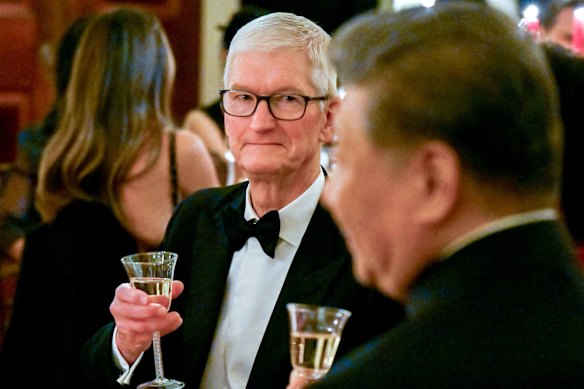
The many American business and technology titans invited to the White House state dinner on Thursday night – Jeff Bezos, David Ellison and Jamie Dimon among them – mostly had each other for company.
There was no delegation of Chinese business executives on the trip, as there was on Xi Jinping’s last state visit to Washington in 2015.
It was one of the many signs that this summit was unlikely to elicit substantial outcomes – commercially at least – other than photographs.
That has largely proven to be true. Little change has emerged from the meetings so far, except for a two-month extension to the trade truce brokered last year in Busan (it now expires in January) and a renewed AI dialogue.
US trade ambassador Jamieson Greer promised more announcements on Monday, while Donald Trump signalled good news for American farmers, though he has said that before.
He also continued his pitch to rebrand artificial intelligence as “super intelligence”, but there was no obvious outcome on AI regulation. The White House had not provided an official readout at the time of writing.
Evan Feigenbaum, vice president of studies at the Carnegie Endowment for International Peace, and a leading voice on Asia, said the affair was “long on performance, short on substance”.
But, he added, “that doesn’t mean there won’t be substance, because they’re going to meet two more times this year. That’s really unprecedented.”
Having already met in Beijing in May, Trump and Xi are due to see each other again at the APEC summit in Shenzhen in November, and at the G20 in Miami before Christmas.
Feigenbaum said one would ordinarily expect more tangible outcomes and co-operation from so much face-to-face time. The absence of this may mean they are still negotiating; the summit schedule gives them more time.
Or it could mean, as Feigenbaum intuits, that “neither side wants that much out of the relationship any more that’s realistic and workable”.
What they do get is an opportunity to cast US-Sino relations in their own terms. For Trump, as always, it is personal. He showered Xi and Madam Peng Liyuan with superlatives, and reiterated how great they get on. Showing off the White House, including the helipad and the forthcoming ballroom, was of great importance.
Xi was also complimentary but never missed an opportunity to reinforce Beijing’s geopolitical message. No clearer was this than during a tea ceremony in the White House’s Red Room on Friday morning.
Trump praised his visitors and thanked the media for its “fair coverage”. Xi, meanwhile, made a short speech about “two people charting the course for the great ship of China-US relations”.
He repeated Beijing’s preferred framing of the relationship as one of “strategic stability”, and said the summit had added more substance to this notion – though how remained a mystery. He spoke of respect, fairness and reciprocity.
Ryan Hass, a China scholar the Brookings Institution in Washington, said the contrast between the two leaders’ approaches was “pretty striking”.
“For Trump, the pageantry appears to be the point,” he wrote on X. “The focus is on forging personal bonds with Xi and signalling that both leaders can keep competition under control.”
Meanwhile, “Xi spoke mostly in terms of state-state relations and national power … [He] seemed bemused by Trump’s entertaining approach to hospitality.”
While in Washington, the Chinese president repeatedly cast China and the US as two “major countries” who shouldered special responsibility to not just steer their own relationship, but to chart a course for the world. Implicit therein is the positioning of Beijing and Washington on an equal footing.
Zhao Minghao, a professor of Sino-US relations at Shanghai’s Fudan University, said Beijing would be happy with the summit and the way it projected Xi as Trump’s equal, though it would have preferred a six-month or yearlong extension to the trade truce.
“If US–China summit meetings can help preserve channels and avoid a new shock, it is of great worth,” Zhao said. “Beijing measures success by process, symmetry and de-escalation, not by comprehensive agreements that were never expected.”
But it was not just policy that was invisible at this meeting. While there was plenty of pomp, circumstance and goodwill, most of it was not broadcast to Americans.
That’s because the five major TV networks – Fox News, ABC, CBS, NBC and CNN – did not participate in the “pool” that films presidential events and distributes footage to other stations around the country. They had refused to take part in solidarity with CNN, which Trump had banned from the White House and the pool.
The ban was fully lifted on Friday (Washington DC local time), and their participation resumed. But it meant reduced exposure of an event crafted with visuals front of mind.
On Friday, the Chinese Communist Party’s official newspaper, the People’s Daily, splashed its front page with six photos of Xi’s US visit, featuring him being greeted by Trump on the tarmac, the red carpet welcome at the White House, and the two leaders shaking hands in the Oval Office.
The optics matter immensely for the Chinese, says Dylan Loh, an expert on Chinese foreign policy at Nanyang Technological University in Singapore.
“It allows Beijing to demonstrate to their domestic audiences – and really to the rest of the world – that they are the US’s peer,” says Loh. “And to say: the US is giving us the respect that we have historically not necessarily gotten. We have arrived.”
Zhao said China now saw itself as a co-equal great power that could withstand US economic force, and had been surprised by how quickly Trump had shifted from extreme confrontation and tariff brinkmanship to accepting Beijing’s framework of “constructive strategic stability”.
“Beijing does not believe rivalry is over,” Zhao said. “Tech decoupling, Taiwan and military mistrust remain. But it judges the balance of psychological initiative to have shifted. China can afford patience and incremental truce management.”
Feigenbaum, who is also a former deputy assistant secretary of state for south and central Asia under George W. Bush, reached a similar conclusion.
China is aware of Trump’s propensity to say almost anything. They also know that whatever Trump says or does, it does not necessarily commit the next US president.
“The Chinese objective is just to ringfence the worst outcomes with the US, park the Americans in a corner and then pursue their opportunities elsewhere, where they actually have them,” Feigenbaum said. “That’s their view of it.”
 Michael Koziol is the North America correspondent for The Age and Sydney Morning Herald. He is a former Sydney editor, Sun-Herald deputy editor and a federal political reporter in Canberra.Connect via X or email.
 Lisa Visentin is the North Asia correspondent for The Sydney Morning Herald and The Age based in Beijing. She was previously a federal political correspondent based in Canberra.Connect via X or email.
From our partners
Disclaimer : This story is auto aggregated by a computer programme and has not been created or edited by DOWNTHENEWS. Publisher: www.smh.com.au