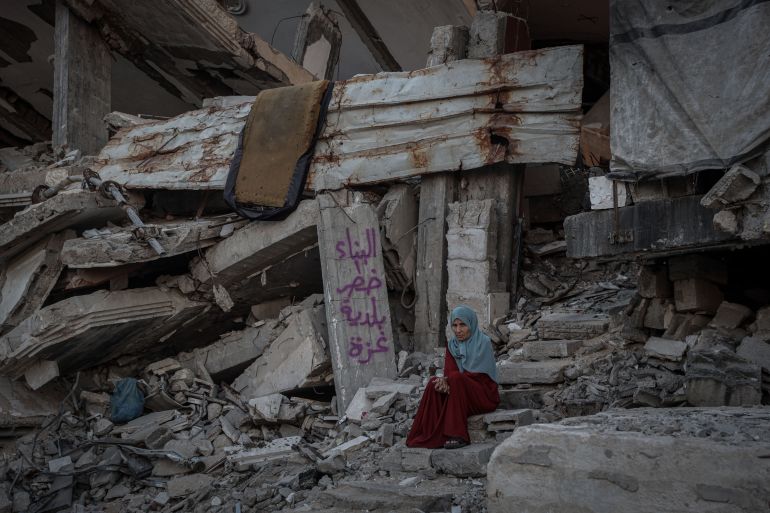
Gaza City, Gaza Strip – The partially collapsed roof above Masada Abu Jarad’s apartment is now made up of broken concrete with twisted steel bars protruding from its edges.
And underneath the section of the room that is now open to the elements after the building’s partial collapse, Masada’s family have pitched a tent to provide shelter.
Recommended Stories
list of 3 itemsend of list
The 60-year-old knows the structure is dangerous. The Palestinian Red Crescent and the Civil Defence visited the family last week and warned them that they should leave. But in Gaza, where Israel refuses to allow proper reconstruction to take place after almost three years of its genocidal war, there are few places for them to go.
“We have no options,” Masada says. “I want to leave, but who will give me an alternative?”
She has lived in the building in Gaza City’s Palestine Square area for the past year, after returning to northern Gaza from displacement earlier in the war. But this still isn’t home. Masada’s family is originally from Beit Lahiya in the far north of the Strip, but had to leave early in the war after Israel decimated the area. They are still unable to return.
After repeated displacement, the prospect of moving again without a safe destination has become exhausting. And even if they could move, the cost is prohibitive.
“Even if there is a better place, tell me how I can afford to rent it,” Masada said.
Masada’s experience reflects a wider housing crisis across Gaza for the Palestinians who have survived Israel’s war, which has killed more than 73,000 Palestinians.
Advertisement
A joint assessment by the United Nations, World Bank, and European Union found that 371,888 housing units, 76.6 percent of the housing stock, had been destroyed or damaged as of October 2025. The assessment also found that rebuilding Gaza will need more than $71bn over the next decade.
The dangers of Gaza’s depleted and damaged housing stock became starkly visible on September 16, when a six-storey war-damaged residential building in Gaza City collapsed, killing 21 people, including 12 children, according to the UN and Gaza Civil Defence.
The collapse has become a warning for families living in other damaged structures.
‘I stay awake so they can sleep’
Abdullah Abu Hajar, 40, lives with his wife and five children in the al-Najma building in Gaza City’s southern Remal neighbourhood.
The six-storey building is severely damaged and unstable. About 17 families, roughly 50 to 60 people, are living there, according to Abdullah.
On the outside walls, municipal notices warn residents and passers-by that the building is unsafe and at risk of collapse.
At night, while his wife and children try to sleep, Abdullah stays awake and listens.
Every unfamiliar sound, such as concrete shifting, stones moving or an unexplained creaking somewhere inside the building, puts him on alert.
“I stay awake all night, keeping watch,” he said. “I can’t close my eyes. I keep just listening to sounds around me.”

Abdullah explained that he feels worried for his children, even though they have adapted to the danger. But he has not.
And after the September 16 building collapse, he grew even more fearful. Since then, he said, he has barely slept.
“I’m already on edge,” he said. “But I don’t know where I can go.”
Abdullah and his family were displaced from Beit Hanoon in northern Gaza after it was attacked by Israel, and moved repeatedly during the war, eventually finding the al-Najma building.
His extended family faces the same uncertainty. Abdullah said that one of his relatives has been moving between southern and northern Gaza, looking for a place where he can pitch a tent.
“I told him to come and stay with us,” Abdullah said. “But he is hesitant because of the condition of this building. At the same time, he has nowhere else to go.”

A room among the rubble
For Islam Hassanein, 36, the same fears are entwined with the place she calls home.
Advertisement
A mother of five, Islam has spent nearly a year living with her family in a single room on the third floor of a damaged building.
She found the room after searching for somewhere to stay. It was filled with rubble and debris.
“We cleaned it and stayed in it,” she said.
The building is leaning and visibly damaged. The plumbing doesn’t work, so the family uses a bathroom outside. There is little that resembles a family home.
But leaving has proved no easier than staying. “We keep looking, but we can’t find anywhere,” she says. “They might even force us out of here. What are we supposed to do?”
Islam says she would leave immediately if she were offered a safe place.
“If they find us a good place and provide us with a tent, we will leave from the morning,” she says. “But where is this place? And where is the tent?”

[Abdelhakim Abu Riash/Al Jazeera]
The building itself regularly reminds her of the dangers.
“Every day, you hear the cracking,” she says. “People who live here tell us, ‘It’s cracking.’ Then a column fell, and they took us out of the building temporarily.”
The potentially deadly risks will become harder to manage as winter approaches, with its colder and wetter weather.
Water can enter through exposed roofs and walls, and the already weakened structure will face additional pressure from heavy rain.
“Last winter was terrifying,” Islam said. “We were constantly afraid that the building would collapse. I spent most days in my family’s tent because this building was full of openings and would flood whenever it rained.”
“Now, I am very afraid of this winter, and I don’t know what we are going to do.”
The UN says thousands of people are sheltering in damaged buildings considered unsafe because better housing options are unavailable.
Israeli restrictions on the entry of tents, tarpaulins and other essential shelter materials are making the situation more difficult, leaving Gaza in a state of limbo, unable to move on from the war, particularly as Israel can choose to escalate the conflict at any time.
UNICEF estimates that nearly 84 percent of Gaza’s population, more than 1.76 million people, are living in overcrowded displacement sites or damaged and inadequate shelters, with little protection from cold, heavy rain and flooding.
Islam says the war has forced families to take risks they once would have considered unthinkable.
She worries about her five children, but sees few choices available to her.
“They are all afraid,” she said. “But what can we do? If there is an alternative, I will leave. We leave it to God.”

Disclaimer : This story is auto aggregated by a computer programme and has not been created or edited by DOWNTHENEWS. Publisher: aljazeera.com