
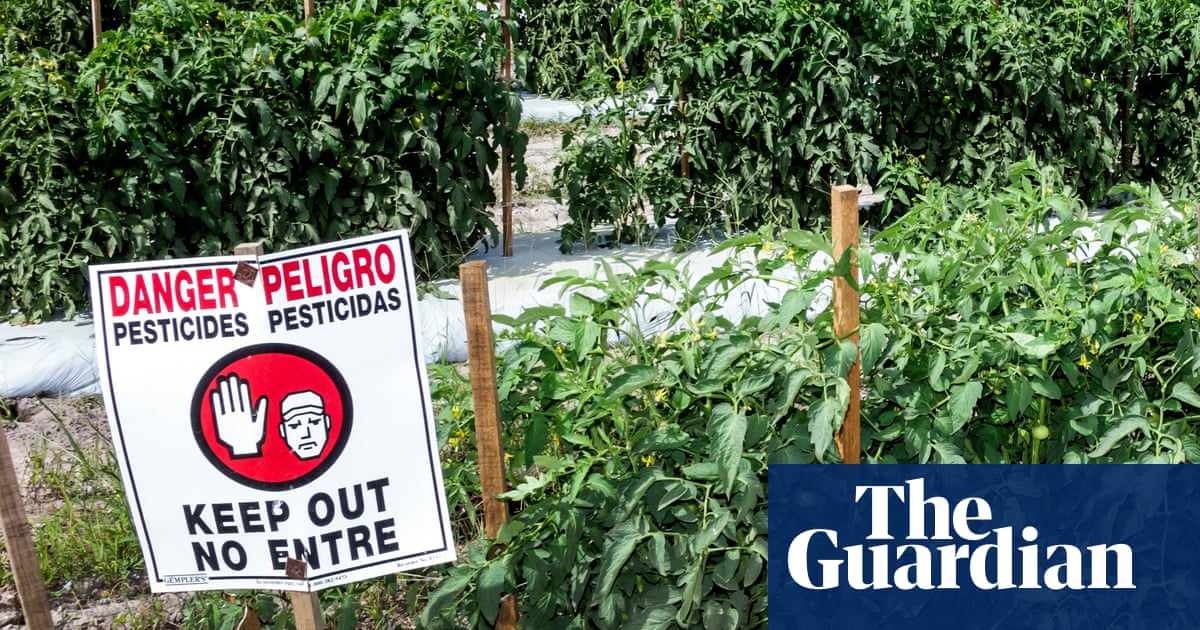
New research has identified at least 485 chemicals used in US pesticide products that are linked to breast cancer, raising questions about the safety of food and other products at a time when early onset breast cancer rates are surging worldwide.
The new peer-reviewed paper, published in Environmental Health Perspectives, a top journal from the American Chemical Society, highlights what public health advocates say are a range of deficiencies in how US pesticides are regulated. The review includes active pesticide ingredients, but also hundreds of so-called “inert”, or inactive, ingredients that typically do not undergo a thorough safety review.
The Environmental Protection Agency only considers each pesticide ingredient’s individual health risks, and does not consider the entire pesticide formula, or exposure to multiple pesticides. The chemicals are not just found in pesticides used on crops, but also in lice treatments applied to children’s scalps, home lawn fertilizers, and flea and tick treatments.
“Adding these exposures up gets pretty consequential and concerning,” said Jenny Kay, a report co-author with the Silent Spring Institute non-profit. “We wanted to bring more attention to the pesticides in different products.”
Beside skin cancers, breast cancer is the most commonly diagnosed cancer in the US. Incidence rates for breast cancer have notably increased by 1% per year, according to the American Cancer Society, and that rise has actually been slightly faster in women younger than 50 (1.4%).
Pesticide use has also increased in recent years, as federal health data via the National Health and Nutrition Examination Survey (NHANES) shows 84 of these specific breast cancer-linked chemicals are present in the general population. But that number, scientists say, is an undercount because it does not track most of the compounds the Silent Spring Institute identified.
The pesticide review is part of a broader systematic effort by the institute to identify where in the economy, and across everyday life, people are exposed to breast cancer-linked chemicals. It identified about 500 in common consumer goods, and 462 in drinking water.
Only about 145 of the pesticide chemicals identified were registered with the EPA as active ingredients, meaning that the chemical industry is either using the inert status to avoid health scrutiny, or exploiting other loopholes.
Inactive, or inert, ingredients are usually added as surfactants or penetrating agents that help disperse the active ingredients or make them more absorbable. About 4,000 inert ingredients are approved for use by the EPA, among them Pfas “forever chemicals”. They are often added to make the pesticide more toxic to a living organism.
“They are not biologically inert, they are just called inert because they do not target the pest,” Kay said. In other words, the body does not distinguish between inert and active ingredients, and inactive substances are no less of a danger to human health.
“It is a regulatory blind spot,” Kay said. The EPA in 2023 rejected a legal petition to start more stringently reviewing inert ingredients.
Kay said another problem lies in hormone-disrupting chemicals causing disease at lower levels of exposure, but not higher. This “non-monotonic dose response” has led the EPA to dismiss some chemicals’ risks, and ignore that they can cause cancer at low levels.
The top officials in the EPA’s pesticide and chemical safety offices are former industry lobbyists. The pesticide office in particular has been viewed as being heavily infiltrated by industry, and subjected to its influence.
“I’m not in the head of EPA scientists, but I do worry a lot about industry pressure and the revolving door between EPA and industry employees because all of that factors into the way the EPA considers and regulates chemicals,” Kay said.
The Silent Spring Institute called for an expansion of California’s Proposition 65, which requires warnings for chemicals known to cause cancer or reproductive harm. The study identified 16 pesticides that are not listed under Prop 65, and the authors say adding these chemicals could discourage companies from using them.
People can protect themselves by buying organic produce, or products that have not been treated with pesticides, as much as possible. If that’s not possible, Consumer Reports has an easy-to-use guide on which fruits and vegetables typically have the highest levels of pesticide residues on them. Among those are blueberries, watermelon, kale and green beans.
A recent report found about 25% of the nation’s water intake and around 675,000 wells draw water contaminated with dangerous levels of atrazine, a hormone disrupting chemical linked to breast cancer. Water-filtration systems can filter pesticides from water, and though no system is perfect, activated carbon and reverse osmosis generally do the best job.
Disclaimer : This story is auto aggregated by a computer programme and has not been created or edited by DOWNTHENEWS. Publisher: theguardian.com




