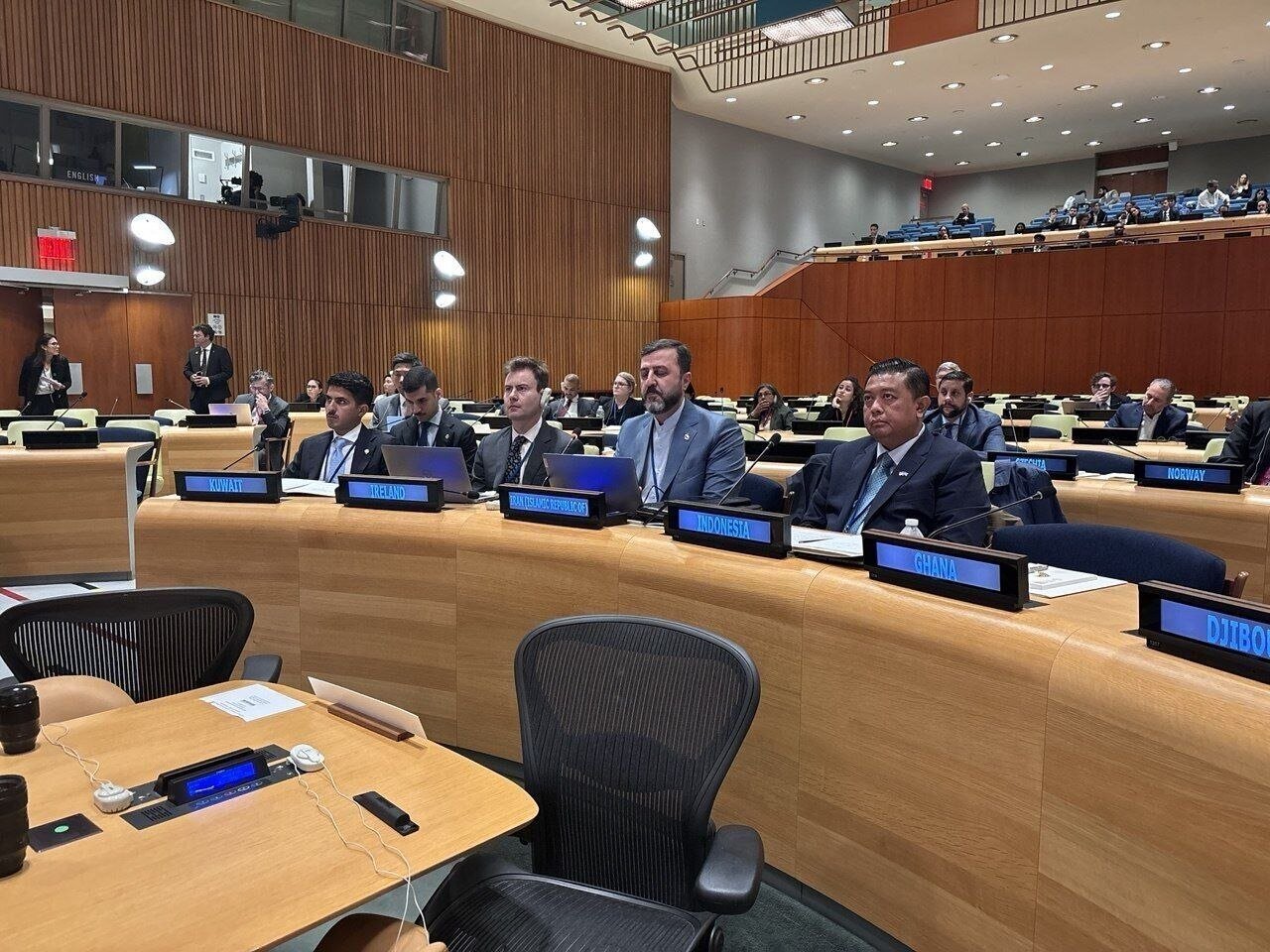
TEHRAN — Iranian Deputy Foreign Minister for Legal and International Affairs Kazem Gharibabadi has warned that the credibility of international law depends on the equal treatment of all states, stressing that national sovereignty and territorial integrity cannot be violated or made the subject of political bargaining.
Addressing a high-level meeting on the defense of international law at the United Nations on Friday, Gharibabadi said international law could fulfill its role in protecting peace, justice and human dignity only if its principles were applied universally and without discrimination.
“The sovereignty and territorial integrity of states are not subject to violation or bargaining,” he said, arguing that no state has the right to disregard the prohibition on the use of force based on political assertions or its unilateral interpretation of a perceived threat.
Iran warns against selective application of international law
Gharibabadi said the credibility of the international legal order ultimately rests on the principle that all states are equal before the law.
He criticized ‘the selective application of international law,’ saying that legal principles are sometimes invoked rigorously against certain countries while being set aside in other cases because of political considerations and geopolitical interests.
He pointed specifically to Article 2(4) of the UN Charter, which prohibits states from using force against the territorial integrity or political independence of another state.
“No country can preserve its security and sovereignty if the fundamental principle of Article 2(4) is undermined,” the Iranian diplomat said.
He argued that allowing political considerations to override the prohibition on the use of force would weaken a central pillar of the international legal system and create a precedent in which powerful states could interpret international rules in their own interests.
Right to self-defense must be upheld
Gharibabadi also stressed the right of countries subjected to aggression to defend themselves, saying such a right must be exercised within the framework of the UN Charter and international law.
He further called for the consistent application of international humanitarian law, particularly the protection of civilians and the distinction between military and civilian targets.
These principles, he said, must apply universally, whether in Palestine, Iran, Lebanon, Yemen or any other part of the world.
The Iranian diplomat’s remarks placed civilian protection and the rules governing armed conflict within the broader question of the credibility of international law, arguing that humanitarian principles cannot be selectively applied according to the identity of the parties involved.
Double standards undermine confidence in multilateralism
Gharibabadi identified ‘double standards’ in the application of international law as one of the major challenges facing the international system.
He said the UN Charter is invoked in some circumstances, while geopolitical interests are allowed to prevail in others. Similarly, he said, strict compliance with UN Security Council resolutions is demanded in some cases, while violations of the same resolutions may go unanswered elsewhere.
The Iranian deputy foreign minister also pointed to differing approaches to accountability.
“In one case, investigations and accountability are called for, while in another, political backing obstructs accountability,” he said.
Such inconsistency, Gharibabadi argued, does more than weaken the principle of justice. It also erodes the confidence of nations in multilateralism and international institutions.
“If international law is not applied equally to all states, its credibility will inevitably be undermined,” he warned.
Iran stresses role of International Court of Justice
Gharibabadi also highlighted the importance of the International Court of Justice (ICJ), the principal judicial organ of the United Nations, in maintaining the authority of international law.
He said the Court must be able to adjudicate disputes between states independently of political pressure and clarify the legal obligations of the parties involved.
“As the principal judicial organ of the United Nations, the Court must be able to adjudicate disputes between states independently of political pressure and clarify their legal obligations,” he said.
Tehran calls for stronger multilateral system
Gharibabadi said Iran was prepared to cooperate with countries that support the sovereign equality of states, multilateralism, the peaceful settlement of disputes and the non-discriminatory application of international law.
He said such cooperation could contribute to strengthening the multilateral system, with the United Nations at its center.
Disclaimer : This story is auto aggregated by a computer programme and has not been created or edited by DOWNTHENEWS. Publisher: tehrantimes.com