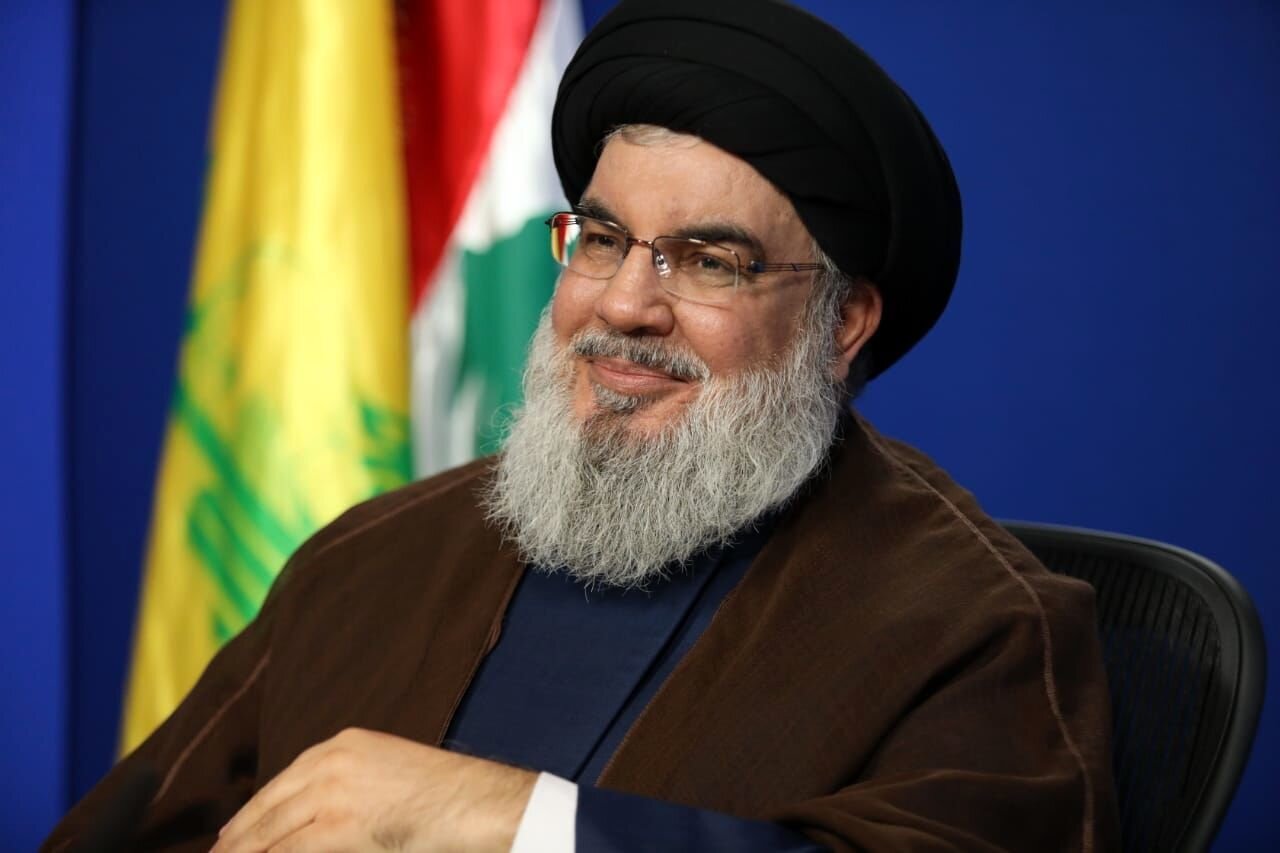
TEHRAN — Hezbollah Secretary-General Sayyed Hassan Nasrallah was assassinated by the Zionist regime with heavy U.S. weaponry that destroyed a southern Beirut neighborhood on September 27, 2024.
The grief over the loss of Sayyed Hassan Nasrallah is more than a personal emotion, and it extends beyond the religious and spiritual meaning attached to martyrdom.
Some departures pass into history as fleeting events. Others fundamentally alter its course. For large segments of Hezbollah’s constituency, the martyrdom of the Secretary-General belonged to the latter category.
Remembering him, therefore, is not simply an act of mourning for a political leader or military commander. It is a moment of reflection on a figure whose life was intertwined for decades with the confrontation against the Israeli-American project in the region, until his voice itself became an inseparable part of Hezbollah’s collective memory and consciousness.
For millions, Sayyed Nasrallah was associated with pivotal moments that cannot be erased: the early years of the Lebanese resistance; the historic victory that followed the liberation of southern Lebanon in 2000; the strategic steadfastness of the July 2006 war; and, finally, the Gaza military support front launched on October 8, 2023.
At every one of these moments, Sayyed Nasrallah was present, not simply as a leader directing battles, but as a force in his own right.
Crowds rallied around him and awaited his speeches, which established what came to be known as “deterrence equations” and restored among the Arab world a renewed sense of dignity.
It is therefore understandable that Hezbollah’s support base should feel it has lost something far greater than an individual. It has lost a voice whose very tone had come to embody the meaning of anti-colonial resistance.
Martyrdom culture and tragedy of human loss
The grief over the loss of Sayyed Nasrallah is more than a personal emotion, and it extends beyond the religious and spiritual meaning attached to martyrdom. It is also grief over a genuine political, moral, and military loss.
Sayyed Nasrallah was not a leader who stood apart from the meaning of martyrdom. He regarded it as a profound goal for those who chose this path. His son, Hadi Nasrallah, had gone before him as a martyr, as had thousands of Lebanese and Palestinian resistance fighters, foremost among them former Hezbollah Secretary-General Sayyed Abbas al-Musawi, who was assassinated in 1992, and the prominent commander Imad Mughniyeh, who was assassinated in 2008.
His own martyrdom affirmed this position by joining the caravan of martyrs. From this perspective, martyrdom is neither defeat nor an ending. But faith in the greatness of martyrdom does not mean that human beings do not suffer, nor does it make the loss of a leader of such stature any easier to bear.
Gravity of the moment
Sayyed Nasrallah’s loss came at an exceptionally sensitive and brutal moment. His assassination was not an isolated event detached from a long history of targeting. Throughout 2024, Hezbollah’s leadership structure had been subjected to a series of assassinations targeting senior commanders, including Fuad Shukr, Ibrahim Aqil, Ibrahim Qubaisi, and others.
By the time Sayyed Nasrallah was assassinated, the Israeli regime had committed heinous crimes against Hezbollah.
This is what gives historical significance to his final speech, delivered on September 19, 2024. It came in the aftermath of the explosions involving communications devices, pagers, and walkie-talkies, in Lebanon on September 17 and 18. The terrorist attack resulted in the deaths of nearly 40 people and injuries to more than 2,900 others.
Sayyed Nasrallah did not describe the incident that day as simply a security strike. He revealed that the regime had targeted approximately 4,000 pagers and 1,000 walkie-talkies and had sought to kill around 5,000 people over the course of two days.
Circumstances, however, reduced the scale of the casualties, as many of the devices were switched off or were not in their owners’ possession. Even so, Sayyed Nasrallah appeared deeply affected, and it was clear that the attack had left a profound mark on him.
Yet even in the midst of that wound, he drew a clear line around the central issue of the confrontation. The child-killing regime, he said, wanted Hezbollah to halt its support front for Gaza and stop the rockets directed at northern Israeli settlements, thereby allowing displaced settlers to return to their homes.
But Hezbollah would not end that front of solidarity with Palestinians as long as the genocidal war on the Gaza Strip continued. That point was fundamental. For Sayyed Nasrallah, the battle was not a separate war but a pressure front to end genocide. Just eight days after that pivotal speech, the occupying regime assassinated him.
Collapse of narratives and reality of confrontation
The assassination itself undercut years of theories and narratives promoted by some regional media outlets, which repeatedly asked: “Why doesn’t Israel assassinate the Hezbollah leader Nasrallah?”
Some went so far as to claim that the regime was deliberately choosing to look the other way.
Yet the reality was that when the regime’s military had the opportunity, it assassinated him without hesitation.
That fact alone warrants a reconsideration of those simplistic explanations. The regime’s earlier failure to assassinate the Hezbollah chief did not mean that it was “protecting” him. Nor should its eventual success become an occasion for gloating or reduce the history of the Lebanese resistance to a single intelligence or security failure.
War is not so simple. Tel Aviv succeeded in achieving a significant security breach, and that cannot be denied. But the history of the conflict demonstrates that attempts to eliminate political and military leaders are an inherent part of the confrontation. Sometimes they succeed; at other times, they fail.
Regional consequences
More significant still are the consequences of Sayyed Nasrallah’s absence at the regional level.
In Lebanon, Hezbollah suffered a major blow that ultimately culminated in the November 2024 ceasefire agreement, under which tens of thousands of Israelis returned to the northern settlements. But the story did not end there.
When the battle erupted again in March 2026, following the illegal Israeli-American war on Iran and the martyrdom of Iran’s Leader, Ayatollah Sayyed Ali Khamenei, Hezbollah resumed launching rockets.
Israeli settlers who had believed the war had ended in 2024 once again found themselves under fire. In Kiryat Shmona, for example, settlers who had returned were confronted with air-raid sirens once more.
For Hezbollah’s constituency, this latest round carried a clear message: despite the strikes it had endured, the assassination of its leadership, and the destruction of large parts of its infrastructure, Hezbollah had not disappeared. It had returned to the battlefield at a moment of extraordinary regional volatility.
Yet despite this military resilience, the loss of Sayyed Hassan remained both present and painful. His absence affected morale, the image of the Lebanese resistance, and its ability to address its supporters through the reassuring voice that had become so familiar.
His absence also came against the backdrop of a turbulent geopolitical landscape marked by dramatic shifts, including the fall of Bashar al-Assad’s government in Syria at the end of 2024. That development weakened one of the most important strategic corridors of the resistance axis.
In Gaza, the decline in momentum on the Lebanese front gave the occupying regime greater latitude to focus its efforts on the Strip, amid enormous political and military pressure on Palestinian resistance forces to accept arrangements affecting their weapons, in an attempt to dismantle them gradually.
This unfolded alongside the regime’s unchecked boldness, which culminated in the illegal war with Iran in June 2025 and again later in 2026.
No time for tears
However justified the grief over the loss of Sayyed Hassan Nasrallah may be, the more important task is to ensure that grief does not turn into despair or paralysis.
True loyalty to his memory lies in continuing along the path he paved with his blood and holding firmly to resistance as an indispensable strategic choice, while recognizing the nature of a conflict defined by a barbaric colonial regime.
The truest expression of appreciation for Sayyed Nasrallah’s legacy lies in maintaining the option of armed resistance and remaining steadfast in this position.
Perhaps the most significant continuing imprint of his legacy can be seen in the strikes and ballistic missiles launched from Iran over the past two years against targets deep inside the Zionist regime. These retaliatory operations reaffirm the principle of reciprocal impact and the balance underpinning the region’s equations.
Disclaimer : This story is auto aggregated by a computer programme and has not been created or edited by DOWNTHENEWS. Publisher: tehrantimes.com