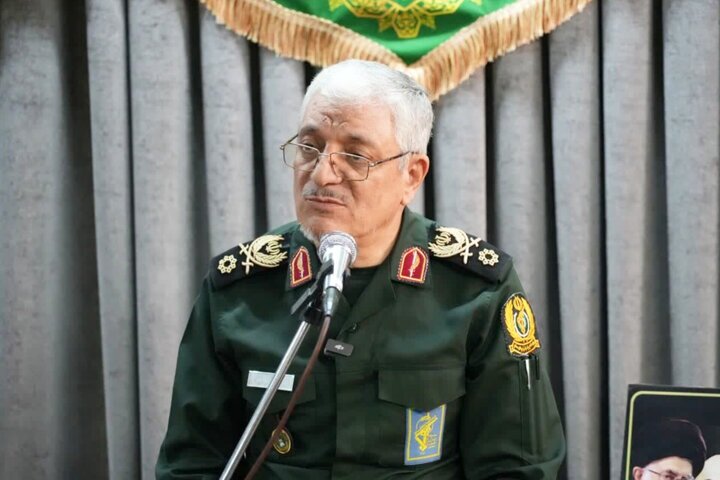
TEHRAN – Iran’s Defense Ministry spokesman says the country’s systematic move toward deep-underground defense infrastructure has significantly altered the strategic balance of power in West Asia, forcing hostile actors to recalibrate their failed military assumptions.
“Part of the strategic capabilities of the Armed Forces have in recent years been deployed in secure environments and underground infrastructure, a move that has frustrated the enemy’s calculations regarding Iran’s defense capabilities and weapons production capacity,” Brigadier General Reza Talaei-Nik said on Saturday.
He added, “The recent wars imposed costs and inflicted damage on Iran, yet the enemy failed to achieve its main strategic objectives, while Iran also imposed costs on them.”
General Talaei-Nik contextualized these developments within the broader evolution of contemporary warfare. He noted that the nature of recent conflicts has transcended traditional kinetic engagements, evolving into a sophisticated struggle where military prowess is merely one component of a larger, multidimensional battlefield.
He described the wars launched by the US and Israel against Iran in June 2025 and February 2026 as wars of technology, specialists, and hybrid warfare, saying that, alongside the military arena, social, economic, media, and cognitive domains had become major fields of confrontation.
He underscored that the current era of warfare bears no resemblance to the Iraqi-imposed war in the 1980s. The velocity of operations, the ubiquity of advanced digital weaponry, and the sheer geographical breadth of the recent conflicts represent a fundamental paradigm shift from the war imposed on Iran by Saddam Hussein’s regime, the spokesman noted.
The resilience displayed by the Iranian defense apparatus has been tested significantly over the past sixteen months. Since June 2025, Iran has been the target of two distinct campaigns of foreign aggression. The first was a 12-day criminal offensive in June 2025, followed by a more prolonged, 40-day campaign that commenced in late February.
Despite the intensity of these offensives, the strategic depth afforded by Iran’s underground infrastructure ensured the continuity of command, control, and retaliatory capacity.
Following the cessation of the second war, a fragile period of diplomatic engagement led to the Islamabad memorandum of understanding (MoU) on June 17, aimed at establishing a durable ceasefire. However, the US has repeatedly violated the tenets of this agreement, escalating tensions in July through waves of airstrikes and an illegal naval blockade. In an exercise of decisive sovereignty, the Iranian Armed Forces responded by conducting precision strikes against strategic American assets across West Asia and enforcing the closure of the Strait of Hormuz.
The failure of the enemy’s campaigns confirms that Iran’s strategic posture has moved beyond mere defensive capability; it has evolved into a comprehensive system of active deterrence. The ongoing integration of subterranean infrastructure with advanced early-warning systems and indigenous missile technology ensures that Iran’s defense remains resilient, regardless of the technological edge claimed by aggressors.
Moving forward, the Iranian defense doctrine continues to emphasize the necessity of simultaneous growth across military, cognitive, and economic sectors. As General Talaei-Nik emphasized, maintaining this deterrence is a prerequisite for national sovereignty. By proving that the most advanced weapons systems and air raids cannot decapitate the Islamic Republic’s retaliatory capabilities, Iran has established a new reality: the cost of aggression against the nation has become prohibitively high, effectively neutralizing the strategic objectives of the United States and its regional allies. The path ahead remains one of fortified resilience, where the interplay of technology and resolve ensures that Iran remains the primary architect of its own security.
Disclaimer : This story is auto aggregated by a computer programme and has not been created or edited by DOWNTHENEWS. Publisher: tehrantimes.com