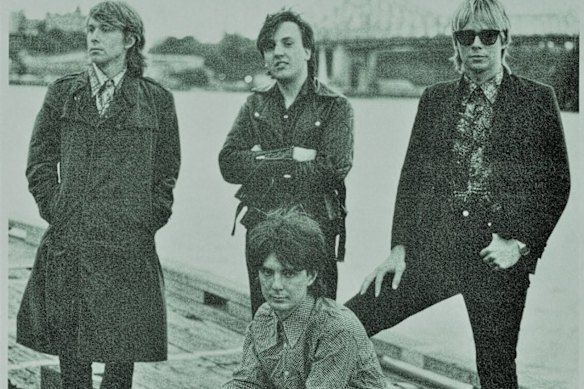

If anyone in Brisbane ever could be, the Atkinson boys, Darren and Greg, seemed destined to be rock stars.
They grew up in Oxley, streets away from both Ed Kuepper (the Saints) and Robert Vickers (the Go-Betweens), both of whom they knew from delivering them fruit for their parents’ greengrocery business.
Better still, their dad, Geoff Atkinson, was a popular DJ on 4BC and 4BK during the 1950s and ’60s, had a music TV show on QTQ9, Teen Beat, had interviewed the Beatles, and nurtured the boys’ love of music by bringing the latest records home from work.
At the end of the 1970s, with Darren on drums and Greg on bass and lead vocals, they put together a band called 42nd Street, moved to Sydney, and promptly and acrimoniously broke up.
But everything would change when they returned to Brisbane and (in 1983) formed the legendary guitar-pop band Ups and Downs with guitarists John Flade and Peter Shaw.
Two singles they released in Brisbane, Living Inside My Head and Perfect Crime, started a buzz down south, including a positive review in The Sydney Morning Herald, so they headed back to Sydney and were signed by Polygram sub-label True Tone Records.
“It was a great time for guitar bands,” Darren recalls.
“Back then, there were so many venues throughout Sydney suburbs, you could play at least three or four nights a week.
“The time was right for a group like us, so we had a lot of early success.”
Ups and Downs were part of the Paisley Underground – an indie rock movement inspired by 1960s psychedelia, but with a darker edge.
“We didn’t want to just be labelled as a ’60s copyist band,” Darren says, admitting, “we created part of that ourselves by wearing paisley shirts on stage”.
Their efforts culminated in their best-known single, The Living Kind: a jangle-pop ode to longing that skirted the lower reaches of the singles chart and got them an ARIA nomination for Best New Talent (Crowded House won that year).
So why did it all go wrong? Why aren’t Ups and Downs talked about in the same breath as another Brisbane guitar band of the era, the Go-Betweens?
First there was the handling of the band’s 1986 release Sleepless, the 40th anniversary of which they are celebrating with a national tour.
“We didn’t do a whole album,” says Darren. “It’s actually a mini-album which is, to this day, a bad marketing idea.”
With just seven tracks, Sleepless was all killer, no filler, and the band were told people would love it. “But it actually went against us, because we couldn’t get into the mainstream album charts. We sold lots on the independent front, but the sales weren’t recognised.”
With their management, they took the view True Tone were not supporting their commercial potential.
“We tried to extract ourselves from that [contract], and that meant we pretty much couldn’t record and didn’t play much,” Darren says.
Adding keyboard player Trevor O’Neill, Ups and Downs were able to sign to Mushroom Records two years later and finally release a full album, Underneath the Watchful Eye. But when the A&R rep who signed them was sacked, they found themselves the label’s unloved child.
Worse still, by the time they re-emerged, a new generation of guitar bands had stolen their thunder.
“I think the defining moment was a gig at Selena’s at the Coogee Bay Hotel. It had Ratcat, the Hummingbirds, Falling Joys and Caligula, all new bands, and we were down towards the bottom of the bill,” Darren says.
“We decided, well, things don’t last forever,” Greg says.
The brothers started a new band, Big Heavy Stuff, with a grungier sound, which found airplay on Triple J and supported Radiohead on their OK Computer Australian tour. After three deals with three different labels, they fizzled out in the new millennium.
Kristin Black, who DJs the weekly 4ZZZ show Heyday, says Ups and Downs were Brisbane’s answer to the Church.
“Sleepless, or Flawless as I have called it, is a brilliant mini album,” she says.
“Combining a moody instrumental opener, with chiming guitar tracks, an unlikely but brilliant Neil Diamond cover [Solitary Man] – it just works.
“There’s something about siblings singing in harmony, they do it best.”
To mark 40 years of Sleepless, Ups and Downs are reuniting to tour it.
They also have a new EP, Radio Is Dead, a fresh and evocative release showcasing the band’s ethereal guitar textures and otherworldly vocal harmonies.
With cover art depicting the Atkinsons’ dad in his radio prime, it’s their first new release since 2017 comeback album The Sky’s In Love With You.
“Greg’s voice doesn’t seem to have aged a day in 40 years,” Black says. “I’m thrilled there’s new Ups and Downs music in the world.”
Ups and Downs still boast their original line-up, with the addition of extra bassist Alex Ronayne.
“I don’t think we had any intention of ever getting back together,” Darren says. “But about 10 years later, someone wanted to put our song on a compilation album, and suddenly it’s ‘do you wanna do a show?’ and next thing we’re ‘maybe we could get back together’.
“It’s not just a nostalgia thing, you know,” Greg says. “For us, it’s reigniting that creative intensity that we had back then.”
“Unfortunately, being hungry for success – it comes with a really dark, competition side,” Darren says. “What’s beautiful about doing it now is there’s none of that, honestly.
“We felt lucky to still be able to do this and still enjoy it.”
Ups and Downs play the Crowbar Brisbane, Friday, October 2; Wallaby Hotel, Mudgeeraba, Saturday, October 3; Crowbar Sydney, Friday, October 9; and Hamilton Station Hotel, Newcastle, Saturday, October 10.
Get alerts on significant breaking news as it happens. Sign up for our Breaking News Alert.

From our partners
Disclaimer : This story is auto aggregated by a computer programme and has not been created or edited by DOWNTHENEWS. Publisher: www.smh.com.au