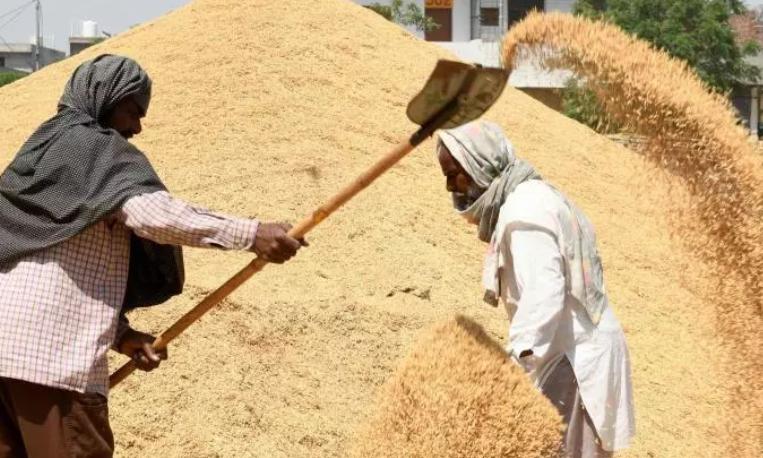
CHENNAI: Despite the prevailing El Nino conditions and the drought in most parts of Tamil Nadu, the government has aimed at marginally increasing food grain production, fixing it at 125 lakh metric tonnes, including 79 metric tonnes of paddy.
Most canals and tanks have gone bone dry due to lack of rains and soaring temperatures. But, only 35 per cent of the farmers in the state depend on canals and tanks, while the other 65 per cent get water from tube wells, borewells and open wells.
The net area irrigated by a total of 2,241 canals is 6.5 lakh hectares (21.66 per cent) and a total of about 41,123 tanks irrigate a total area of 3.98 lakh hectares (13.27 per cent). About 45.8 per cent of the farmers use 14,70,165 open wells for watering the crops in an area of 13.61 lakh hectares. A total of 3,76,944 tube wells and borewells account for irrigation of 5.85 lakh hectares, which is 19.51 per cent.
Though water could be taken from under the ground by digging hundreds of feet from open wells, tube wells and borewells, the groundwater table, too, goes down when water bodies turn dry and there is no rain for a long time. However, the government hopes to tide over the crisis through several programmes.
Tamil Nadu’s average food grain production is 112 lakh metric tonnes and a higher quantity of 121 lakh metric tonnes had been achieved in 2025-26. Under the action plan for 2026-27, the agriculture department has planned to cultivate rice, the staple food, in 20 lakh hectares to harvest 79 lakh metric tonnes by getting a productivity of 3,798 kg per hectare.
Tamils have been consuming rice from ancient days and the classical literature mentions several varieties such as white rice (vennel), red rice (sennel), hill rice (torai rice) and bamboo rice. The verses show the cultivation of rice mostly in the land of Marudham which is the land of fields. It also depicts the cultivation of rice in the hilly areas, named Kurinji, and the forest areas, termed Mullai.
Several verses show Tamil warriors taking rice mixed with meat and ghee (similar to modern-day biriyani) and kings offering the same food to the poets who visit them. Some of the poems show mothers running behind the children to make them eat rice mixed with milk and honey. The modifications of rice like puffed rice and rice flakes (aval) are also mentioned.
Paddy is also considered sacred since the poems in one of the classics, ‘Natrinai’, show worshipping of Lord Muruga by scattering paddy mixed with goat’s blood. Another classic, ‘Pathitrupathu’, describes a ceremony in which Chera kings offer rice to the ancestors of Tamils who were living in a land which was located in the southern direction from Tamil Nadu. (now Indian ocean). Even savant Thiruvallur refers to the ancestors of Tamils as ‘Thenpulathar’ (people who lived in the southern land).
Now, the agriculture department has divided the state into four zones, Kurunji zone, north zone, south zone and central zone, and planned to create advanced agricultural infrastructure in each zone based on their unique natural resource, requirements and relative advantages. The department also aims to avert the wastage of paddy in rains due to lack of storing facilities.
There are plans to establish modern storage structures in procurement centres to prevent crop losses to respect the hard work of farmers and to protect their yield. Besides, the agricultural department is working to convert rain-fed agricultural lands into fully irrigated lands. Projects have started for the rejuvenation of thousands of minor irrigation tanks which lost their capacity to store water due to lack of maintenance and growth of bushes, besides encroachment and pollution.
The natural nutrient cycling will be strengthened and the soil organic carbon content will also be improved to restore soil fertility. The microbial activity will be promoted and green manure crop seeds are being distributed for 1 lakh acres at a subsidised rate. Multi-grain seeds will be distributed to farmers for 22,000 acres at subsidised rate.
To facilitate the incorporation of green manure and multi-grain crops into the soil for natural nutrient enrichment, ploughing subsidy will also be provided. The department had allocated Rs. 63.5 crore for the implementation of this scheme.
Paddy cultivation plays a vital role not only in ensuring food security but also in improving the livelihood and employment opportunities of the rural farming community. Paddy is cultivated during three cropping seasons: kar or kuruvai from April to July, samba from August to November and navarai from December to March.
To attain the target of 79 lakh metric tonnes of paddy in an area of 20 lakh hectares in the 2026–27, the government is carrying out demonstrations on high-yielding paddy varieties, besides relying on system of rice intensification (SRI) method of cultivation, machine planting and direct seeded rice (DSR) technologies.
Under the National Food Security and Nutrition Mission (NFSNM) for 2026-27, rice will be cultivated in 11 districts, including Pudukkottai, Tiruvarur, Nagapattinam, Mayiladuthurai, Ramanathapuram, Sivagangai, Thanjavur, Tiruvannamalai, Cuddalore, Thoothukudi and Virudhunagar.
The government will also boost rice production through interventions such as cluster demonstrations on direct seeded rice, flood- and drought-tolerant and bio-fortified rice varieties. The agriculture department will also implement cropping system-based demonstrations, distribution of paddy micronutrient mixture, liquid bio-fertilisers, plant protection chemicals and green manure seeds besides bio-control agents benefiting 53,666 farmers.
Farmers will also be encouraged to conserve and revive the traditional paddy varieties of the state by setting up seed farms for which seed production incentive will be provided for 110 metric tonnes. The government is also distributing 150 MT of traditional paddy seeds at 50 per cent subsidised rate.
Disclaimer : This story is auto aggregated by a computer programme and has not been created or edited by DOWNTHENEWS. Publisher: deccanchronicle.com