Seven-year-olds usually leave notes about homework, favourite cartoons or weekend plans.
Jayshree Vijay Mohan’s daughter was writing something else. “Amma, I’m crossing my fingers that you reach the top and come back safely.”
The note was waiting for Jayshree as she prepared for one of the biggest challenges of her life: climbing Mount Kilimanjaro, Africa’s highest peak.
Her daughter knew her mother was attempting something difficult. What she did not fully understand was everything that had led to that moment: the stroke that had paralysed the left side of her mother’s body, the months spent relearning movements most people never think twice about, the endless therapy sessions, the falls, the exhaustion and the uncertainty.
For Jayshree, the mountain was never simply a mountain.
It was a question she had been asking herself since October 2021: What happens when life changes in an instant? Do you accept the limits placed before you, or do you discover new possibilities beyond them?
A few years later, the Chennai-based entrepreneur, mother of two and stroke survivor would answer that question by setting two Guinness World Records on Mount Kilimanjaro. Long before the world saw the summit photographs, however, two young daughters were watching a different kind of climb unfold at home, one measured in therapy sessions, falls, exhaustion and the decision to try again.
That was the climb her daughters had been watching all along.
Before the records, she was ‘a mom of two’
Ask Jayshree to introduce herself, and she does not begin with the records.
“Yes, I’m currently a Guinness World Record holder,” she says with a laugh. “But otherwise, I’m an entrepreneur and a mom of two.”
The mountaineering came later. The world records came later. Before the stroke, Jayashree’s life looked much like it does for countless women juggling multiple roles.
Based in Chennai, Jayshree was building her career in the financial advisory space while raising two daughters with her husband and family. Days moved between work commitments, school schedules, family responsibilities and future plans.
In October 2021, Jayshree was on a family road trip from Trichy to Chennai when she noticed the left side of her body going numb. She called a doctor, who warned that she could be having a stroke. With no hospital nearby on the highway, she reached one only later that night.
“Everything for me changed in just one road trip,” she recalls. “It was like there was a version before and a version after. Though I believe this is a better version of me, there is a day-and-night difference between who I was then and who I am now.”
The stroke left the left side of her body paralysed. Things she had done without thinking now took effort and concentration.
But the physical changes were only one part of what she was dealing with. She also had to come to terms with a version of herself she did not recognise yet.
“The first war I had to fight was accepting myself,” she says. “Everything else was visible to the world. But what was happening inside me was the real battle.”
Learning to trust her body again
For Jayshree’s mother, Uma Vijaymohan, watching her daughter navigate those early days remains one of the most difficult periods of her life.
“As a mother, there is nothing more painful than seeing your child suffer,” she says. “One day, she was managing her career, home and children effortlessly, and the next, she was struggling with things that we all take for granted.”
Like many families navigating a medical crisis, they found themselves celebrating milestones they had never imagined would become significant.
“The biggest challenge was balancing hope with reality,” says Uma. “Recovery from a stroke is not a straight path. Some days showed progress while others felt like setbacks. We had to learn patience and celebrate the smallest victories.”
/filters:format(webp)/english-betterindia/media/media_files/2026/09/24/mount-kilimanjaro-2026-09-24-18-01-04.png)
Those victories often began with the most basic movements. When physiotherapist Dr Naresh S first met Jayshree, their conversations revolved around rebuilding the foundations of daily life
“We were dealing with something much more basic: getting her body and brain to trust each other again,” he says.
Recovery, he explains, is often misunderstood. “What people don’t understand about stroke recovery is that visible weakness is only one part of the problem. The invisible fatigue is often much harder. Even simple exercises could completely drain her.”
There was also the frustration of knowing what she wanted her body to do and finding that it could not always cooperate.
“That gap between intention and ability can break people from the inside,” says Dr Naresh. “It is emotionally exhausting.”
Through the frustration and fatigue, Dr Naresh noticed one pattern.
“She would get frustrated. She would get upset. But she always came back ready to try again.”
Two Tamil words became her way forward
During recovery, Jayshree found herself returning to two simple Tamil words: Avolo daan (that’s it).
At a time when so much of her life had changed without warning, the phrase helped her stop circling around what had already happened. She could not undo the stroke. But she could decide what to do next.
For Jayshree, Avolo daan slowly became a way of moving through recovery: accept what had happened, and take the next step from there.
“Whatever has happened has happened. I cannot reset it. I cannot redo it. So, I told myself to think about the journey ahead?” she says.
For Jayshree, acceptance meant refusing to spend her energy wishing for a different reality.
/filters:format(webp)/english-betterindia/media/media_files/2026/09/24/mount-kilimanjaro-2026-09-24-17-58-11.png)
“The first thing stopping me from moving forward was my own acceptance,” she says. “Once I accepted myself and took that first step, everything else became easier.”
Dr Naresh noticed that difference almost immediately.
“Most patients ask, ‘Will I get back to where I was?'” he says. “Jayshree’s questions were different. She wanted to know where she could go from here. What more could she do?”
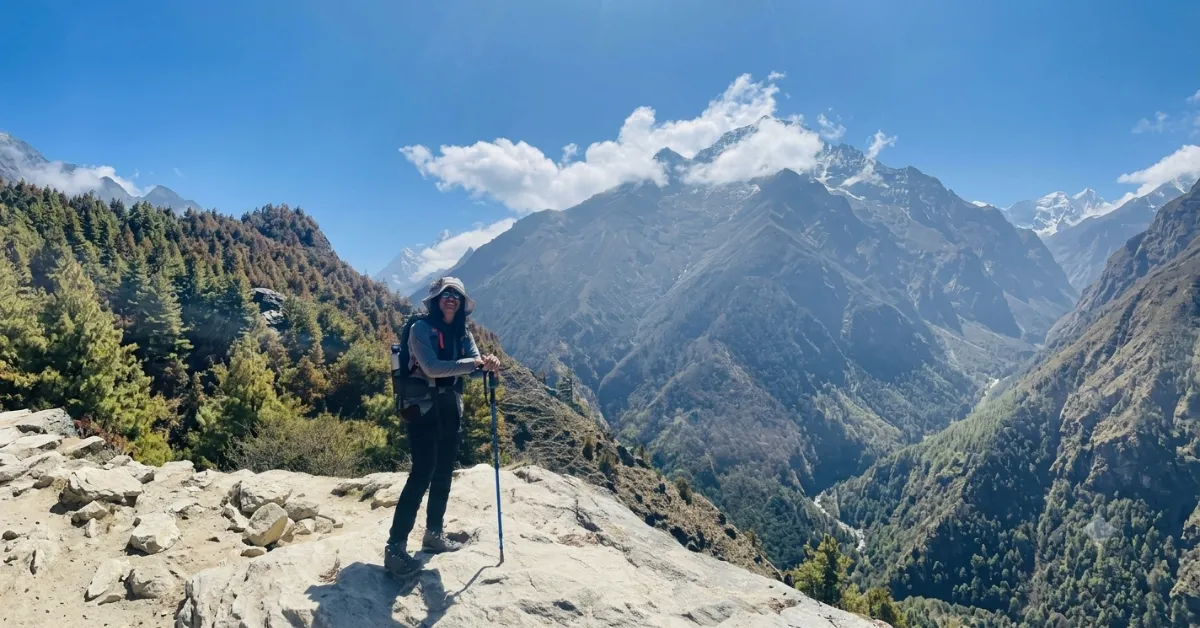
She started testing that question in small ways, then bigger ones. Eventually, it took her somewhere she had never imagined herself going, especially as someone who had always been afraid of heights: into the mountains.
‘I combined my strength with my fear’
Long before she became a mountaineer, Jayshree loved walking. “Walking was always like my therapy. I used to walk 10 or 12 kilometres effortlessly.”
After the stroke, even that became difficult. Balance issues and physical limitations challenged something she once loved.
She had also feared heights for years.
So when she began asking herself what challenge she wanted to attempt, an idea emerged.
/filters:format(webp)/english-betterindia/media/media_files/2026/09/24/mount-kilimanjaro-2026-09-24-18-02-53.png)
“I combined my strength with my fear. That is how mountaineering entered my life.”
She had never gone on a trek before. Her first major expedition was an attempt to reach Everest Base Camp, undertaken just a year and a half after her stroke.
It was far from smooth.
“There were places where I could not breathe properly. There were falls, fatigue and moments where I wondered how I would continue,” she recalls.
But the experience taught her something invaluable. “I was testing my limits,” she says. “My mind carried me further than my body could.”
That experience planted a seed that would eventually lead her to Kilimanjaro.
Stairs, inclines, injuries
When Jayshree decided to climb Mount Kilimanjaro, the people closest to her did not immediately share her confidence.
“My first reaction was worry,” says her mother. “Altitude works against her condition and cold weather restricts blood flow. Any mother would worry.”
Dr Naresh had similar concerns. “When she first told me she wanted to climb Kilimanjaro, I thought it was too ambitious,” he admits. “But then I understood that the mountain itself was not the biggest challenge. The challenge was finding herself.”
So before Jayshree could think about the summit, she had to prepare her body for everything the climb would ask of it.
“We worked on endurance, stairs, inclines, balance and recovery after exertion,” says Dr Naresh. “Everything became about building capacity.”
That preparation soon began taking up a large part of her everyday life. Almost four hours a day went into training, while the rest had to be fitted around work, recovery and raising two daughters. “The children could not see me much. Even when I was home, I was often exhausted or recovering from an injury.”
Then, just weeks before the climb, she suffered a significant fall and injured her shin.
“She was limping while coming down stairs,” recalls Dr Naresh. “We suggested pushing the climb to the following year. But she was determined to do it during Stroke Awareness Month.”
/filters:format(webp)/english-betterindia/media/media_files/2026/09/24/mount-kilimanjaro-2026-09-24-18-05-04.png)
The decision to continue meant the family had to adjust too. Her husband and family stepped in where needed, helping keep things running for her daughters, aged seven and ten, while Jayshree trained and recovered.
“Recovery is never an individual journey,” says Uma. “It becomes a family journey.”
By then, the Kilimanjaro goal had already become something the whole family was living with, long before Jayshree set foot on the mountain.
‘Amma, you can do this’
Throughout training, her daughters became two of her biggest supporters.
“Every other day they would make small notes for me,” says Jayshree. “They would write things like, ‘Amma, you can do this’ or ‘Amma, you are my inspiration.’ That would fuel me for the next 10 days.”
One note remains particularly memorable. Before the climb, her daughter wrote: “Amma, I am crossing my fingers that you summit and come back safely.”
Jayshree never told her children she was attempting a world record. They already worried about her enough.
“They were mentally going through much more than I realised.”
For Uma, seeing the impact on her grandchildren has been one of the most rewarding parts of the journey.
“My proudest moment was hearing them tell their friends that success is not straight and not the same for everyone,” she says. “That lesson cannot be taught in a classroom.”
Uma says the girls were absorbing what they saw at home. “They watched their mother never take ‘no’ for an answer.”
Jayshree sees the same lesson reflected in everyday conversations.
“Today my daughter tells her younger sister that success is not about achieving your goals. It is about how much effort you put into getting there,” she says. “That is not something she read in a book.”
The finish line was only part of the story
There was a reason Jayshree had chosen Kilimanjaro in particular.
“It is a freestanding mountain,” she says. “Most mountains are part of ranges. Kilimanjaro stands alone. It is also a dormant volcano with so much power inside it. I could relate to that.”
The idea of pursuing a Guinness World Record emerged only a few months before the climb.
/filters:format(webp)/english-betterindia/media/media_files/2026/09/24/mount-kilimanjaro-2026-09-24-18-05-54.png)
Even then, she viewed the achievement differently from most athletes.
“In my application, I wrote that I wanted this record to be broken immediately,” she says. “The day another stroke survivor breaks my record will be my real summit moment.”
In September 2025, four years after her stroke, Jayshree took on Mount Kilimanjaro. She completed the ascent in five days, six hours and 50 minutes, and the descent in 10 hours and 26 minutes.
Guinness World Records recognised both achievements in the CIH (Coordination Impairment–Hemiplegia) female category: the fastest ascent and the fastest descent of Mount Kilimanjaro.
For Dr Naresh, however, those numbers captured only the final stretch of a climb he had watched unfold over months.
“People see the summit photo,” says Dr Naresh. “But I got to see all the days that came before it. Every exercise. Every walk. Every frustrating day. Every injury. That is where Kilimanjaro was actually climbed.”
Today, Jayshree hopes her story encourages others to rethink recovery, motherhood and possibility.
“In life, all of us have our own mountains,” she says. “If I could climb mine, I believe everyone can climb theirs too.”
Her daughter had asked her to reach the top and come back safely. Jayshree did both. But by the time she returned home, her daughters had seen something no world record could capture: they saw their mother fall, recover, begin again, and keep going.
All images courtesy of Jayshree Mohan
Disclaimer : This story is auto aggregated by a computer programme and has not been created or edited by DOWNTHENEWS. Publisher: thebetterindia.com