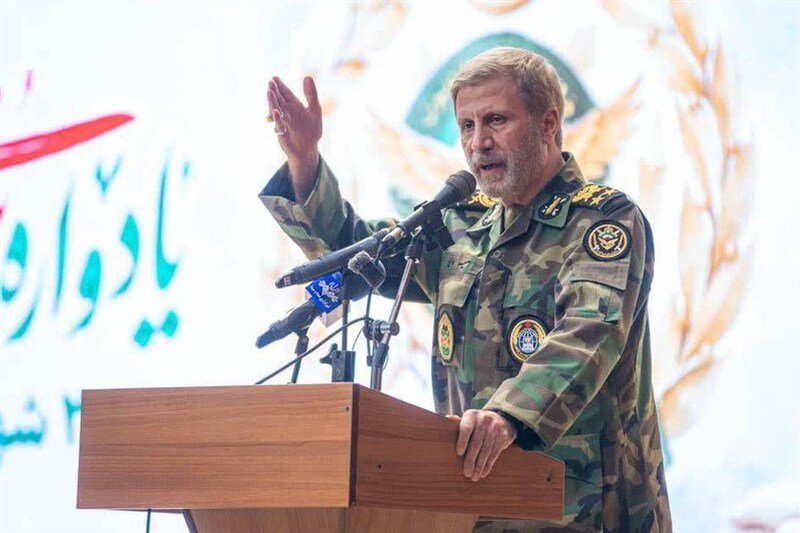
TEHRAN — Commander-in-Chief of the Iranian Army Major General Amir Hatami said on Sunday that lasting security in West Asia requires an end to the military and political presence of the United States and Israel, stressing that collective regional stability can only be built from within rather than dictated by extra-regional powers.
“Security in the region will not be achieved without eliminating the US presence and driving the US and the Zionist regime out of the region, and this is not far off,” Major General Hatami stated during an address in the Iranian capital.
Addressing neighboring states and broader regional governments directly, the top commander underscored the counterproductive nature of relying on foreign militaries for defense and stability.
“I ask all neighbors and regional nations, as an Iranian soldier, to pay close attention to this matter: you have seen that alignment and cooperation with the United States does not produce security. The genuine security of this region is generated from within the region and rests solely in the hands of regional countries themselves, and this reality will undoubtedly come to pass,” Hatami noted.
Reaffirming the Islamic Republic’s strategic stance against foreign coercion, the commander emphasized that the era of Western hegemony across strategic regional corridors has ended.
“Iran is not a place for their excessive ambitions and arrogance,” General Hatami warned. “We have reiterated time and again that if this region is forced into instability, such insecurity will envelop everyone. It is unacceptable that we—who have inhabited this region for centuries and are its rightful proprietors—should be deprived of its resources and strategic advantages, while foreign actors travel from across oceans to exploit everything for themselves. Such imperialist dreams will never materialize.”
Turning specifically to vital maritime arteries and global shipping lanes, the army chief highlighted the country’s sovereign resolve to safeguard its core economic lifelines against unilateral sanctions and maritime interdiction.
“If Iran cannot engage in trade, and if the Iranian people cannot lead a normal life, then no party will be permitted to trade or live in peace in this region,” he stated. “The Strait of Hormuz is our choke point of dignity, sovereignty, and honor. We will never permit the nation’s adversaries to reap the strategic dividends of this pivotal logistical bottleneck while the Iranian nation remains arbitrarily deprived of its rights.”
Reflecting on the joint US-Israeli war against Iran, which was launched on February 28, General Hatami said despite the scale of aggression, the adversary’s calculations have failed completely.
“The aggressor enemy has sustained devastating and painful blows; nevertheless, our dedicated soldiers across all branches of the Iranian armed forces stand fully primed and ready to deliver even heavier retaliatory strikes if provoked,” he declared.
The commander-in-chief observed that the rhetoric currently emerging from Western capitals reflects a collapsing international standing and an acute sense of battlefield paralysis.
“The adversary’s global prestige and strategic credibility are teetering on the brink of total annihilation,” Hatami remarked. “The shrill outcries and frantic rhetoric they are currently broadcasting stem precisely from the collapse of that manufactured aura of invincibility. They find themselves ensnared in chronic confusion and utter helplessness, having no strategic answer for a cohesive nation of ninety million people who universally view themselves as soldiers defending their homeland.”
The army chief further characterized anti-Iran positions of President Donald Trump as deceptive psychological warfare designed to fracture national cohesion.
“It is for this exact reason that the American president declared some months ago that ‘help is on the way for the Iranian people.’ Yet, the entire world witnessed the reality of their so-called help in the form of brutal aggression,” Hatami continued. “Today, thoroughly trapped in the quagmire of their own disastrous misadventures, he resorts to rhetoric that mirrors his own administration’s conduct, slandering the dignified Iranian nation with accusations of terrorism.”
Hatami characterized such statements as symptomatic of profound strategic bankruptcy in Washington after meeting fierce domestic and regional resistance.
“These vile proclamations are born out of sheer desperation and the stinging rebuke they have received directly from the Iranian populace,” he stated. “With absolute shamelessness, they openly declare their intent to apply maximum pressure on our society to instigate riots. And when asked to what end, they respond: to incite a civil war. And when asked why a civil war, they bluntly admit: to seize dominion over Iran across a carpet woven from Iranian blood.”
The army chief delivered his remarks during a major commemoration ceremony held in Tehran honoring the memory of the late Chief of Staff of the Iranian Armed Forces, Major General Mohammad Abdolrahim Mousavi.
Major General Mousavi was assassinated alongside Ayatollah Seyyed Ali Khamenei, the Leader of the Islamic Revolution; Major General Mohammad Pakpour, commander-in-chief of the Islamic Revolution Guard Corps (IRGC); Major General Aziz Nasirzadeh, minister of defense and armed forces logistics; and Ali Shamkhani, senior adviser to the Leader and secretary of the Defense Council, on the first day of the US and Israel aggression on February 28.
The targeted decapitation strike—which struck at the core of Iran’s military, security, and civilian leadership apparatus—has fundamentally reshaped the geopolitical landscape of West Asia. Rather than fracturing Iran’s defensive doctrine, the martyrdom of the country’s paramount political and operational leaders has catalyzed a unified command realignment.
In military academies, diplomatic circuits, and policy institutions across the Global South, the legacy of the fallen commanders is increasingly framed not merely as a tragedy, but as an inflection point that ended the post-Cold War presumption of Western military impunity in the Persian Gulf. Defense analysts note that by targeting the leadership echelon directly, the US–Israeli axis has eliminated any remaining avenues for diplomatic containment, transforming Iran’s doctrine and asymmetric defense mechanisms into an active, comprehensive campaign designed to systematically dismantle Washington’s forward operating bases, naval deployments, and allied installations throughout the region.
Disclaimer : This story is auto aggregated by a computer programme and has not been created or edited by DOWNTHENEWS. Publisher: tehrantimes.com