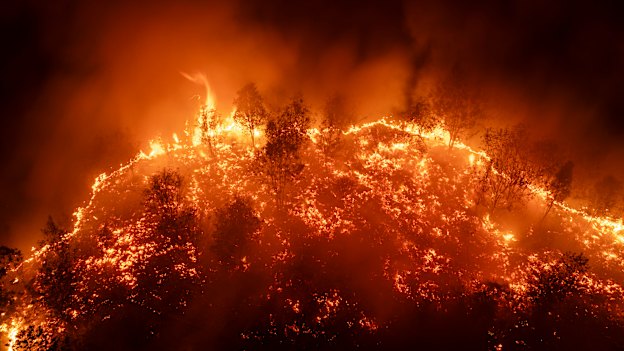
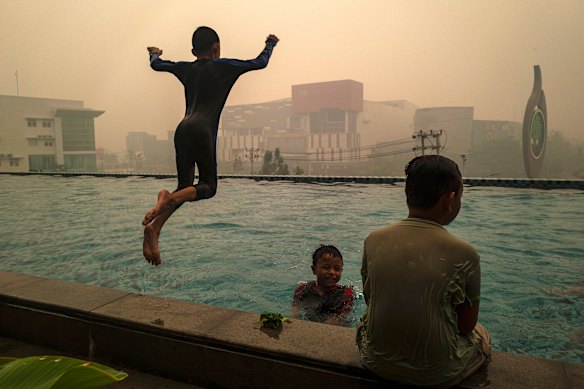
For months, millions of people have been living under a stifling blanket of toxic haze, fuelled by a punishing drought brought on by the El Nino weather pattern.
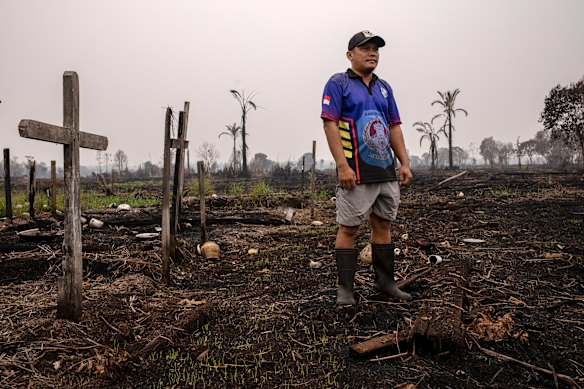
Pontianak, Indonesia: Staring out at the charred cemetery about 30 metres behind his house in Indonesian Borneo, Trovimus Akoi told of the sleepless Sunday night he spent battling an inferno far too close to home.
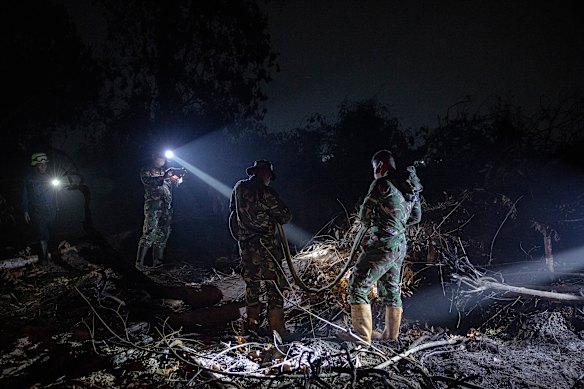
He first spotted the wildfire about half a mile away while feeding his chickens. Within hours, the fire tore across the parched terrain at terrifying speed. As the blaze closed in on his community, he and his neighbours armed themselves with hoses, buckets and hand pumps and started a desperate fight to save their homes. With the canals and ponds completely dried up by a drought, they dug three-metre-deep holes into the earth in search of groundwater.
“The flames were about 10 metres high, and all we could see was red,” Akoi told me when I visited him last week, pointing to the goosebumps rising on his arms. “The smoke was so thick and wind was so strong. Our lungs hurt, our eyes burned, but we had to keep going.”
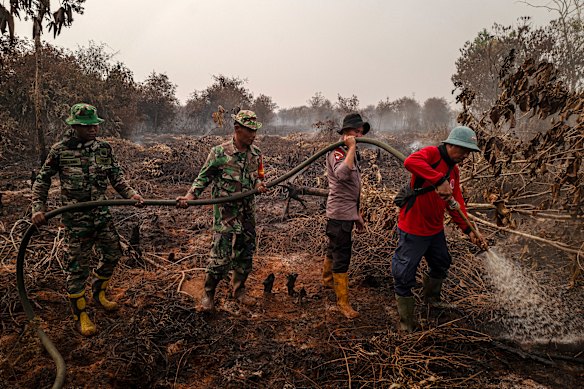
Although they eventually received help and saved their homes, what Akoi, 38, and his neighbours battled in late August was more than a natural disaster – it was also a human-made calamity produced by years of deliberate land clearing for cash crops, including timber and palm oil.
He lives in Kubu Raya regency in West Kalimantan province, which contains millions of acres of peatlands, a kind of wetland. Across Indonesia – which shares the island of Borneo with Malaysia and Brunei – the conversion of these bogs into farmland has dried them out and transformed them into tinderboxes. So far this year, wildfires have incinerated tens of thousands of acres in this province alone, fuelled by an unforgiving drought brought by a powerful El Nino climate shift.
In Pontianak, the provincial capital, Tresna Waniati, a 33-year-old volunteer firefighter, was ready for her next deployment despite having just been discharged from the hospital for a severe respiratory infection. For the past three months, she had been inhaling carbon-choked air while battling the wildfires, leaving her four-year-old son at home with her parents. To reach the remote fire hotspots, she navigated rugged terrain on her motorcycle, which was weighed down by water pumps, cans of fuel and rolls of hoses.
“The fires and the smoke are extraordinary this time,” Tresna said. “Scarcity of water makes it harder. Of course, we are all exhausted, but we have to do it.”
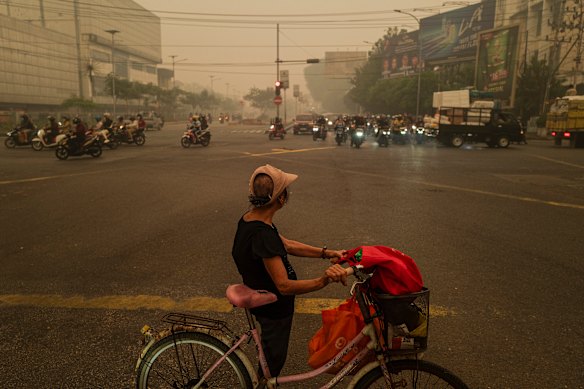
Millions of people across West Kalimantan have been living for months beneath this stifling blanket of haze. Air quality has repeatedly hit hazardous levels, forcing authorities to extend a state of emergency. Hundreds of schools have suspended in-person classes while reduced visibility – to a few hundred metres – has brought regional transport to a crawl. Some residents wear face masks, but many said they were fed up with them.
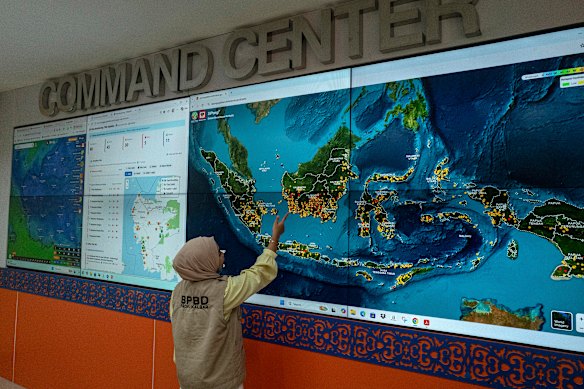
Forest fires occur annually in Indonesia, but this year’s devastation could be among the worst on record. Government figures show that about half a million acres burned through July, but the independent platform Nusantara Atlas said the toll through August was 2.2 million acres.
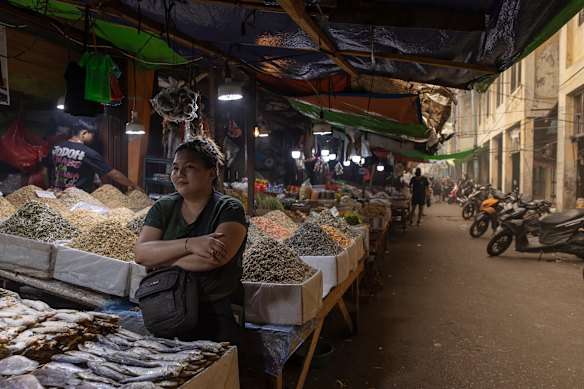
The normally bustling market alleys in Pontianak appeared emptier than usual this month, their sounds muffled by the heavy air. Elisabet, 31, was arranging her dried fish containers, wiping away a fine dusting of soot that had settled on the display trays. A few hurried shoppers moved briskly, eager to grab staples before retreating indoors to escape the amber haze that blanketed the city and turned afternoon skies into a murky twilight. Since the haze took hold of the city around late June, she said, her daily sales had dropped by nearly half.
“I know breathing in this toxic air is bad for my health, but I cannot afford to stay home,” said Elisabet, who, like many Indonesians, goes by one name. “I’m just hoping for a few sales, so my goods don’t go to waste.”
The Centre of Economic and Law Studies, an Indonesian think tank, estimates that the country’s wildfires from January to August could inflict up to 123.1 trillion rupiah ($9.7 billion) in economic and healthcare costs, a figure expected to climb if the burning continues through the end of the year.
The human toll is also severe. More than 13 million people across seven provinces have been exposed to toxic smoke. According to the Health Ministry, the number of people suffering respiratory infections in these regions more than doubled over one week in September, as the number of hot spots soared. Between August 18 and September 21, health officials recorded nearly 175,000 cases. About a quarter of these were children under five years old.
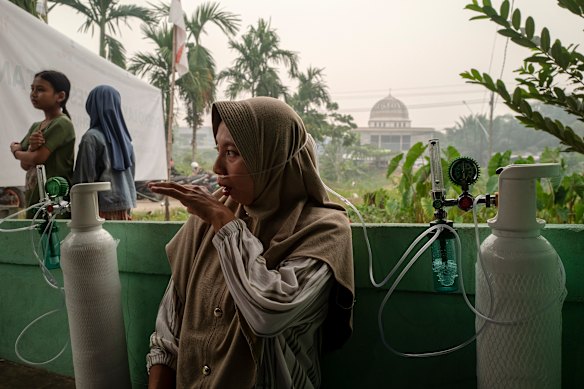
The Muhammadiyah Disaster Management Centre, a non-profit, has set up 13 “Oxygen Houses” where the public can get medical care and oxygen therapy for respiratory distress caused by smoke inhalation. In addition, two mobile units provide oxygen to people in fire zones who are unable to leave or could not afford to evacuate.
“Our volunteers deliver oxygen tanks to the vulnerable or too ill people in the impacted zones,” said Hermayani Putera, the centre’s co-ordinator. “The Oxygen Houses serve as a refuge, clean-air sanctuary – a break from the polluted smoke.”
With the haze spreading to neighbouring Singapore, Malaysia and the Philippines, Indonesia’s President, Prabowo Subianto, has accepted international assistance from Japan and Malaysia to tackle the fires. He has also ordered a major crackdown on commercial “slash-and-burn” agriculture, in which companies clear forests and burn the fallen trees to make way for new fields.
So far, the Forestry Ministry has suspended the permits of 26 companies that have cut forests to grow cash crops. Authorities are investigating multiple companies on possible criminal charges, warning that they could permanently lose their permits and face massive fines, among other punishments.
However, environmental groups argue that these measures offer little relief to hard-hit regions like West Kalimantan, where policy enforcement has been lax despite previous moratoriums on forest clearing and mandates to protect and restore peatland.
“Many of the fires occurred in peat ecosystems where companies with permits operate,” said Indra Syahnanda, head of advocacy and campaigns at WALHI West Kalimantan, a conservation group. “It is the government’s job to ensure these companies comply with the rules and regulations. Having it on paper does not mean they are applied in the field.”
Instead of going after companies pursuing cash crops, conservationists say the Indonesian government often blames Indigenous communities, which have traditionally practised slash-and-burn farming methods, for igniting blazes. Members of the Indigenous Dayak communities say that their methods of clearing small plots of land and building firebreaks have served them well for generations. Crucially, they add, they never clear out flammable peatland.
“It hurts to be accused and made into scapegoats when we strictly adhere to our local wisdom,” said Akoi, who is Dayak.
But the suffering from the fires is universal. Many in the community are experiencing chronic coughing fits and shortness of breath.
“We miss breathing in fresh air and seeing clear sky,” Akoi said. “All we can do is place our hope in God and our ancestors.”
This article originally appeared in The New York Times.
Get a note directly from our foreign correspondents on what’s making headlines around the world. Sign up for our weekly What in the World newsletter.
Disclaimer : This story is auto aggregated by a computer programme and has not been created or edited by DOWNTHENEWS. Publisher: www.smh.com.au