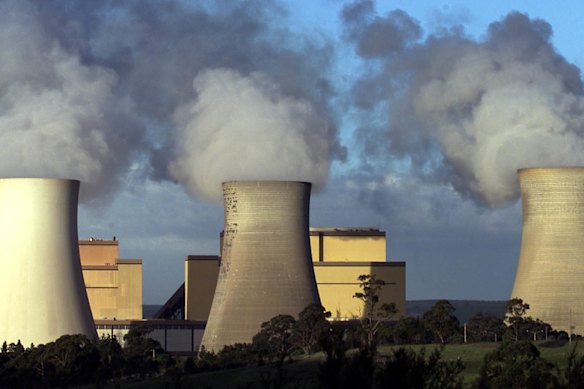

A new fight has erupted over the future of Australia’s remaining coal-fired power stations, as renewable energy leaders push for expanded federal pollution laws to prevent fossil fuel generators from delaying their closures.
While coal still supplies about half of eastern Australia’s electricity, its years left powering the grid are numbered. More than half of all remaining coal-fired generators are scheduled to close by 2035 as they near the end of their usable lives, facing soaring maintenance bills and declining reliability.
However, a recent decision to extend the operation of Origin Energy’s massive Eraring power station in NSW by another two years – pushing its closure out to 2029 – has intensified concerns that more plants may end up running past their promised exit dates. Eraring’s extension was approved amid concerns from energy officials and the state government that the grid was underprepared for its exit without raising the risk of blackouts or price rises.
In submissions to the Albanese government, conservation and clean energy advocates warn shifting coal closure timelines could complicate large-scale investment decisions in renewables and batteries at a critical time. They are calling for coal and gas plants to be brought into the federal government’s flagship emissions-reduction policy, the “safeguard mechanism” scheme, which requires the nation’s 215 biggest industrial polluters to cut their carbon footprint or offset their emissions by purchasing carbon offsets.
Advocacy groups including the Climate Council argue that applying the scheme to coal-fired power stations for each year beyond their current retirement dates would strengthen incentives for operators to adhere to their announced timelines because it would force them to pay for their emissions if they stay open.
“Unclear closure timing creates uncertainty about future wholesale prices, which undermines renewable project business cases and lowers renewable investment, leaving projected capacity shortfalls that are then cited to justify coal extensions,” the Climate Council said in a submission.
“The safeguard mechanism can play a role in breaking this cycle.”
Currently, grid-connected power generators do not face the same emissions reduction caps as other industrial emitters, as the government pursues different strategies to decarbonise the electricity sector. Energy Minister Chris Bowen launched a review of the safeguard mechanism this year to ensure it remained fit for purpose beyond 2030.
However, the major utilities that own the power stations have issued stark warnings against the proposal. The Australian Energy Council, representing coal plant owners including EnergyAustralia, Origin and AGL, said those advocating for the change failed to recognise the vital system-stability function that coal and gas power stations still provided, particularly amid concerns that the buildout of renewable energy, storage and transmission lines is running behind schedule.
“In these circumstances, thermal assets could not be retired from the system without significant reliability impacts, and inclusion in the safeguard would merely result in higher prices without achieving the desired emissions reductions,” Australian Energy Council policy manager Rhys Thomas said.
The optimal approach to ensure the timely exit of retiring coal plants was “multifaceted”, he added, and including them in the safeguard mechanism in instances where some needed to stay open would push higher electricity costs onto consumers, worsening cost-of-living strain without achieving emissions reductions.
Instead, said Thomas, governments should do more to facilitate the timely exit of coal by encouraging “predictable and durable” market signals, support the rollout of more fast-start gas-fired power stations to plug renewable supply gaps, and enough infrastructure to maintain adequate “system security”, including inertia, to ensure the grid can withstand sudden disturbances and ride through shifts in frequency.
Experts from the independent Grattan Institute last year calculated that Australia would struggle to meet its current emissions-reduction targets without a constraint on electricity sector emissions, and expanding the safeguard mechanism to coal plants “could solve this problem” without a significant jump in household energy bills. The think tank’s Bills down, emissions down report found that the $5800 the average household spends each year on gas, electricity and petrol could be cut to less than $2900 in today’s money by 2050, driven by the fall in petrol costs as people switch to electric vehicles, as well as the growing uptake of solar panels and batteries and the ongoing shift from gas stoves and water heaters to electric.
Expanding the safeguard mechanism to coal plants may increase the price of electricity from 2030 to 2035, but it would ultimately amount to just $100 a year extra to a household’s overall energy costs by 2050 compared to a scenario without it, the report said.
The Business Briefing newsletter delivers major stories, exclusive coverage and expert opinion. Sign up to get it every weekday morning.
 Nick Toscano is a business reporter for The Age and Sydney Morning Herald.Connect via X or email.
From our partners
Disclaimer : This story is auto aggregated by a computer programme and has not been created or edited by DOWNTHENEWS. Publisher: www.smh.com.au