On Sunday, the American team did what American teams always do when playing for cups of every size and shape, be it your Curtis Cup or Walker Cup, your Presidents Cup, your Solheim Cup, your Ryder Cup. Not always always, but pretty much always. Win or lose, when American golfers are playing their own ball in an 18-hole mano-a-mano match, they outplay their opponents.
In 1999, at the Ryder Cup at the Country Club near Boston, the Americans pulled out an unlikely victory with an 8.5-3.5 shellacking in the third and final act. Last year, at the Ryder Cup at Bethpage near New York, the Americans won another 8.5 points on Sunday, though that time it wasn’t enough to snatch victory from the mouth of defeat. On Sunday at Medinah at the Presidents Cup, the Americans won 9.5 points and the Internationals only 2.5 in a 17-13 American win.
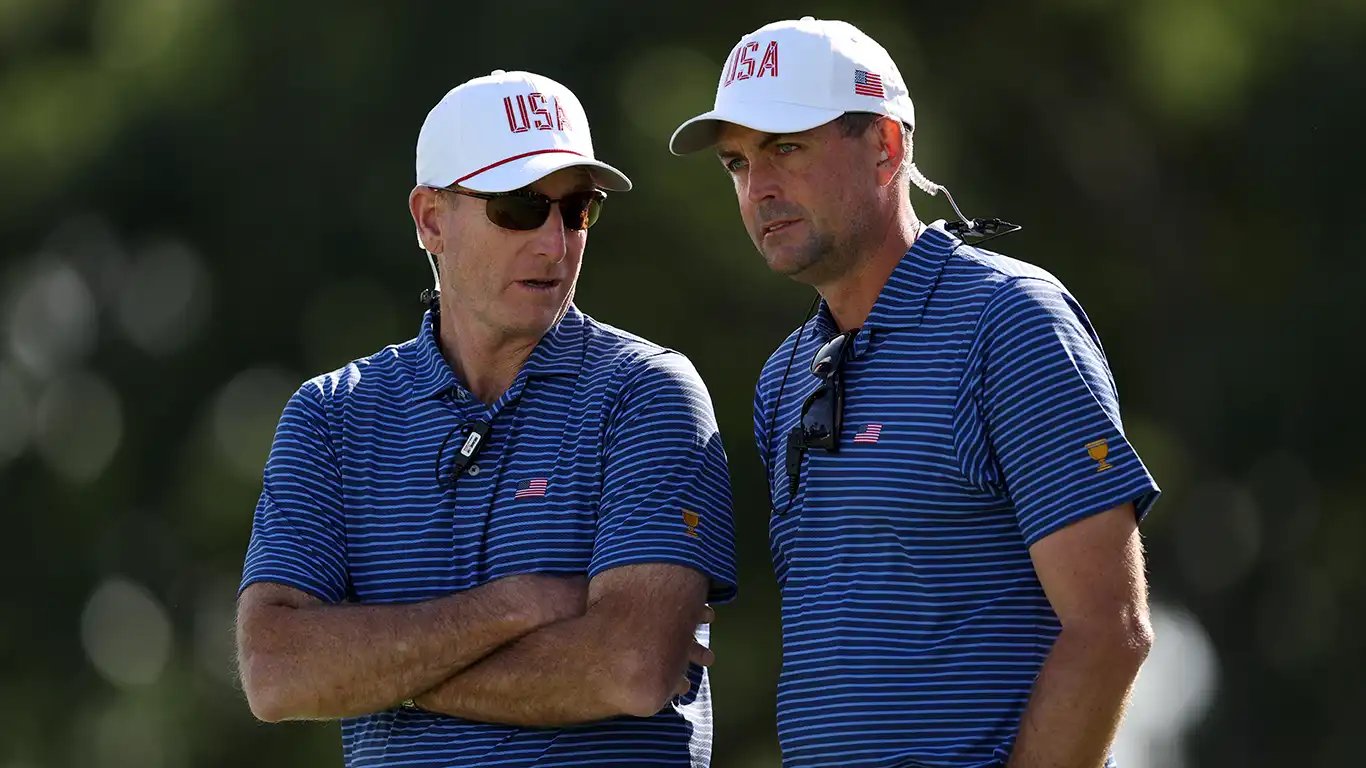
People who were there said it felt like a Ryder Cup. Watching from home, as your correspondent did, it felt like a Ryder Cup. Chanting fans, spilling into boorishness. The usual body-language questions: This good? Justin Thomas with a hand to his ear, asking for more crowd noise. Captains and assistant captains riding in carts, devices in their ears. Donald Trump on the first tee, as he was last year at Bethpage, this year in a white USA hat embroidered with a 45 and a 47.
The great Medinah No. 3 course itself, where the 2012 Ryder Cup was played, when the Americans lost after a rare and lousy singles showing. The parade of ads for American products (Lincoln cars, Pfizer pharmaceuticals, MassMutual investment products) backed by iconic American Top-40 hits (“Waterfalls,” “Just What I Needed,” “Freebird”). Jim “Bones” Mackay, keeping it real while marching fairways, NBC Sports mic in hand, identifying shots so challenging one was described as a “layup pitch shot.” You don’t hear that, week in and week out on the PGA Tour.
And that’s really the redeeming and amazing thing about any of these team competitions with a cup and bragging rights at stake: They are a world apart from the weekly 72-hole stroke play we know so well on the PGA Tour.
And therein lies the issue and the challenge that Jim Furyk will face next year at Adare Manor in Ireland at the Ryder Cup. He’s getting a second crack at the American captaincy — he captained the listing ship that was the U.S. team at the 2019 Ryder Cup in France. He was one of Brandt Snedeker’s assistants at Medinah this year. The Americans have not won a Ryder Cup in Europe since 1993.
So what can Furyk take from this year’s tune-up (yes, of course — it’s way more than that)? For years, being on a Ryder Cup was viewed more as an honor and a reward than a calculation and a bet. Furyk, as a player, came up on the former. Snedeker did one bold and questionable thing, in making his captain’s picks: He took a kid and a rookie, Jackson Koivun, over a wily veteran and a U.S. Open winner, J.J. Spaun. Spaun had to be hurt. Snedeker’s call to him was short and, per Spaun, blunt. Koivun went 2-0-1. Could Spaun have done more? We’ll never know. Koivun is off and running. Next year, Furyk will be in a place where he has to make a similarly bold choice. And all the while, Furyk has to make sure he’s not being bold for the sake of being bold.
Was Snedeker’s semi-shocking decision to bench Scottie Scheffler on Saturday afternoon ridiculous, bold, brilliant? Maybe all three, in the end. Scheffler was tanned, rested and ready for his Sunday singles match, and he won it handily on the day the U.S. would need the momentum of the event could change from one swing to the next. Furyk surely noted that, too.
The other stuff is the other stuff, and it’s huge. You can’t count on a Sunday down-by-three rally. The U.S. team will have to figure out how to create winning alternate-shot teams for Friday and Saturday at next year’s Ryder Cup. The Americans will have to figure out how to play an American-style course in a country famous for its traditional golf. It takes a mental adjustment. They will have to figure out a way to get to the Ireland early enough to get over jetlag. Tired players — Tiger Woods most notably — were an issue Furyk’s last time out, in Paris.
Sunday night, my colleague Nick Piastowski asked Furyk what he learned at Medinah. Here (lightly edited) are some of the things he said:
“I’ve been around these teams for a long time. I started back in ’97. So I’ve seen a lot of lineups. I’ve seen a lot of team rooms. I think you’re always learning. I’m always trying to find ways, new ideas.
“We’ve made some good runs on Sunday, but it’s hard to really get them over the hump and actually finish it off, and these guys finished it off like I’ve never seen before.
“If you’ve been listening all year and you’ve heard my media, it’s really been about, Why did you come back? Why did you want to be the Ryder Cup captain? Because I love these guys. I really do. I think they’re special. We’ve got a lot of great veterans in the room. We’ve got a lot of folks that we really lean on, and we’ve got a lot of young
guys. Our three rookies, they balled out this week. I’m really proud of them. I’m really happy for them.
“More than anything, I just want these 12 guys down here to really enjoy themselves and enjoy what they accomplished together because it was special today.”
This wasn’t the last thing he said but it was the most important:
“I love these events — they’re the favorite parts of my career.”
If a captain can convey that to his players, it might improve alternate-shot play, and that could make all the difference.
Michael Bamberger welcomes your comments at Michael.Bamberger@golf.com.
Disclaimer : This story is auto aggregated by a computer programme and has not been created or edited by DOWNTHENEWS. Publisher: golf.com