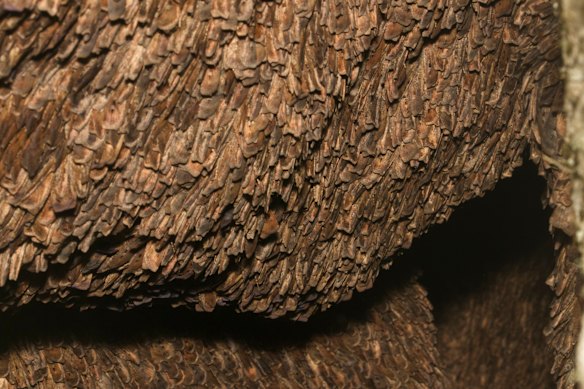

They are about the size of a 50 cent piece, weigh as much as a Tic Tac and travel up to 1000 kilometres for their seasonal migration, using celestial navigation and the Earth’s own magnetic field. Now, after a near total population collapse, bogong moths are delighting scientists with sudden spring abundance.
“I am absolutely losing my mind right now,” says Ayesha Kelly, a masters student at the University of Western Sydney, where she is studying the moths. “I just feel so lucky. I feel like we have been blessed by the moth gods.”
Kelly, like other moth buffs in NSW, is submitting her photographs of bogongs to the iNaturalist website so their movements can be recorded and tracked.
She uses light traps, which catch bogongs for observation and release, at her home in the NSW Blue Mountains, and this year the traps are heaving. Her mother says the number of the insects seen around Sydney this year reminds her of her childhood.
After drought struck much of their lowland breeding areas, bogong moth numbers collapsed by more than 99 per cent between 2017 and 2019, causing them to be listed as endangered in 2021, says Dr Marissa Parrott, a senior conservation biologist for Zoos Victoria, who helps run Bogong Watch, a citizen science project that also tracks the animal’s annual migration.
Their sudden return this year clearly has something to do with better conditions and increased rain, but bogong moths still remain mysterious, Parrott says.
We don’t fully understand why their numbers crashed so terribly, nor why they have returned. It is estimated that in the 1980s as many as eight billion moths made the migration from their breeding grounds to spend summer in alpine caves, where they gather in what are known as “gregarious aggregation”. That number is thought to have fallen to about four billion by 2017. In the years that followed, few were seen at all.
“They went from being so numerous that they could block out the moon and the stars as they flew overhead to nearly undetectable,” says Parrott.
The impact of the loss was profound. The moths’ migration serves not only to pollinate native vegetation but also as a huge transfer of protein and nutrients into the delicate ecosystems of the high country. They serve not only as food for birds and mammals, but also improve the soil. With the moths absent, scientist found that litters of critically endangered mountain pygmy possums in the Victorian alps disappeared too. Today it is thought that just 2000 of the possums survive in the wild.
“We’re so excited to see the numbers coming through this year,” says Parrott, who leads Zoos Victoria’s Moth Tracker website. “I think it’ll be some time before we get back to the heyday of where they used to be, but we know through the Moth Tracker website, we’ve already had more bogon moth submissions come in the last month than in previous years. We’ve already surpassed last year’s total.”
She says that despite healthy rains this year, the broader conditions that led to the decline remain in place, particularly in the high country where the moths spend their summer. Caves where the animals shelter from the heat and slow their metabolism over summer are growing warmer with climate change.
Asked what advice she has for anyone who has suddenly found their home hosting hundreds of moths, Parrott urges just marvelling at the moment.
“I want to point out how exciting it is to have an endangered species actually coming through your backyard, or visiting you at home. People don’t need to travel to find these beautiful endangered animals. What they can do is turn off unnecessary outdoor lights, which stops the moths from being drawn from their migration and helps them on their way.
“They can, for the future, plant native plants like callistemons and grevilleas; they can avoid insecticides.
“Don’t panic if you see large numbers of moths because they’re just moving through, and this is how it should be. This shows that an endangered species is recovering, and that’s something we can all celebrate.”
Get to the heart of what’s happening with climate change and the environment. Our fortnightly Environment newsletter brings you the news, the issues and the solutions. Sign up here.
 Nick O’Malley is National Environment and Climate Editor for The Sydney Morning Herald and The Age. He is also a senior writer and a former US correspondent.Connect via email.
From our partners
Disclaimer : This story is auto aggregated by a computer programme and has not been created or edited by DOWNTHENEWS. Publisher: www.smh.com.au