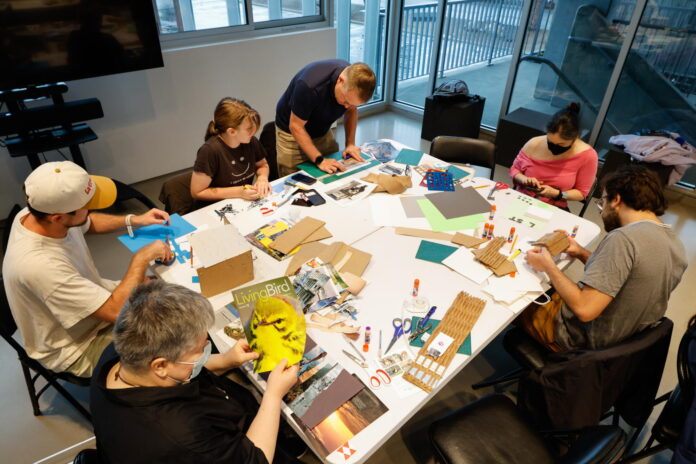
Crayoned letters, scraps of fabric and cutouts of Neil Armstrong crowd the bright room as artists old and young construct collages using mementos from the Cold War’s space race, a decades-long competition between the United States and former Soviet Union to achieve technological superiority and flaunt nationalism. The intensive crafting is part of the twice-monthly “Samizdat Sundays” workshops at the Wende Museum in Culver City.
Taught by L.A.-based artist and poet Kate Ingold, the workshops center on samizdat, a practice in which Soviet dissidents hand-typed literature, criticism and poetry to bypass state censorship. Each week, Ingold opens the workshop with a new prompt related to speech suppression — an issue with renewed currency today.
“[Samizdat] means working within the limitations of the material or the space that you have,” Ingold said. “It was a way for people to make things outside of the institutional parameters that the Soviet Union was imposing on people, and distribute it themselves too, often in secret.”
Participants work on their art projects at Kate Ingold’s weekly Samizdat Sundays workshop at the Wende Museum.
(Carlin Stiehl / For The Times)
Inspired by the museum’s Soviet Hippie collection, an archive that documents the suppressed Soviet subculture of the 1960s through photos, clothing and memorabilia, the workshops use historical events as foundations for creative prompts.
Since the workshops started last year, Ingold has hosted a diverse number of sessions and continues to teach every other Sunday. One workshop featured the creation of “mini moon bags,” modeled after pouches from the Soviet Hippie collection. Another session focused on writing letters to outer space, an act influenced by the race to the moon. In each workshop, Ingold encourages students to use discarded textile material to make art.
“There are trillions and trillions of new images being generated now by AI,” Ingold said. “Textiles give us something else. They give us this other way of being in the world.”
In an era of increasing political turmoil and technological upheaval, and as the U.S. and certain other democracies move to curtail public expression, Ingold said the themes of her workshops remain relevant for individuals hoping to cultivate forms of individual resistance.
“We have such public lives. That is a big part of how we are told to be successful in America,” Ingold said. “[That public life] is not only being looked at by other people, but also by the algorithms and by the corporations that are mining all of one’s presentation, speech and creation. Generative AI is literally taking intellectual property and mashing it up with other people’s and making money off of it.”
Ingold said that she teaches samizdat to combat these practices. Under the Soviet Union, dissident artists, poets and creators distributed their work within small, private networks, according to Ingold. Through samizdat-based art, individuals can reclaim forms of private expression.

Wendy Raigosa, 27, uses repurposed materials in her art project at Kate Ingold’s weekly “Samizdat Sundays” workshop at the Wende Museum.
(Carlin Stiehl / For The Times)
“What if we had things that no one else saw? What does that mean? What does it mean that maybe 2,000 years from now, somebody will see it?” Ingold asked. “I think there is a very interesting play happening here in terms of the public and private.”
As Americans increasingly live their lives on public platforms, the Trump administration has ramped up efforts to control the public discourse. The administration has banned journalists it disagrees with from covering the White House; used the Federal Communications Commission to threaten television networks that air comments it dislikes; placed pressure on the Smithsonian Institution to alter the way it presents American history; and cracked down on diversity, equity and inclusion efforts.
Media Matters and NewsGuard, two press watchdog groups under scrutiny by the Federal Trade Commission for their editorial judgment, recently fought costly legal battles over protected expression. And in an index from Reporters Without Borders, a nonprofit organization tracking press freedom across 180 countries, the U.S. ranked 64th, its lowest grade since the early 2000s.

Instructions are taped on the wall at Kate Ingold’s weekly “Samizdat Sundays” workshop at the Wende Museum.
(Carlin Stiehl / For The Times)
Adam Sieff, a lawyer in 1st Amendment litigation and professor of law at USC’s Gould School of Law, said he’s seen an increase in “unusual and unprecedented” pressure campaigns from the current administration to censor speech, including going after law firms, nonprofit organizations and universities, as well as enacting executive orders designed to punish those institutions.
“Even before [Trump] was president, he has taken a dim view of the 1st Amendment and is extremely litigious and cares a lot about his reputation,” Sieff said. “He will bully publishers through the threat of litigation to try and get them to print things that are favorable to him.”
The Wende’s Soviet Hippie collection contains ephemera that dovetails with the current moment, and aims to “illuminate the political and cultural changes of the past” and “offer opportunities to make sense of a changing present.”

Pearse O’Malley, 25, works on his project at Kate Ingold’s weekly “Samizdat Sundays” workshop at the Wende Museum, which leans into Soviet-era political resistance as art.
(Carlin Stiehl / For The Times)
“[The museum] is an antiauthoritarian model, because it’s about openness and freedom of expression and thought,” Ingold said. “I think their entire approach is about this openness and also a real, critical look at authoritarian regimes of the past and this whole era.”
According to chief curator Joes Segal, the exhibition dedicates two sections to authoritarianism — one to the cult of personality and the other to the act of resistance. Conceived together, these sections parse examples from socialist history and form connections between the past and present.
“We are now living in radically politically divided times, and there is a danger of moving towards a more autocratic or totalitarian political system in the United States,” Segal said. “Having insights into how people managed living under such political circumstances, in a situation like the Soviet Union, which was way more severe and still is under Putin than it is currently in the United States, gives a perspective and also a warning.”
Anne Martens, a workshop attendee as well as an artist and poet, said the idea of surveillance and dissident art intrigues her. Growing up with diplomat parents, Martens lived in communist countries such as Romania and Burma, now also called Myanmar.
“What are the parallels today to the things that I experienced and witnessed when I was a kid? … The very real and dangerous consequences of speaking up, vulnerable people being attacked and economic hardship — all of those are things that I’ve experienced indirectly,” Martens said. “It resonates with me, and my own work incorporates a lot of it.”

A house built from memory by Pearse O’Malley, 25, as part of Kate Ingold’s weekly “Samizdat Sundays” workshop at the Wende Museum.
(Carlin Stiehl / For The Times)
Bridget Eliot, another workshop attendee, grew up in Germany during the Cold War when the Berlin Wall remained intact. She said that she did not expect to see the rise of fascism in the United States.
“My grandparents were murdered in concentration camps. And to see how the world, again, is swinging that direction, where there are too many people in favor of a totalitarian government, is crazy,” Eliot said.
In a period defined by government crackdowns on free speech, technological data mining and increasing 1st Amendment lawsuit filings, workshop attendees may use samizdat as a means of subversion.
“To me, the idea of exploring art as a tool to express dissent, question the status quo, criticize or try to bring about change, or get people to think is a given. That’s what art should be, and art has always been,” Eliot said.
The Wende Museum will begin holding sessions twice per month starting in October.
More to Read
Disclaimer : This story is auto aggregated by a computer programme and has not been created or edited by DOWNTHENEWS. Publisher: latimes.com