
This story is part of “India Invented This?” — The Better India’s weekly trivia series that uncovers the Indian minds, ideas and innovations behind inventions that have shaped the way we live. From ingenious solutions created by scientists and engineers to technologies developed in response to some of India’s biggest challenges, each story goes beyond the invention to explore the problem it solved, the impact it created and why it still matters today.
At 14, Remya Jose had more than enough competing for her time.
She was preparing for her Class X exams, spending nearly four hours travelling to school and back, and helping at home while her mother was ill and her father was undergoing cancer treatment. Then there was the laundry.
With no washing machine at their home in Kerala’s Malappuram district, Remya and her twin sister, Soumya, spent hours washing the family’s clothes by hand. Soaking, scrubbing, rinsing and wringing ate into time she desperately needed elsewhere.
Her family could not afford a washing machine. But Remya began wondering whether she really needed to buy one in the first place.
She had seen how an electric washing machine worked. At its heart, a drum simply had to keep turning through water and detergent. An electric motor usually did that job.
Remya looked at something her family already had and asked a different question: could a bicycle do it instead?
Could a bicycle do the job of a washing machine?
After her Class 10 exams, Remya began putting that question on paper.
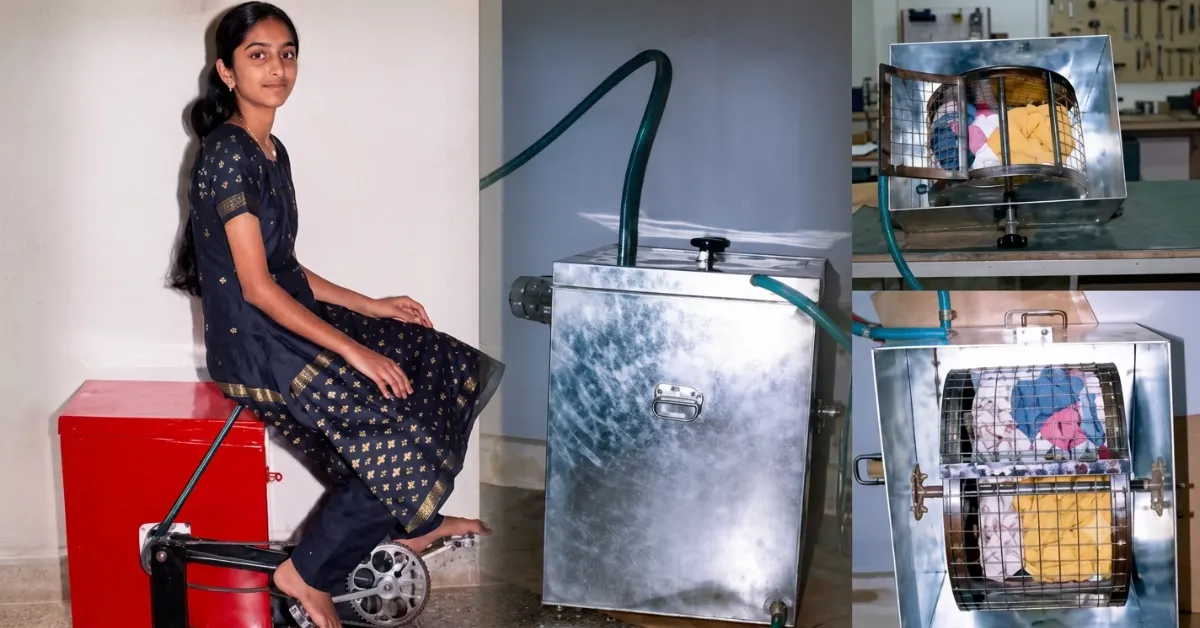
She sketched a machine that could replace electrical power with the mechanical power generated by pedalling. Her father, a schoolteacher, took the drawing to a nearby automobile workshop, where mechanics helped turn her design into a working machine using the materials she specified.
The result looked part washing machine, part exercise cycle.
So, how does a bicycle wash clothes?
The contraption had an aluminium cabin containing a horizontal, perforated cylinder made of iron mesh. The cylinder was connected to a cycle chain, pedals and a seat.
The process was surprisingly straightforward.
Clothes were placed inside the cylinder, while the cabin was filled with water and washing powder. After soaking for at least 10 minutes, the user simply sat down and pedalled for three to four minutes.
As the pedals turned, the cylinder spun rapidly, agitating the clothes and cleaning them. The dirty water could then be drained, fresh water added and the process repeated.
And Remya’s machine had one more trick. With the water drained out, continued pedalling used centrifugal force to remove water from the clothes, leaving them about 80 per cent dry.
In other words, the same movement that powered the washing also doubled up as exercise.
No electricity? The machine would still keep washing
The idea was particularly suited to the problem Remya was trying to solve.
Electricity in rural areas could be unreliable, while conventional washing machines were expensive. Her pedal-powered version cost around Rs 2,000 and did not depend on a power supply. It was also portable and could continue working even when electricity was unavailable.
/filters:format(webp)/english-betterindia/media/media_files/2026/09/28/remya-jose-2026-09-28-15-53-32.png)
Photograph: (Millennium India Education Foundation)
What began as a teenager’s attempt to reclaim some time from a household chore had now become a grassroots innovation.
The National Innovation Foundation later recognised Remya’s invention, officially documenting it as the ‘Washing Cum Exercise Machine’. A patent was filed in 2003, and the invention eventually received Indian Patent No. 207634. Remya also received the Student Award at NIF’s 3rd National Competition for Grassroots Innovations and Traditional Knowledge in 2005.
Her father had initially wondered whether she should simply learn to wash clothes by hand. Her mother had worried that tinkering with machines might distract her from studies.
But Remya was not trying to escape the chore. She was trying to make room for the things that mattered beyond it.
At 14, with a bicycle, a few materials and a problem sitting right in front of her, she found a way to turn pedalling into washing, and a tedious household task into something far more useful: time.
Sources:
‘Meet Remya Jose: The 14-year-old Kerala girl who built a pedal-powered washing machine without electricity to save time for her board exams and earned a National Award from President APJ Abdul Kalam for it‘, by The Times of India, Published on 10 September 2026.
’14-year-old Indian schoolgirl invents a pedal-powered washing machine for those with no electricity’ by Bright Vibes
’14-year-old Kerala girl losing time washing clothes by hand during her Class X exams designed a bicycle-powered washing machine for Rs 2,000 that doesn’t need electricity’ by Te Economic Times, Published on 3 September 2026.
Disclaimer : This story is auto aggregated by a computer programme and has not been created or edited by DOWNTHENEWS. Publisher: thebetterindia.com




