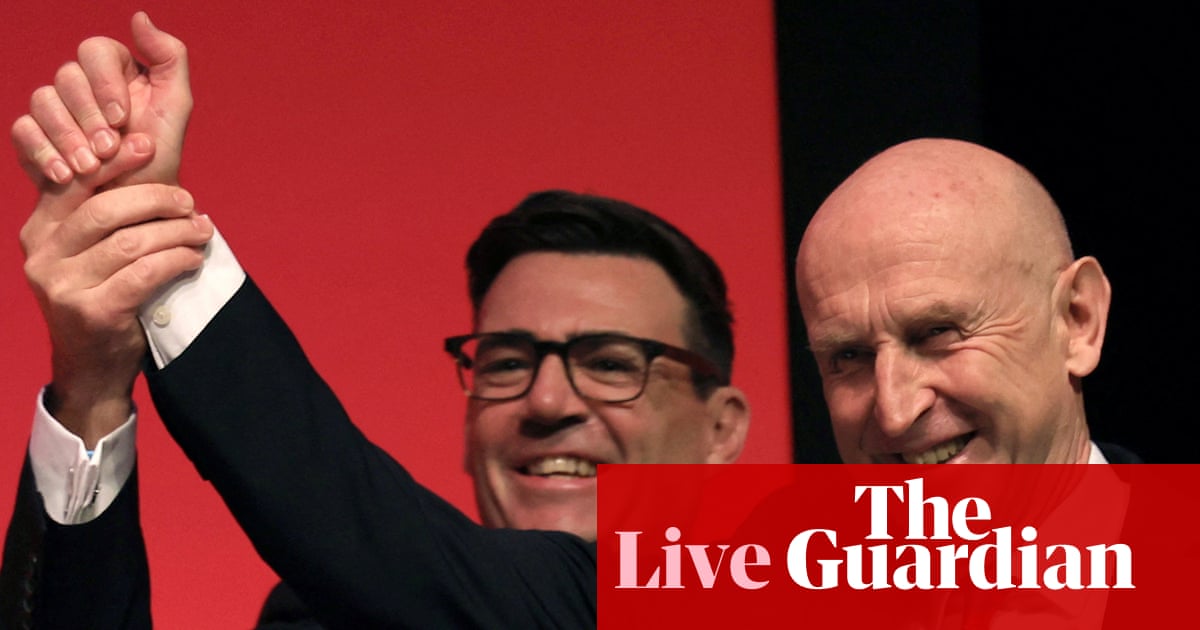
Healey explains why fiscal responsibility matters.
On day one as chancellor I said my first duty is fiscal discipline, and I’ll tell you why.
It underwrites every promise this government makes on growth, on jobs, on national security and on public services. We can’t succeed without it.
And that’s why the prime minister and I are united in meeting the fiscal rules, balancing the books with a buffer against uncertainty, controlling borrowing to bring down inflation, and reducing long term pressures on our finances, and confidence.
That commitment is so important. There is nothing progressive about losing control because it’s always working people who pay for it.
There is no other party in British politics that relishes its own past as much as Labour. Even when they liked their previous leaders, the Conservatives were not inclined to go on about them at party conference. The liberals have to go back more than 100 years to recall their glory days, and even the most ancient Lib Dem peer doesn’t have a memory that good. Other parties are short on hero figures in history. But Labour, in some respects, is the most conservative party on the block – constantly harking back. Only among this tribe would a tie once worn by a chancellor more than 20 years ago gain the status of a relic.
So, in that sense, Healey’s speech was perfectly crafted – rich with sentimental references to the party’s history, and the nation’s too. But wallowing in nostalgia will only get you so far, and at times it felt this was serving as cover for the fact that Healey did not have a lot new to say. That is not necessarily the chancellor’s fault; he was a surprise appointment in a new government, and a lot of issues remain unresolved.
There were a smattering of smallish announcements in the speech. But the main takeaways were messages that we have already heard from the government, but which Healey felt were important enough to repeat to the Labour conference: that the cost of servicing debt is crippling (see 12.20pm), that he’s fully committed to the fiscal rules (see 12.25pm), and that welfare reform is a “moral duty” (see 12.31pm). This platform is hard to distinguish from Rachel Reeves’.
Perhaps the most interesting line came at the end, after Healey referenced Tony Crosland (another Labour history lesson). Healey said:
That’s the lesson for our generation. And Labour isn’t just here to cut the cake in a different way.
We have to bake a bigger cake and make sure that it’s fairly shared.
This is a much wiser lesson than Boris Johnson’s cakeism. But it begs the question, how? On this, Healey did not really provide answers.
Healey ended his speech with a passage about growth.
It was 70 years ago at a Labour conference that Tony Crosland published his book on the future of our party [the Future of Socialism].
He wrote it then believing that economic growth will take care of itself, and that Labour’s job was simply to share out the proceeds.
Twenty years later he realised he’d been wrong. The growth doesn’t just happen. We have to work for it. We have to create the conditions for it and without growth there is no social democracy. You can’t fund ends without the means.
And that’s the lesson for our generation. And Labour isn’t just here to cut the cake in a different way.
We have to bake a bigger cake and make sure that it’s fairly shared.
So whether it’s the cost of business or the cost of living, the only long term answer is growth. Good growth in every postcode, a dual mission from the Treasury and No 10 North.
Healey said London should not have to “shoulder the economic burden alone”. The government wanted growth in every postcode, he said.
Growth wasn’t just a graph or spreedsheet, he said. It was about whether a family could afford to go on holiday.
At the start of his speech, Healey talked about having a miner’s lamp on a shelf at home and he came back to that as he ended his speech.
When you leave this conference, remember that miner’s lamp, those workers didn’t carry it for themselves. They carried it for those beside them. They carried it for their community. They carried it for the ones who came after.
That is our job now, to light the way for a generation that’s been told there is no way through.
Good work, fresh hope, a new age of industry and the solidarity that has always carried this country forward.
Healey said the government would not let AI leave workers behind.
AI is the greatest innovation of our time. It’s a general purpose technology that will simply transform our society at every level.
Every business, every community, every hospital, every school, everywhere can benefit from adopting AI.
It’s at the centre of a groundswell of new world-leading British tech companies, and it’s the driving force with which this new age of industrialisation can be built.
Yes, we need to face the serious risks to national security, to personal data and to our children’s well-being, and it will change our labour market in fundamental ways.
But I give you this commitment. We won’t let AI leave Britain’s workers behind, and we will make sure that Britain wins in this AI revolution.
Healey gives credit to the GMB union for getting the shipyards investments “over the line”.
He says he is proud of the partnership with unions. And he defends having a union figures on the Bank of England’s court, saying “Britain’s economic success is built on the success of working people”.
That’s a reference to this row.
He also says he will re-establish the union learning fund, a scheme set up by the Tony Blair government to fund workplace learning but axed by the Tories.
I’m proud of the fact that last time 180,000 workers every year got new training through that fund, and we’ll do that again.
Better skills, better prospects for British workers – because of the decisions taken by this Labour government.
Healey says the government has committed £6bn for contracts for British shipyards, including the new docks for submarines on the Clyde. (See 7.54am.)
Healey says Rolls-Royce is today announcing investment worth an extra £300m in its British factories in Derby, in Bristol and Glasgow, and in Rotherham.
And he says that is an example of what he means by proposing a “new age of industrialisation”. (See 7.54am.)
Healey says, as a downpayment on the Milburn report, he is announcing a local apprenticeships service
He says it will be “led by mayors, targeted at these young people, delivering thousands more apprenticeships for these young people with local teams – a bit like football scouts for apprenticeships – local teams who will go to local firms that have never taken on a trainee and say ‘We’ll help you do it.’
Every mayor will be able to take part.
And there will be £100m in funding for the scheme, funded by savings from the DWP.
Healey says the Alan Milburn report on Neets, out soon, will show the scale of the challenge facing young people.
He goes on:
Our social security system must always be there for those who can never work.
But for everyone else, benefits should be a bridge to work, to wider participation, to a better life, not a trap that people can’t escape.
And, conference, it is simply not progressive to allow a bigger and bigger benefits bill, and a system which offers an income but doesn’t offer a future.
So once again, as a Labour government, it falls to us to act.
And this is more than a just an economic must. This is a moral duty.
I refuse to write off a million young people like the Tories have done.
Healey turns to Nigel Farage.
It’s not just the shadow chancellor. Look at Reform UK – dodgy donors, fantasy funding behind every plan and Nigel Farage.
He wants you to think he’s a man of the people. But when it comes to the economy, he’s Liz Truss with a Bitcoin account.
(Actually, Truss probably has her own Bitcoin account.)
Healey explains why fiscal responsibility matters.
On day one as chancellor I said my first duty is fiscal discipline, and I’ll tell you why.
It underwrites every promise this government makes on growth, on jobs, on national security and on public services. We can’t succeed without it.
And that’s why the prime minister and I are united in meeting the fiscal rules, balancing the books with a buffer against uncertainty, controlling borrowing to bring down inflation, and reducing long term pressures on our finances, and confidence.
That commitment is so important. There is nothing progressive about losing control because it’s always working people who pay for it.
Healey confirms he is committed to the fiscal rules.
He goes on:
As Andy has argued, this country has seen political power centralised, economic control privatised, Britain de-industrialised.
And the result? Too many people today feel that Britain hasn’t been working for them, for their family and for their area.
Disclaimer : This story is auto aggregated by a computer programme and has not been created or edited by DOWNTHENEWS. Publisher: theguardian.com