
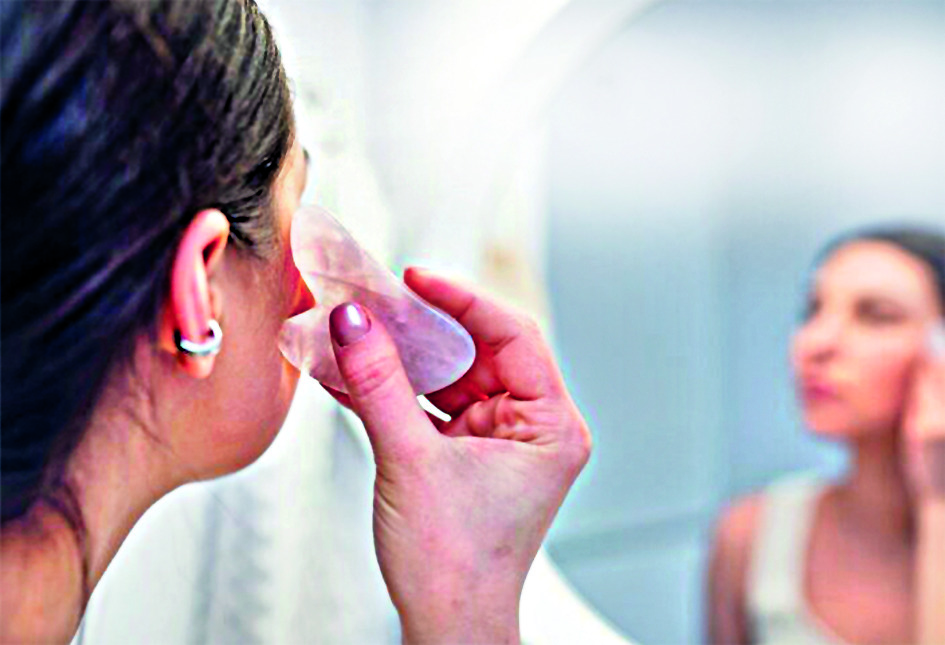
Few beauty rituals have travelled as dramatically from traditional medicine to social media as gua sha. The smooth stone tool, now a familiar sight in skincare videos and celebrity routines, has become synonymous with facial massage, sculpted cheekbones and glowing skin. But long before it became a beauty accessory sold by luxury brands and promoted by influencers, gua sha was part of a broader traditional healing system with a very different purpose.
Stone-age Serenity
Rooted in Traditional Chinese Medicine (TCM), gua sha traditionally involves scraping or pressing the skin with a smooth-edged tool. Historically, the technique was used on the body rather than primarily on the face, with practitioners employing it for conditions associated with muscle pain, tension and other forms of discomfort. The practice can temporarily leave reddish or purple marks on the skin, known as ‘sha’, which are considered part of the traditional treatment process.
A Beauty Ritual
The modern beauty industry’s relationship with gua sha looks considerably different. Facial versions of the practice are typically performed with flatter tools made from materials such as jade, rose quartz or other stones. Rather than producing the pronounced marks associated with traditional body gua sha, facial routines generally involve gentle strokes along the cheeks, jawline, forehead and neck.
Good Vibes Only
Beauty practitioners and skincare enthusiasts often promote facial gua sha as a way to massage the face, temporarily reduce puffiness and create a more defined appearance. The ritual has also become part of a larger culture of at-home wellness, where skincare is presented not only as maintenance but as a daily form of self-care.
“People often come to me because they want that refreshed, less-puffy appearance, and the massage itself can feel incredibly relaxing,” says Ankita Singh, beautician. “But I always explain that the effect is different from permanently changing
the structure of someone’s face. It is about massage, circulation and temporary appearance rather than physically sculpting new cheekbones.”
Social Media Trend
The transformation accelerated with the rise of Instagram, TikTok and YouTube, where beauty routines are increasingly consumed as visual content. Gua sha fits neatly into that environment: the tools are photogenic, the movements are easy to demonstrate and the results can be presented through before-and-after imagery.
Online, however, the language surrounding the practice can sometimes extend beyond what is supported by scientific evidence. Claims that gua sha can permanently reshape facial structure, eliminate wrinkles or dramatically alter the appearance of the face have circulated alongside more modest claims about massage and temporary depuffing.Dermatologists generally distinguish between the immediate cosmetic effects of massage and claims about lasting anatomical changes. “Gentle facial massage may temporarily improve the appearance of puffiness, particularly by moving superficial fluid, but it should not be confused with permanently reshaping facial anatomy,” said Amitabh Agrawal, dermatologist. “People should also be cautious about excessive pressure or aggressive scraping, because irritation, bruising and skin damage are possible.”
Tradition vs. Commodity
Gua sha’s popularity has also prompted a broader conversation about cultural appropriation. As the technique has entered Western beauty markets, its traditional context can sometimes disappear behind minimalist packaging.
The concern is not simply that an ancient practice has become popular. Traditional practices have historically travelled before too. The debate centres instead on what happens when a culturally significant practice is separated from its historical and medical context and repackaged primarily as a consumer product.
For some observers, the popularity of gua sha represents an opportunity to introduce more people to East Asian approaches to wellness. For others, the trend illustrates how global beauty industries can extract individual practices from their cultural origins while turning them into profitable lifestyle products.
Heritage and Hype
The story of gua sha is therefore more complicated than its appearance on a bathroom shelf might suggest. Its journey from traditional healing practice to global beauty ritual demonstrates how cultural traditions can be transformed by migration.
The modern facial gua sha ritual may be considerably gentler and more cosmetic, but the stone tool carries a history that predates the social media trend by centuries. As consumers continue to embrace it, the challenge may be finding a balance between enjoying a beauty ritual and understanding the cultural tradition from which it emerged.
Ultimately, gua sha’s viral success reveals that ancient practices can become global phenomena almost overnight, but their histories do not disappear simply because their meaning has changed.
Disclaimer : This story is auto aggregated by a computer programme and has not been created or edited by DOWNTHENEWS. Publisher: deccanchronicle.com




