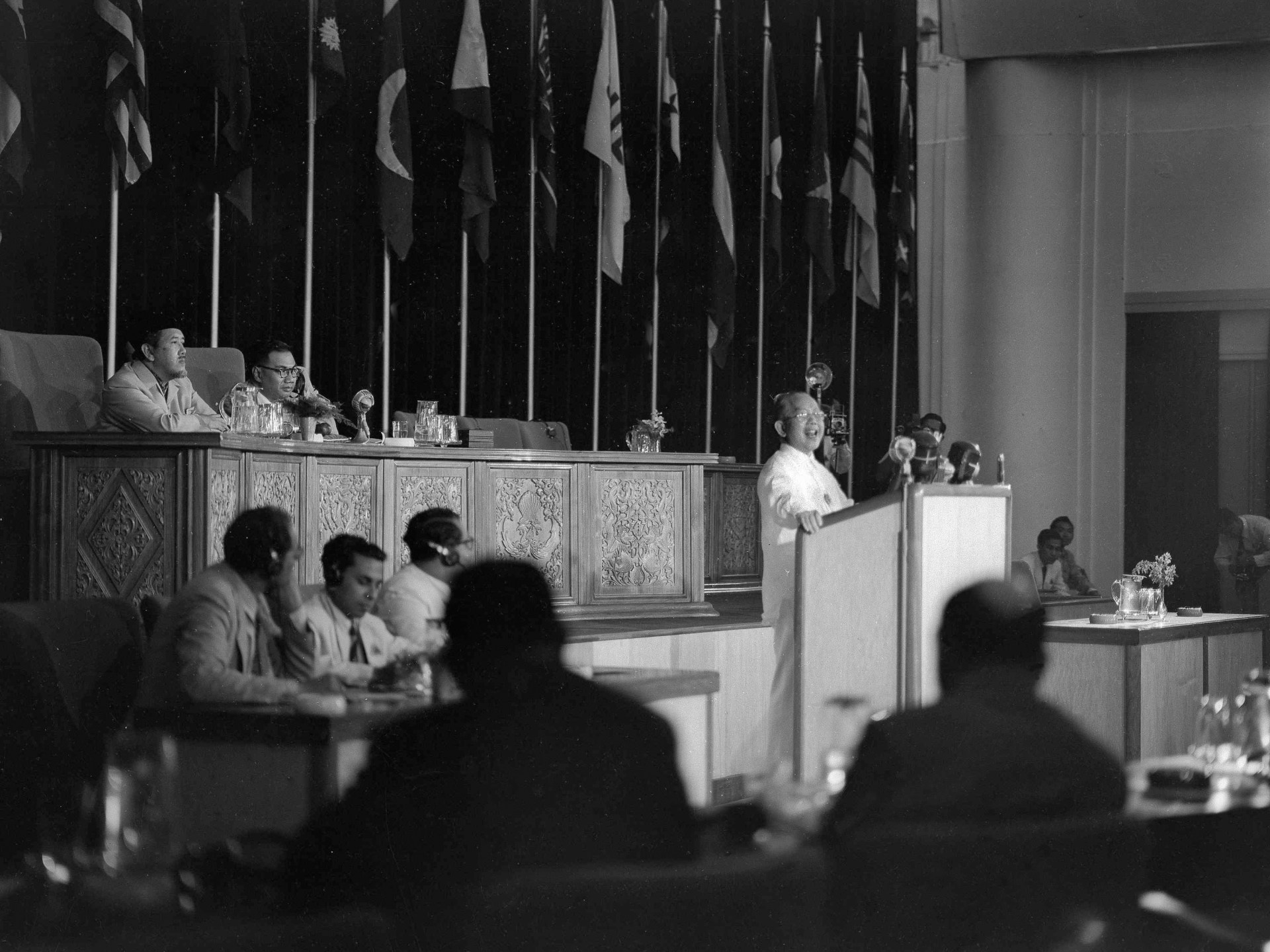
In a world torn apart by geopolitical bullying and geoeconomic warfare, great-power conflict and inequality that concentrates wealth and statecraft in the hands of a few, the Bandung Conference is gaining renewed relevance.
The developing world’s momentous meeting in 1955 laid the groundwork for a new international order and South-South cooperation. It asked a question that everyone, even rich nations, is asking today: who gets to write the rules of the global economy?
That moment needs retelling. In 1955, 29 nations of Asia and Africa, former colonies representing more than half the world, met in Bandung, Indonesia, for a conference hosted by President Sukarno. Riding on the wave of anticolonial struggles, they agreed on an ambitious framework founded on sovereignty and economic, cultural and political cooperation, elevating the United Nations Charter’s spirit of human rights above militaristic alliances.
The conference’s most powerful outcome was South-South solidarity: nations and peoples charting a path independent of the two great powers of that time – the United States and the Soviet Union. As the “Third World” alliance grew, practical efforts to support decolonisation emerged out of it, including the Non-Aligned Movement and bodies like UN Trade and Development (UNCTAD).
As a new Al Jazeera film shows, the “Bandung spirit”, despite efforts not to antagonise great powers, was treated as a direct threat. Many countries faced crushing pushback for committing to the decolonisation agenda – coups, invasions, economic warfare and debt and austerity crises – that left them beholden to old masters, not their development aspirations.
Advertisement
Seventy-one years later, the structures of inequality persist. Despite dramatic growth in parts of the Global South, particularly in East Asia, Global North countries control 69 percent of global wealth while comprising just 20 percent of humanity. Low- and middle-income countries spend on average nearly half their national budgets on debt repayments, mainly to rich creditors in rich countries.
Meanwhile, wealth inequality has soared within nations, concentrating power within small elites while ordinary people struggle. Just 3,000 billionaires hold wealth equivalent to more than 15 percent of global gross domestic product (GDP).
It would be a stretch to suggest that the level of South-South cooperation envisioned at Bandung endures today. The Economist recently quipped, “A damp squib Bandung anniversary shows a lack of solidarity.”
Yet external realities are forcing a reckoning that nostalgia cannot. The powerful are acting with impunity, breaking the brittle cover the so-called rules-based order relied on.
Consider the US-Israel war on Iran – its violence and devastation across the region, and its shock to global fuel and fertiliser prices, punishing common people everywhere.
Consider the wrecking ball of tariffs and its impact on poorer economies, or the profoundly unequal effects as well as drivers of climate breakdown.
Consider the ongoing genocide in Gaza and the impunity afforded to the perpetrators.
The reality is much of the world never accepted the post-World War II order – dominated by powerful nations – as truly legitimate, as the Bandung project demonstrated. But that order did not need to be legitimate to be unavoidable; the alternatives were too costly.
Today, even compliance offers scant security in a world where “might is right”. That is forcing wealthy nations to finally come to terms with what the rest of the world long knew.
Countries must not passively accept these conditions. As Brazilian President Luiz Inacio Lula da Silva put it recently in response to US President Donald Trump’s threat of tariffs: “The world has changed; we do not want an emperor.”
At this time of rupture, the Bandung Conference can offer lessons for rethinking the rules of global cooperation.
First, cooperation alone is value-neutral; the substance matters. More cooperation that advances neoliberal priorities, be it among middle powers or poorer nations, is not the answer.
Second, we need much better institutions. There is an urgent need for serious financial institutions built for the Global South. Alongside this, the IMF and the World Bank should be boldly reformed away from reliance on austerity towards addressing inequality and national sovereignty.
Advertisement
Credit groups such as the Paris Club need to be counterbalanced with borrowers’ clubs of poorer nations. The UNCTAD Borrowers’ Platform, to be launched next month, shows countries can work together to reshape the rules of debt restructuring.
Third, reducing inequality between countries is a partial picture without addressing inequality within and across them. At Bandung, Sukarno warned against “economic control” within nations. Every nation must tackle the consolidation of wealth and power among a tiny few, and boldly reduce the gap between the ultrarich and the rest. Raging against major powers abroad while helping the rich exploit the poor at home does not pass the test of economic liberation.
Fourth, concrete steps are also needed internationally: a negotiation for a fairer international tax system at the UN that ends tax havens and abuses, efforts to tax the ultrarich everywhere and a rewrite of intellectual property rules to prevent corporate monopolies that can come at a devastating human cost.
Fifth, there should also be new trade formations that do not give special powers to foreign investors, and instead focus on advancing workers’ rights and environmental protections. Such forms of South-South cooperation can be vital to addressing the climate crisis.
How cooperation is done matters too. Bandung inspired people across developing and developed countries alike – an internationalist solidarity needed today. Forward-looking policymakers in the Global North have a chance to work constructively – in contrast to the Trump administration’s coercive approach – transforming rules many now admit were rigged.
Spain shows new coalitions are possible on development financing and democracy. The G20 presidencies of Brazil and South Africa have offered hope for multilateralism. An International Panel on Inequality shows new cooperation to address inequality led by the Global South is possible.
Ultimately, the push will come not from leaders but from the people and movements who make them act. Who actually gets to write the rules of the economy? Surely, all of us.
The views expressed in this article are the author’s own and do not necessarily reflect Al Jazeera’s editorial stance.
Disclaimer : This story is auto aggregated by a computer programme and has not been created or edited by DOWNTHENEWS. Publisher: aljazeera.com