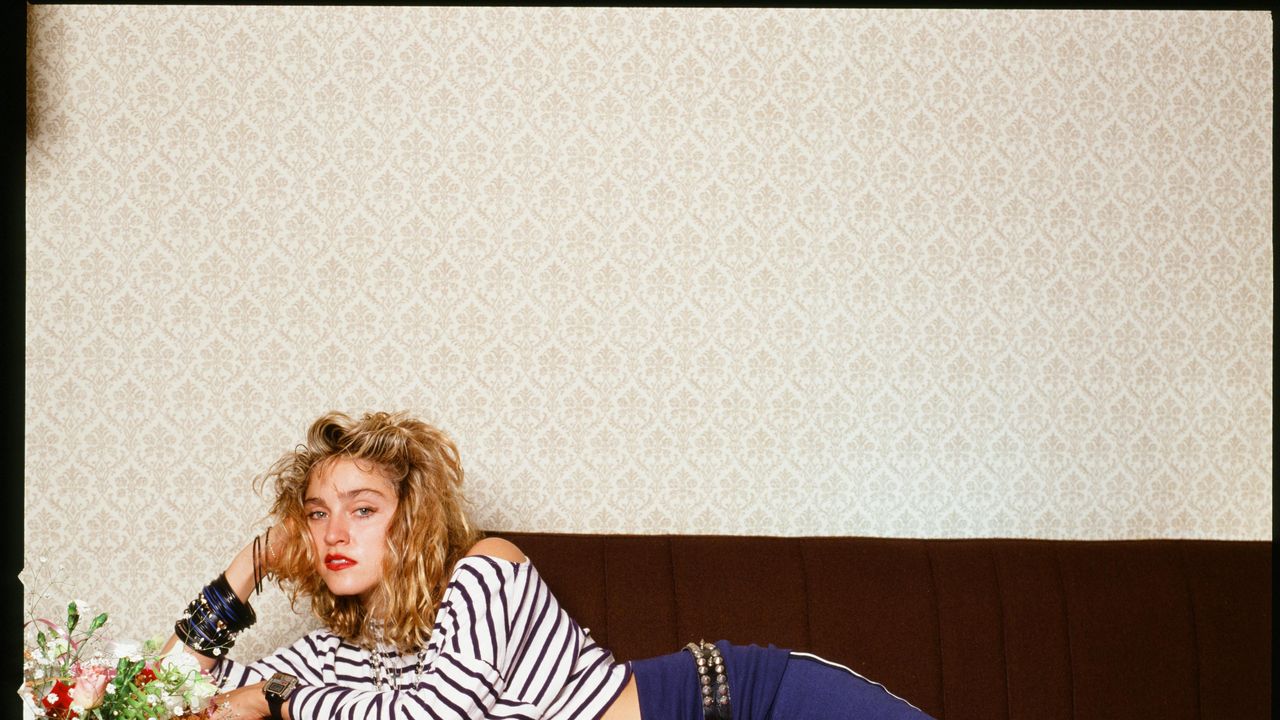
Ever the re-inventor, Madonna’s beauty identity is defined by her willingness to abandon it: brunette to blonde, virgin to dominatrix, Old Hollywood bombshell to spiritualist. And these transformations weren’t simply exercises in looking different. In the 1984 release of the video for “Like a Prayer,” Madonna traded her platinum Marilyn look for dark curls and a slip dress as she danced in front of burning crosses and kissed a Black saint, using her image alongside religious imagery to address race, religion, sexuality, and injustice. The video drew the ire of the Vatican, but it also showed that when Madonna changed how she looked, we could grasp her message using more than just our ears. But this instinct extended well beyond a single music video. She made out with not one, but two, women at the 2003 VMAs, dressed as a groom and flanked by her two brides. Against that history, the TikTok “clean girl,” “mob wife,” or “office siren” aesthetics that my generation cycle through feel comparatively hollow. While Gen Z is mastering the art of adopting a look, we’ve not necessarily made it mean something.
What we have to learn from Madonna is less about her activism, or even how radically she expanded what a pop star could be, but what pop music could actually mean. Before she sings a lyric, the hair, makeup, clothes and character have already told you she has something new to add to the conversation. Throughout her career, Madonna has treated beauty as a language rather than a superficial endpoint. Looking good was never her whole assignment, but looking different could challenge what was expected of her, attract attention for what she wanted to say, and, once her point was made, she could find a new message and a new look to champion it.
Unfortunately, I wasn’t around for many of Madonna’s incarnations, but I always felt connected to them. As a little “spitfire,” also known as “a handful” in teacher communities, I related to the indignation of “Don’t Tell Me.” Later, I shocked camp counselors with my rendition of “Give Me All Your Luvin’” at a talent show. By the fourth grade, I was attending the MDNA Tour at Yankee Stadium in my favorite sparkly jean skirt, a modest get-up compared to the harness and ball gag of my 62-year-old seatmate. Madonna’s greatest contribution to modern pop might be the one thing today’s pop stars are increasingly discouraged from doing: becoming someone completely new.
For a generation with more beauty inspiration at our fingertips than any before us, that kind of experimentation should be easier than ever. Instead, social media gives us an endless catalog of ways to transform ourselves, while making us hyperaware of which transformations are flattering, clickable, and on-brand. The wisdom I hope we learn from it is that what we look like is inextricably linked to what we have to say, and, on a larger scale, what we can create. Madonna offers a lesson in the power of appearance beyond likes, follows, and commercial benefit. Rather than chasing a trend, maybe Gen Z can take a cue from thinking about what we want to say—and how we amplify that with how we look.
Disclaimer : This story is auto aggregated by a computer programme and has not been created or edited by DOWNTHENEWS. Publisher: www.allure.com