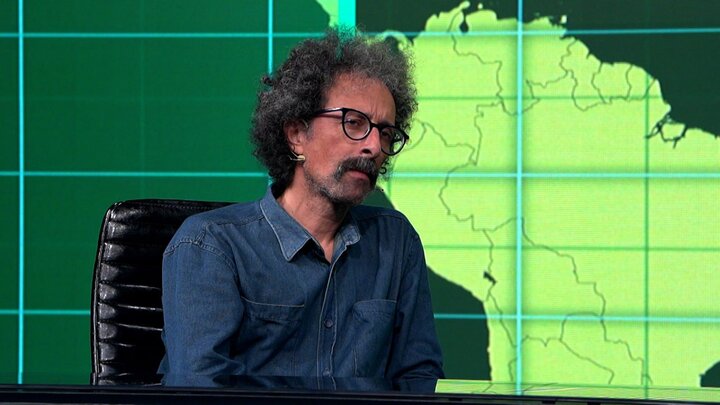
TEHRAN- Iranian filmmaker Babak Khajepasha believes cinema should do more than portray suffering. For him, a film dealing with war, the death of children, or a social tragedy should leave audiences with questions rather than simply tears.
Khajepasha, whose “In the Arms of the Tree” was selected as Iran’s submission for the 2025 Academy Awards, has repeatedly turned to children and family in his films. His latest feature, “The Land of Angels”, deals with children in Gaza. The film has also taken part in international events, including the Altyn Minbar Kazan International Film Festival, where it received the Grand Prix for Best Feature Film. Khajepasha is also among the jury members of the 2026 BRICS+ International Film Festival in St. Petersburg.
In an interview with the Tehran Times, he spoke about the possibility of making a film on the recent tragedy in Minab, the difficulty of depicting the death of children without reducing cinema to melodrama, his decision to make films during the 40-day war, and what he saw during a recent visit to Hiroshima. He also discussed the international position of Iranian cinema, his earlier criticism of the Oscars and some major festivals, and why family remains one of the subjects he wants to pursue in his future work.
Looking beyond the tragedy
Speaking about the possibility of making a film about the tragedy in Minab, Khajepasha said he would be more interested in exploring the reasons behind such events than simply depicting their devastating consequences.
“The aspect that I, as a filmmaker, can enter and that deserves to be explored is the reason behind this tragedy,” he said, stressing that society should ask why it has been forced to experience such pain.
The filmmaker pointed to the loss of children in different parts of Iran, including Minab, Lamerd, Tabriz and Kermanshah during the recent war, saying that while addressing the suffering of children is important, cinema should also investigate why children repeatedly become victims of conflict and violence.
This concern, he explained, was also central to his research for “The Land of Angels”. During his research and conversations with Palestinians, he encountered stories that demonstrated the profound psychological impact of losing a child.
Khajepasha recalled speaking with a Palestinian father who had been holding his child when the child was killed. According to the filmmaker, the man later repeatedly returned to the same place, hoping that he too would be killed so that he could join his child. The father said he could not understand why he had been left alive.
For Khajepasha, such stories demonstrate that the killing of a child affects much more than the immediate victim. It leaves a psychological wound on the family and, ultimately, the wider community.
Yet he believes that cinema must be careful not to turn such suffering into an exercise in emotional manipulation.
From tears to questions
That is also why Khajepasha is wary of making films about war and children that rely entirely on emotion.
If simply seeing the suffering of children were enough to change the world’s response to violence, he said, the many films and documentaries made about Gaza and other conflicts would already have brought about such a change.
“Just talking about how much pain we are in does not necessarily take us a step forward,” he said. “We have to look at this from an intellectual perspective. We have to search for its causes and ask where this pain is supposed to take us.”
For “The Land of Angels”, he wanted the audience to leave with a question.
A viewer may accept that there are fighters, a military conflict and casualties in a war, he explained. But the death of thousands of children should lead to another question: why are these children being killed?
That question, in his view, can open the door to wider discussions about the position of children in contemporary society, the pressures placed on them and even the declining importance attached to having children in some parts of the world.
Khajepasha prefers this kind of cinema to a film that simply asks its audience to cry.
“I don’t want to make a film merely so that audiences cry,” he said. “We have to value the film itself. There have to be other reasons for making it.”
He pointed to techniques used in dramatic literature and epic theater, including distancing, which encourage audiences to think about a work instead of simply surrendering to its emotional effect. A film, he said, should stay with the viewer as a question after the screening.
When filmmaking becomes a duty
The same idea of responsibility was behind Khajepasha’s decision to work during the 40-day War.
At the time, Tehran and other parts of the country were facing an extraordinary situation as they came under US and Zionist regime airstrikes. Khajepasha said he saw people from different professions doing more than their normal duties: bakers working additional shifts, doctors and nurses continuing their work in hospitals and other citizens finding ways to contribute.
For him and some of his colleagues, filmmaking became another form of service.
“Sometimes we make films because we are filmmakers. Sometimes, as Iranians, we have another national duty,” he said. “At that point, it is no longer simply about filmmaking. It is a form of service.”
Under ordinary circumstances, he acknowledged, starting a production so quickly and without the usual preparation would not have been logical. But he felt that the circumstances demanded a response.
“As someone working in the arts, I felt I had a responsibility,” he said. “My instrument is cinema and television.”
He began work only a few days after the war started and now looks back on the experience with particular satisfaction.
The reason, he explained, was not necessarily that the films were more successful than his other work. It was the feeling that he was doing something directly for his own people.
“I am happy that, during that period, instead of standing on the sidelines, I was able to take a step,” he said.
Hiroshima: between memory and spectacle
A recent trip to Hiroshima gave Khajepasha another opportunity to think about the way major human tragedies are remembered.
He attended the annual ceremony commemorating the victims of the atomic bombing of Hiroshima and found the gathering visually striking and, from a filmmaker’s perspective, fascinating. Yet he said the event left him with mixed feelings.
The scale of the tragedy, he argued, seemed much greater than what was being conveyed by the ceremony.
“I felt that, instead of the truth being fully expressed, I was watching more of a show,” he said.
Khajepasha extended that observation to the way peace is sometimes represented internationally. He questioned the gap that can exist between institutions and governments that publicly promote peace and countries whose policies have contributed to conflicts elsewhere.
But his experience in Japan did not leave him simply pessimistic. He said he encountered ordinary people who appeared genuinely concerned about events beyond their own borders.
When some Japanese people learned that he was Iranian, he recalled, they immediately brought up the victims of the recent tragedy in Minab and other Iranian victims.
He said he had encountered similar reactions in other countries and believes that ordinary people may ultimately understand such tragedies more deeply than political rhetoric suggests.
Iranian cinema and the international festival circuit
Khajepasha also returned to comments he made while “In the Arms of the Tree” was Iran’s Oscar submission. At the time, he had questioned whether artistic quality alone determines a film’s international success.
His criticism, he explained, was not simply about whether his own film would advance in the Oscar race. He was talking about the broader position of art and cinema.
In his view, political considerations, lobbying and relationships can influence some major international cultural institutions. He also believes that the influence of politics has become particularly visible in some film festivals.
That does not mean he considers the entire international festival circuit politicized.
He mentioned festivals held in South Korea, Morocco, Egypt, Armenia, Russia and Turkey among festivals that continue to offer valuable platforms for filmmakers. Iranian cinema, he stressed, has also received genuine international recognition through films by directors such as Asghar Farhadi and Majid Majidi.
The quality of an individual film, he argued, should not be reduced to the festival at which it appears or the prize it receives.
“A festival award alone cannot determine the value of a film,” he said.
He also believes filmmakers themselves have a responsibility not to allow the desire for international recognition to dictate their artistic choices.
Family at the center
Children feature prominently in both “In the Arms of the Tree” and “The Land of Angels”, but Khajepasha does not see himself primarily as a filmmaker of children’s stories.
His deeper interest, he said, is the family.
He usually tries to include children in his films because their presence gives the story another dimension, but he would like to explore the family itself more extensively in future work.
“I would like to make more films about the family itself,” he said, describing it as one of the most important and vulnerable foundations of human societies.
He believes the issue has particular importance in Iran because family relationships are deeply connected to the country’s cultural identity.
Iran cannot simply reproduce changes that have taken place in other societies, he argued. Relationships among parents, children and extended family members have a particular cultural meaning in Iranian society.
For that reason, he believes Iranian cinema should address the pressures facing families instead of treating changes in family structures as inevitable.
‘First make a good film’
Khajepasha will soon have an opportunity to examine films from the other side of the filmmaking process, as a jury member of the BRICS+ International Film Festival in St. Petersburg.
At the time of the interview, the festival’s films had not yet been sent to the jury, so he had not begun watching them. But he already knew what his first criterion would be.
The film itself comes first.
For Khajepasha, a film needs to have a sound story and plot as well as convincing cinematic elements such as mise-en-scène and visual language. A political or social message cannot make up for weaknesses in the filmmaking.
He is particularly critical of films that appear to have been made primarily to deliver a message.
“If we want to criticize a society, we first have to make a good film,” he said. “If we simply shout our message at the audience, the audience will realize immediately that the filmmaker has an agenda.”
The same principle applies to films carrying messages that he himself agrees with, he added.
“A good film that disagrees with our beliefs can sometimes be less damaging than a bad film that is trying to promote our beliefs,” he said.
As a juror, Khajepasha said his first priority would therefore be cinematic quality.
“Before a film can make an audience believe in its message, it has to make the audience believe in the film itself,” he concluded.
SAB/
Disclaimer : This story is auto aggregated by a computer programme and has not been created or edited by DOWNTHENEWS. Publisher: tehrantimes.com