
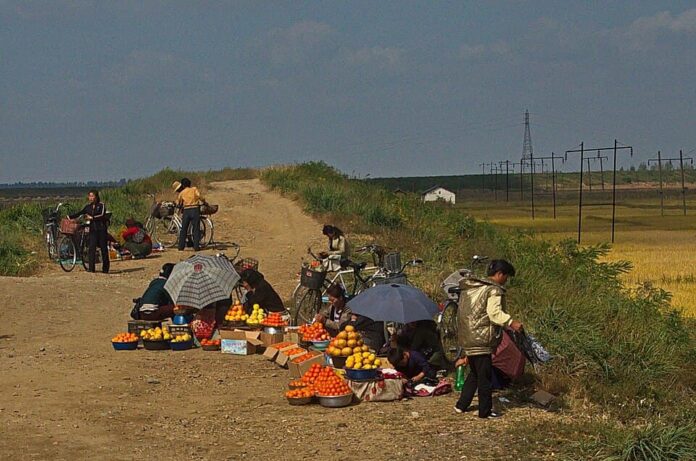
Poor road conditions across North Korea’s North Hamgyong province are driving up tire costs for drivers in 2026. Cracked asphalt, deep potholes and long unpaved stretches are wearing out tires within months of purchase. Many drivers now find themselves stuck in a costly cycle of repairs and replacements that eats into their earnings.
Drivers who earn a living with their vehicles in Hoeryong and Chongjin are growing frustrated by constant flat tires. A source in North Hamgyong province shared the complaints with Daily NK on Monday.
“Some drivers have to replace their tires again less than a year after putting on new ones,” the source said. “That’s why there’s so much anger about the state of the roads.”
Some roads in North Korea are paved, but the state rarely maintains them and many surfaces are in bad shape. The asphalt often cracks and potholes open up after the summer monsoon season and the winter freeze.
In most cases, local authorities handle repairs by mobilizing ordinary people and employees of state agencies and enterprises. North Korea routinely drafts citizens into unpaid labor for construction, farming and infrastructure projects. These campaigns often come with demands for cash or materials that work like an informal tax.
“Ordinary people who aren’t experts get mobilized for road repairs, and they have to pay for materials too,” the source said. “They also have to do the actual work themselves, which is a heavy burden on them.”
“Many of them take part only reluctantly, so they cut costs wherever they can,” the source added. “They spend the money they collect sparingly, and the repairs often end up being just for show.”
“Even after the roads are fixed, you can hardly see any difference, and they soon go back to how they were,” he said. “Drivers who keep using these roads pay for repairs and replacements over and over because their tires wear out so easily.”
Poor road conditions eat into drivers’ earnings
One driver in his 40s from North Hamgyong province spent 3,000 Chinese yuan (about $420) on new tires this spring. Even so, he has needed to have punctures patched several times since then, according to the source.
“Maybe it’s because the roads are so bad, but my tires keep getting holes and going flat,” the driver said. “It feels like I’m making money, but it keeps going into repairs for the tires and the rest of the car.”
“With more and more vehicles on the roads in our country, we need a ‘great road revolution’ now,” he said. “Otherwise, drivers like me will just keep getting stuck with the repair bills.”
The damaged roads cause more than inconvenience for travelers, since higher maintenance costs cut directly into what drivers earn. Tire repairs and replacements have become a recurring expense for drivers who carry passengers and goods for a fee. Privately operated vehicles, often registered under state enterprises, form the backbone of North Korea’s informal transport network.
The frequent tire damage has also kept demand for repair services steady inside North Korea, according to the source. As a result, the country continues to import Chinese-made tires along with the materials and parts needed to fix them.
“Rising demand for tires and repairs may mean more income for dealers and mechanics,” the source said. “But it also means drivers have to pay more, and they pass those costs on to their passengers.”
“In the end, the cost of these bad roads lands on everyone who rides in a vehicle,” he said. “People put their money and labor into road repairs, but nothing really improves, and then they pay higher fares too.”
“That’s why people call it pouring water into a bottomless jar,” the source said.
Reporting from inside North Korea
Daily NK operates networks of sources inside North Korea who document events in real-time and transmit information through secure channels. Unlike reporting based on state media, satellite imagery, or defector accounts from years past, our journalism comes directly from people currently living under the regime. We verify reports through multiple independent sources and cross-reference details before publication.
Our sources remain anonymous because contact with foreign media is treated as a capital offense in North Korea — discovery means imprisonment or execution. This network-based approach allows Daily NK to report on developments other outlets cannot access: market trends, policy implementation, public sentiment, and daily realities that never appear in official narratives.
Maintaining these secure communication channels and protecting source identities requires specialized protocols and constant vigilance. Daily NK serves as a bridge between North Koreans and the outside world, documenting what’s happening inside one of the world’s most closed societies.
Disclaimer : This story is auto aggregated by a computer programme and has not been created or edited by DOWNTHENEWS. Publisher: dailynk.com





