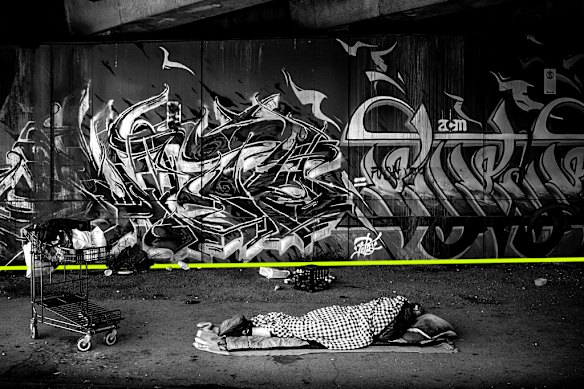
Street homelessness could be drastically reduced across Victoria over the next decade under an ambitious plan to find rough sleepers and connect them with services rather than waiting for people to seek help.
Under the $27.8 million statewide expansion of a program pioneered in inner Melbourne, teams of homelessness workers will be sent onto streets around Victoria to profile homeless people, build trust and connect them with housing and support.
Combined with new community housing projects and existing specialist services, experts in the sector say, the bolstered outreach offers a blueprint that can overcome rough sleeping and prolonged homelessness, provided current building efforts are stepped up.
Known as assertive outreach, this model of support workers going into the community and engaging with individuals directly rather than waiting for people to access services, will support Victoria’s work to develop a profile for every rough sleeper, known as a by-name list.
Former New York mayor Bill de Blasio, who plans to place the issue front and centre at October’s Melbourne Assembly, says the approach is key to tackling homelessness.
The Department of Families, Fairness and Housing Services is appointing services to operate the new assertive outreach programs in all areas of the state after success in inner Melbourne since 2018.
“For the first time, there will be a statewide network of assertive outreach teams helping connect more people sleeping rough with housing and support services,” a department spokesperson said.
The COVID-19 pandemic created an unprecedented need to house the homeless, resulting in 4500 Victorians being put up in hotels during lockdowns in an attempt to slow the spread of the virus, and showing what could be done when the issue was made a priority.
However, within two years of lockdowns ending, the number of rough sleepers had grown amid soaring rents and a continued lack of social housing.
Victoria consistently has the highest number of people seeking specialist homeless services in Australia, according to the Australian Institute of Health and Welfare, with one in every 63 people receiving assistance compared with the national average of one in every 92 people.
Where family and domestic violence was the most common reason Victorians sought services in the 2020-21 financial year, by 2024-25, the most common reason was financial difficulties, followed by family and domestic violence, and the housing crisis.
George Hatvani of homelessness organisation Launch Housing, is leading the Advance to Zero program, which promotes the use of assertive outreach and by-name lists, and has housed 850 people since its inception in July 2019.
“We know what it takes to end homelessness and end rough-sleeping homelessness – it’s a combination of housing and support in the right numbers and at the right times,” said Hatvani, who is the head of systems change and advocacy at Launch Housing.
“What we’re trying to do with Advance to Zero is show that for this group of people who are experiencing some of the most extreme forms of homelessness, it can be ended, and we can build the system that can do that, and that expands out to other living situations.”
While about 3 per cent of Victorians experiencing homelessness are sleeping rough at any one time, the true number affected is far higher, as many people transition through couch-surfing or crisis accommodation between periods on the streets.
Rather than waiting for people to seek help, assertive outreach workers find rough sleepers and work towards placing them in crisis and permanent housing, as well as connecting them to curated services.
Hatvani said assertive outreach might start with making eye contact with somebody on the street and buying them a coffee, but could eventually create a pathway to social housing.
“They’re dealing with, where am I going to be right now? Am I going to eat? Am I going to be safe?” he said.
“Our workers are then just trying to engage, to try to develop a relationship, trying to make themselves useful, and then slowly try to understand what’s happening for that person.”
After three decades of declining investment in social housing, such accommodation now accounts for only 3 per cent of Victoria’s housing stock. As a result, waiting lists can be two years or more.
Victoria’s Big Housing Build includes a pipeline of 11,000 new social housing properties. Advocates say this is a start towards reaching the 5 per cent social housing rate that is needed.
A recent addition is St Kilda’s Madden House, which opened in October 2025 to provide 26 self-contained units with on-site support services for rough sleepers with complex issues.
St Kilda Community Housing chief executive Andrew D’Arcy said the number of rough sleepers in the City of Port Phillip had been almost halved thanks to the $10 million facility, which is fully funded by the state government and Port Phillip Council.
The rest of St Kilda Community Housing’s 20 buildings, which house 341 people in the area, operate using the low rents its tenants can afford.
D’Arcy believes the Madden House blueprint could end Melbourne’s rough-sleeping issue.
“We can solve rough sleeping, but it does involve a little bit of investment,” he said. “Not everybody needs Madden House. Some people just need housing managed by an outfit like ours, that’s focused on them, that’s person centred, so the answer is there.
“I get surprised when I walk around the city and there is a lot of rough sleeping. I look at it and think this is quite easily solved.”
The rollout of a statewide by-name list will aim to profile every rough sleeper, prioritise those in the greatest need, and funnel the most appropriate services through a single trusted source.
Having pledged to tackle homelessness when he first ran for mayor of New York, Bill de Blasio said he soon realised the same approach did not work for very different people, and the city began building profiles in the same way Victoria is trying to do now.
“What we started to do was create a profile for each person of exactly what they had experienced, the different parts of their reality that were weighing them down, whether it was medical, physical, mental health issues, employment issues, criminal justice issues,” he said.
One example de Blasio gives is homeless people who can sometimes be reunited with their families – encouraged by a subsidy to cover any extra costs.
“There was a lot of these very real-world considerations, but we realised through our work that we weren’t even getting to the starting line because we didn’t have the right information. We weren’t individualising the approach. When we started to do that we saw a lot more success.”
Melbourne Assembly will be held from October 19 to October 21. More information is available on the Melbourne Assembly website.
From our partners
Disclaimer : This story is auto aggregated by a computer programme and has not been created or edited by DOWNTHENEWS. Publisher: www.smh.com.au