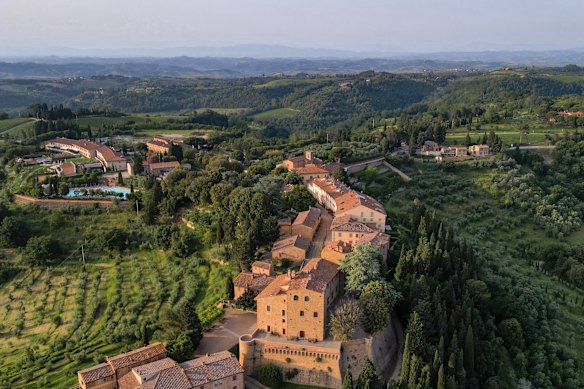

The Tuscan resort of Castelfalfi is at maximum capacity for its annual Spring Festival in late March – quite literally; it’s a sell-out.
In December, 30,000 people came for its Christmas market, so management made the smart decision to ticket this weekend event, while keeping it free for locals. Even so, it still seems like every family in the Pisa-Siena-Florence triangle is making an appearance at some point over the two-day program, if the line of parked cars lining every access road to the hilltop village is anything to go by.
As hotel guests, my 10-year-old daughter, Lottie, and I need only to flash our room key and we’re ushered straight past the security fence, where an explosion of music from competing loudspeakers awaits.
Some stallholders – selling everything from potted flowers to truffle paste and lots of pretty handmade jewellery (including a lemon pendant necklace blown from Murano glass that’s calling my name) – look increasingly fatigued by the mash-up of Britney Spears and ABBA blasting through the air from different directions.
I, however, am completely swept up in the buzz, singing along while sipping a Paloma spritz poured from one of the food trucks. In classic pre-teen fashion, Lottie – deep in her own culinary heaven thanks to a bombolone (doughnut) filled with Kinder chocolate – keeps her distance from her ever-embarrassing mother.
Sign up for the Traveller Deals newsletter
Get exclusive travel deals delivered straight to your inbox. Sign up now.
Via Castelfalfi Castello and Via Castelfalfi haven’t always been so lively. In fact, for most of the late 20th century, the two streets that made up this borgo were silent. In a copy and paste of thousands of medieval settlements across Italy, the hillcrest village had emptied; the last of its residents lured to the big smoke and the opportunities it offered in the 1950s.
The buttercream-toned huddle of stone buildings overlooking the Valdera – one of Tuscany’s lesser-known patches, yet only 45 minutes from both Pisa and San Gimignano – stood tall but forgotten, mementos of a bygone era when these valleys hummed with rural life.
Nearly two decades ago, German tourism group TUI acquired the entire village and its surrounding estate and took the first steps in transforming it into a high-end eco-resort. In 2021, it was sold to Indian-Indonesian billionaire Sri Prakash Lohia.
The new owner has raised the bar. Among Castelfalfi’s current accolades are two Michelin Keys and a Forbes Travel Guide five-star rating, no doubt hooked on features such as a signature suite designed by Stefano Ricci inside the village’s 14th-century castle.
Across the estate’s 1090 hectares, guests can book on-site activities ranging from truffle hunting and wine tasting to pizza making, lake fishing, e-bike touring and a night jeep safari.
A sleeping beauty awakened, Castelfalfi’s fairytale is part of a growing hospitality trend that’s breathing new life into Europe’s abandoned hamlets and villages.
Many of these villages-turned-hotels fall under the concept of albergo diffuso, Italian for scattered hotels. The term is a nod to the typical character of these properties: rooms spread across multiple buildings in a village, with guests navigating cobblestone streets and covered alleyways instead of internal staircases and lifts to access communal areas such as breakfast rooms, reception desks and restaurants.
Castelfalfi’s dining options include a sweet gelateria and a delicatessen straining under the weight of different styles of pecorino cheese, alongside a cosy pizzeria tucked along its main streets. Meals are accompanied by the estate’s olive oils (the rosemary-infused variety paired with freshly baked focaccia is a meal in itself), and attentive waitstaff top up my glass with elegant house wines.
Not all reborn villages come with Castelfalfi’s luxury trimmings – or price tag. Some of the most memorable reveal themselves only after dedicated internet sleuthing.
That’s how another Italian spot, Colletta di Castelbianco, appeared on my radar more than a decade ago. Near the French border in Liguria, the village was severely damaged in an 1887 earthquake. Inhabitants started to trickle away, and by the 1970s, the population was a mere five people. In the 1980s, a group of local entrepreneurs banded together to revitalise it, emphasising original materials and techniques in the rebuild. Ahead of its time – and certainly pre the global pandemic remote work boom – the project was imagined as a “teleworking” community, although now it has a definite out-of-office vibe.
The hamlet appears glued among thick vegetation to the slopes of the unspoilt Pennavaira valley, about 20 minutes inland from the seaside resort of Albenga. Its silhouette resembles a cluster of Greek Island homes, only with flat-roofed buildings fashioned from slate grey stones rather than whitewashed walls.
There’s nothing but nature’s greens for company, which I admire while floating in a lap pool built into the terraced landscape. A casual, vine-covered bar and bistro beckons for late afternoon aperitivo that drifts into dinner.
Tucked up in the northern reaches of France’s vine-speckled Languedoc region, Village Castigno is a scattered hotel in the village of Assignan that’s long been on my travel wish-list, too. While never abandoned, Assignan’s population had dwindled to less than 200, and the village’s demographics were steadily ageing when Belgian couple Marc and Tine Verstraete purchased and restored the nearby 12th-century chateau Castigno in 2007.
Late last year, when road-tripping across France’s Mediterranean arc with my sister and younger daughter, I thought I’d stumbled upon a savvy hack. Why pay €300-plus for a family room at the hotel when I could book a privately owned house in the village – with an “excellent 9.0 rating” on booking.com – for €77, instead? With the savings, I reasoned, we could splash out on dinner at Castigno’s acclaimed Thai restaurant, inside a spacious village house, and return as external guests for breakfast – coming out more or less even. Apart from where we slept, our stay would revolve around Castigno’s facilities.
Check-in with our friendly host is smooth and our cottage home, called La Maison De Blanche Neige (Snow White’s House) for the evening is, on first impressions, cute if not a little musty. We don’t linger, keen to reach Chateau Castigno’s tasting room before it closes for the day at 5pm.
Inside an impressive cork-wrapped structure shaped like a wine bottle when viewed from above, our cellar host shares the backstory: when the Verstraetes acquired the chateau and the surrounding vineyards, their intention was simply to make wines to enjoy with friends in their new home.
Opportunity soon came knocking. Not only did they snap up 150 hectares of land surrounding the chateau, but also derelict properties in the village at their doorstep. Today, guests lodge in one of 21 rooms in apartments and standalone houses, temporary neighbours alongside Assignan’s permanent population of 160.
As we swill and swirl the vineyard’s fresh, juicy sparkling rosé, I mention where we’re staying. Our host nearly spits out his wine: it turns out that Snow White’s House doubles as a “love room”, available for short-stay rendezvous of the “romantic” kind – explaining the hooks on the ceiling in the main bedroom.
We dissolve into laughter, the lesson swiftly learnt to book within the official scattered hotels themselves. Yet, our adventure makes for a great story when we return, and is one additional tale to add to the countless layers of history these old stone villages across the continent hold.
THE DETAILS
STAY
Castelfalfi (castelfalfi.com) doubles from €810, including breakfast; Colletta di Castelbianco (colletta.it) apartments from €88, based on double occupancy, direct bookings; Village Castigno (villagecastigno.com) doubles from €146 (open April to mid-December).
The writer, based in France, was a guest of Castelfalfi and travelled to Assignan and Colletta di Castelbianco at her own expense.
From our partners
Disclaimer : This story is auto aggregated by a computer programme and has not been created or edited by DOWNTHENEWS. Publisher: www.smh.com.au