Russian foreign minister questions ‘what will become of UK’ and future of ‘the Celts’
-
Published
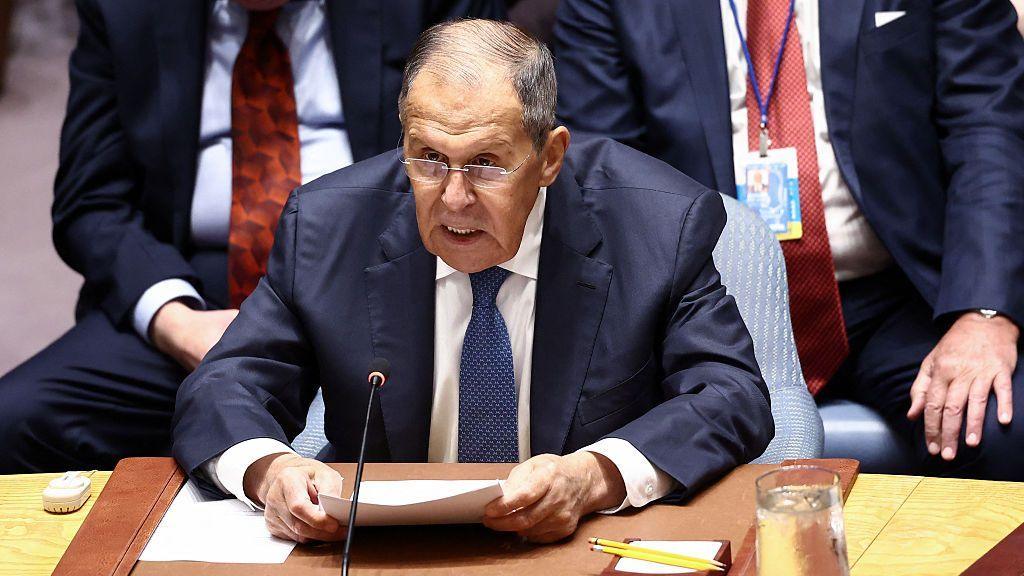
Russia’s foreign minister has questioned the future of the UK, suggesting it looks uncertain with “the Celts” looking to hold independence referendums.
Sergey Lavrov made the comments at a youth conference where he said he did “not know what will become of the country called Great Britain”, according to The Times, external.
The comments come weeks after the first ministers of Wales, Scotland and Northern Ireland declared “Westminster’s time is coming to an end” and signed an agreement to say it had no right to “block democracy”.
In response to Lavrov’s comments, Plaid Cymru said Wales’ constitutional future was “a matter for the people of Wales”, and “not for the Kremlin to endorse, oppose or exploit”.
In the conference, Lavrov also suggested the west had too much influence in the UN Security Council, external – the five permanent members are China, France, Russia, the UK, and the US.
According to The Times, he said: “The Celts — Wales, Ireland, Scotland — are now seeking to hold referenda.
“We do not advocate the expulsion of any of the permanent members of the security council. Although, of course, the scale of the British Empire, when it first took its seat in the UN security council at the organisation’s founding, has, naturally, diminished to the utmost degree.”
 Image source, ✎EPA/Shutterstock
Plaid Cymru won a historic Senedd election victory in May, which means for the first time the biggest party in each devolved parliament is pro-independence.
First Minister Rhun ap Iorwerth has declined to give a timetable for a referendum.
Former diplomat Craig Murray, who was jailed over blog posts he wrote about the trial of Alex Salmond in 2021, attended the international youth festival in Yekaterinburg after revealing he had been flown to the city by the Russian state.
In his blog, he said the meeting between the first ministers had been “featured with striking prominence” in Russian media.
 Image source, Getty Images
Ap Iorwerth said last weekend there was “no turning back” on the independence journey, as he became the first leader of Wales to attend a Yes Cymru march.
In response to Lavrov’s comments, a Plaid spokesman described Russia as an “existential threat to modern democracy”.
“Plaid Cymru believes firmly in the right of nations to determine their own future through democratic means. That applies to Wales, and it applies to Ukraine,” the spokesman said, referring to Russia’s full-scale invasion of the country in 2022.
They said the memorandum with the SNP and Sinn Féin was about “strengthening democracy, cooperation, and standing up for the interests of our nations and communities”.
“Wales’ constitutional future is a matter for the people of Wales, and it is not for the Kremlin to endorse, oppose or exploit,” the statement added.
Stephen Gethins, the SNP’s external affairs minister who had sanctions imposed on him by Russia, said: “The Scottish Government is committed to ensuring the people of Scotland have the democratic right to decide their constitutional future, just as we support the people of Ukraine and elsewhere in democratic Europe determining their future too.”
Sinn Féin has been asked to comment.
More top stories
-
-
Published8 hours ago

-
-
-
Published2 hours ago

-
-
-
Published5 hours ago

-
Disclaimer : This story is auto aggregated by a computer programme and has not been created or edited by DOWNTHENEWS. Publisher: BBC