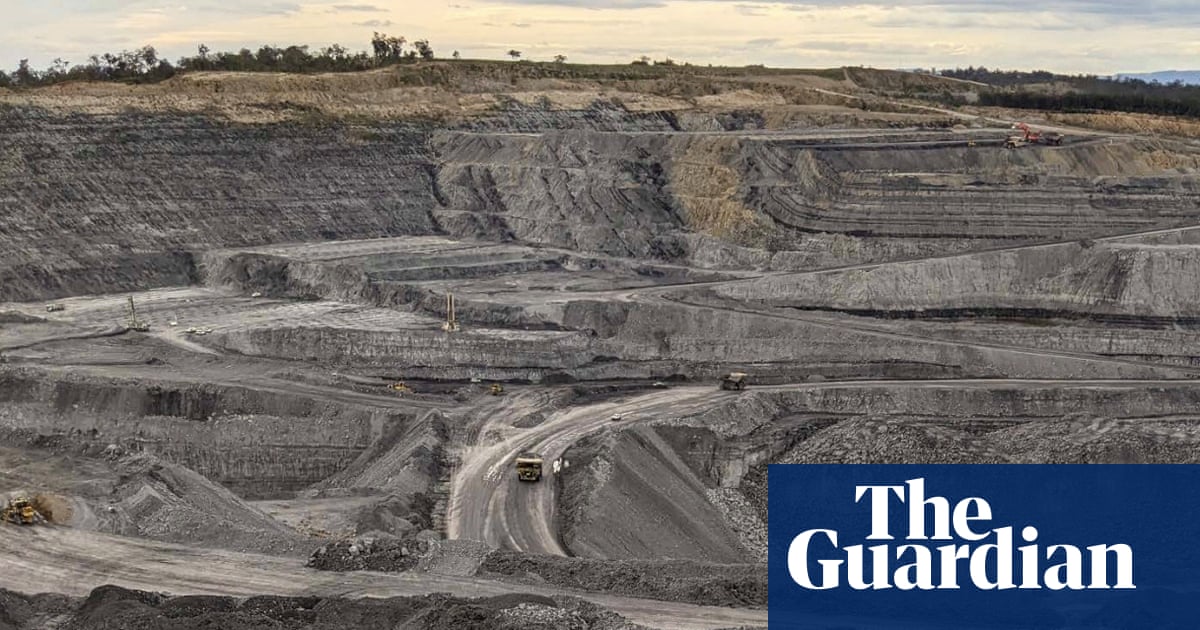
The biggest coal project before authorities in New South Wales, the HVO mine, will emit the equivalent of about 809m tonnes of climate-warming carbon dioxide if it wins approval.
That number, for most people, will carry little meaning, as might the calculation that adding that amount of greenhouse gas to the atmosphere will cause an extra 0.00036C of global heating.
But what if the public was instead told that that amount of carbon dioxide would expose almost half a million people to unprecedented heat, or kill nearly 15 million coral colonies on the Great Barrier Reef every time it bleaches?
All those statistics come from a new tool that translates the emissions from burning fossil fuels into estimated real-world climate effects taken from peer-reviewed climate studies.
“Small numbers in global warming can mean catastrophic impacts,” says prof Sarah Perkins-Kirkpatrick, a climate scientist at the Australian National University who is part of a team launching the Carbon Impacts Tracer.
The NSW Independent Planning Commission is expected to make a decision this week about the future of the HVO mine, with the joint owners Yancoal and Glencore hoping to keep digging at the Hunter Valley site until 2045.
Plugging the project’s expected emissions into the tracer suggests, for example, the extra heat trapped in the atmosphere by its emissions will reduce crop production every year by an amount that is the equivalent to the minimum dietary requirements of 276,129 people.
The tool can be used to estimate the impact of carbon dioxide emissions from any project, company or state – or for any known amount of emissions – across eight different factors including the loss of labour hours due to excess heat, the loss of glaciers, the death of corals or lost food production.
Central to the tool is a metric known as Transient Climate Response to CO₂ Emissions (TCRE) – an established calculation that every billion tonnes of CO2 causes about 0.45C of global heating.
Once an amount of CO2 is known – such as from a major fossil project – it’s contribution to global heating can be calculated and, from there, says Perkins-Kirkpatrick, measured against already published studies.
“Every tonne of CO2 maters and we’ve known this for decades,” she said.
“To pinpoint what this means with a high degree of confidence has taken us a long time. This [tool] is to hold big fossil fuel emitters accountable. It is not meant to be a blame game. It just shows that all emissions have impacts and now we can prove it.”
All the results are presented as the best estimate within a likely range of uncertainty, with links back to the original scientific studies used for the calculations.
Perkins-Kirkpatrick accepts some may be sceptical of the results, but counters “we are not making these numbers up for shits and giggles.”
“This is based on the best analysis published in the peer-reviewed literature,” she said. “
And this is only the tip of the iceberg when it comes to the impacts [of fossil fuel burning].”
The Carbon Impacts Tracer was developed by scientists at the Australian National University, the Australian Research Council Centre of Excellence for the Weather of the 21st Century and the Lethal Humidity Global Council, and was funded by the Minderoo Foundation.
Maria Nawaz leads the Australian Climate Accountability Project at the Australian Human Rights Institute at the University of New South Wales – a partner in the tracer project.
“One of the major challenges in climate litigation has been establishing a direct link between a government or a corporation’s actions and climate harms and suffering,” she said.
“Governments and corporations have argued their emissions are ‘just a drop in the ocean’ and too small to measure.
“But we can now refute this defence and show the emissions of any state or corporation can be tied to a global warming figure and then human and ecological harms. It is transformative.”
Elaine Johnson, an experienced climate lawyer and director of Johnson Legal but not involved in the work, said there will be governments and corporations that will not welcome the development of the tool.
“Fossil fuel companies do not want people to be able to make that connection between their products and, say, deaths from heatwaves.
“But now the science is at the point where we can make those connections clearly. That is a story the industry does not want told.”
The Guardian approached Glencore, a partner in the HVO mine, for comment, but received no response.
Disclaimer : This story is auto aggregated by a computer programme and has not been created or edited by DOWNTHENEWS. Publisher: theguardian.com