Managers of state-run grain stores in North Korea’s South Hwanghae province pushed rice prices well above market rates in September 2026. Provincial authorities summoned them over the price hikes, but the managers returned to work without facing real punishment.
The managers run grain stores in four counties of the province: Songhwa, Jaeryong, Unryul and Ryongyon. They were urgently summoned to the South Hwanghae provincial people’s committee on Sept. 19, a source in the province told Daily NK on Monday.
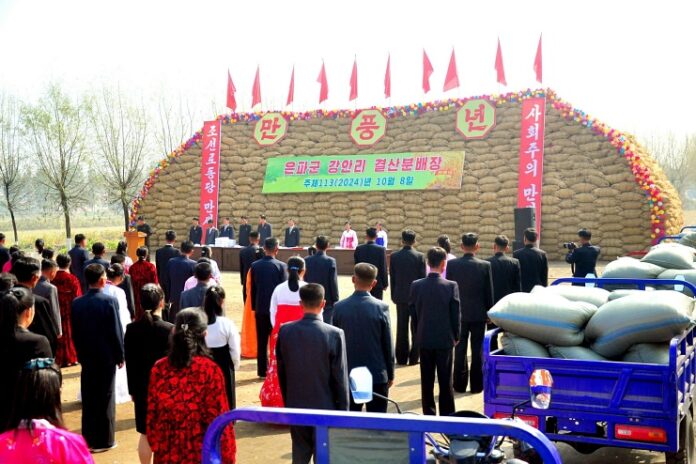
Under Kim Jong Un, North Korea has expanded its network of state-run grain stores in recent years. The policy aims to pull the rice and corn trade away from private markets and bring food prices back under state control. Donju, meaning “masters of money,” are newly wealthy entrepreneurs who finance much of North Korea’s commercial activity.
The grain stores began selling rice at 56,000 North Korean won per kilogram on Sept. 1. Market rice prices were hovering around 50,000 won per kilogram at the time, so the stores charged over 10% more.
Some stores sold large quantities of rice at that price from 8 a.m. to 8 p.m. every day. Within a few days, they had raised the price as high as 60,000 won.
Local people then filed a string of complaints with the provincial party committee, the source said. The managers were eventually called before the provincial people’s committee for questioning.
The managers were held separately at designated locations from Sept. 19 to 20, according to the source. There they attended ideological review sessions and wrote formal statements of self-criticism.
The provincial people’s committee accused the managers of four main violations of state pricing rules. First, they unilaterally raised the price to 56,000 won on Sept. 1. Rice was selling for around 50,000 won in other cities and counties across the province at the time.
Second, they set the price as a so-called “wholesale price” meant for bulk trading between merchants. Because it was not a retail price for ordinary customers, it pushed up rice prices in nearby markets.
The managers were also faulted for opening their stores for 12 hours a day without state approval. They were further criticized for later raising prices to around 60,000 won, which deepened supply instability.
Donju behind rice prices avoid harsh punishment
The harsh punishment that many local people had expected never came, however. “The managers wrote a few pages of self-criticism and went through an ideological review session,” the source said. “Then they went straight back to their stores as if nothing had happened.”
“At first it looked like officials were going to make a big deal of it,” the source added. “In the end, though, nothing much came of the whole case.”
The managers are not simply heads of state institutions but donju who have poured large sums into the stores. They reportedly used personal funds to build the store facilities and set up their own rice supply networks. They even pay the wages of store employees out of their own pockets, according to the source.
In some parts of North Korea, state agencies nominally oversee grain stores while private traders handle the actual business. Donju and merchants are deeply involved in procuring and selling grain behind the state’s official front. Some stores have recently begun raising grain prices ahead of local markets, which then drives up market prices.
The provincial people’s committee and law enforcement agencies reportedly found it hard to take firm action as a result. They feared that punishing or removing the managers could destabilize the local rice supply chain.
The source said the donju‘s long-standing financial ties with provincial officials also shaped how the case was handled.
“People say there isn’t a single provincial official who doesn’t owe these four donju a favor,” the source said. “If they shut down the grain stores, food distribution across every city and county would be in an uproar right away.”
The state set up these grain stores to control grain distribution and food prices across North Korea, yet the stores now depend on private capital and distribution networks to keep operating. That leaves authorities unable to firmly punish store operators who break the state’s own pricing rules.
Reporting from inside North Korea
Daily NK operates networks of sources inside North Korea who document events in real-time and transmit information through secure channels. Unlike reporting based on state media, satellite imagery, or defector accounts from years past, our journalism comes directly from people currently living under the regime. We verify reports through multiple independent sources and cross-reference details before publication.
Our sources remain anonymous because contact with foreign media is treated as a capital offense in North Korea — discovery means imprisonment or execution. This network-based approach allows Daily NK to report on developments other outlets cannot access: market trends, policy implementation, public sentiment, and daily realities that never appear in official narratives.
Maintaining these secure communication channels and protecting source identities requires specialized protocols and constant vigilance. Daily NK serves as a bridge between North Koreans and the outside world, documenting what’s happening inside one of the world’s most closed societies.
Disclaimer : This story is auto aggregated by a computer programme and has not been created or edited by DOWNTHENEWS. Publisher: dailynk.com