
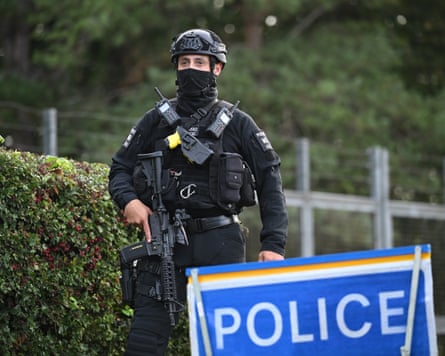
Good morning. Vehicles suspected of carrying explosives zipping across Britain, entirely unbeknownst to authorities, is a disconcerting prospect.
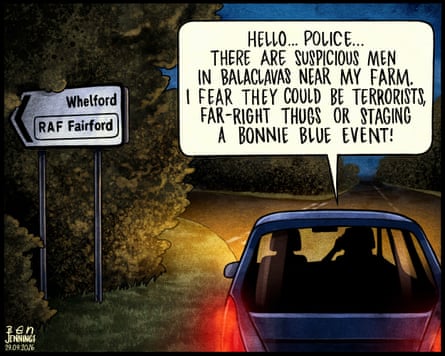
Initially, it seemed precisely this had occurred in Gloucestershire early on Sunday. A major attack on RAF Fairford appeared to have been scuppered by “pure luck”, a local farmer said, after she noticed suspicious vans and masked men on an otherwise deserted country lane. Had she not tipped off police, the vigilant villager believes the five men arrested on terror offences would not have been apprehended. That account prompted questions about whether police and security services had been caught off guard.
Bu new details emerging suggest there are competing, if not conflicting, versions of how events unfolded in the Cotswolds this weekend. So what exactly happened in the early hours of Sunday morning? In today’s First Edition, we’ll explore this, and some other unanswered questions, with the help of Guardian international security correspondent Jason Burke. Before that, this morning’s headlines.
Five big stories
-
Energy | Andy Burnham will take his first major step to putting Britain’s utility companies into public control when, at the Labour conference, he announces a new government-backed body to invest in the electricity grid.
-
Immigration | Home secretary Shabana Mahmood has signalled she is considering watering down her plans to make it harder for foreign workers to claim permanent residence in the UK, amid growing demands for a U-turn from cabinet colleagues and unions.
-
AI | Two of the “godfathers” of modern AI and senior executives at OpenAI and Anthropic have warned governments to prepare for an AI “intelligence explosion”, which they say could be the most consequential technological development in history.
-
Petrol | The price of diesel on UK forecourts has hit an all-time high average of 199.18p a litre, as the conflict in the Middle East continues to drive the cost of fuel to record levels.
-
Ebola | A senior member of the Democratic Republic of the Congo’s ruling party was beaten to death on Sunday after appearing on a radio programme to raise awareness about the Ebola outbreak, a party representative has said.
In depth: What we do (and don’t) know about a suspected bomb plot in the Cotswolds
In the early hours of Sunday, a farmer from the village of Whelford was travelling home from a party along quiet rural roads. She was about to drop off a friend, while her husband dozed in the passenger seat. Around 1am, however, she encountered three vans “parked in a really weird fan shape” blocking the path to her farm, close to RAF Fairford, an airbase operated by the US air force.
Forced to turn around, she then described seeing “a large group of hooded and masked men” at a nearby junction, who quickly dispersed.
After a failed attempt to contact the Ministry of Defence, she phoned the police at 1.36am and posted in the local residents’ WhatsApp group. Roughly 10 minutes later, armed officers were on the scene. Five men were arrested 300 metres from the base’s perimeter, first under the Explosives Act, and subsequently also on suspicion of preparing a terrorist act. All five – UK nationals from London aged between 23 and 25 – were released on bail yesterday.
In interviews, the farmer, who has remained anonymous, reiterated her belief that her tip off “foiled whatever plans” were unfolding. “I am absolutely staggered that it was left to me, as a member of the public, to see and report this,” she said.
That the high-security site was so exposed, and that the vans suspected of carrying explosives in its vicinity went totally unnoticed, has since raised questions. While thanking the farmer for her efforts, defence secretary Wes Streeting was quick to cast doubt on her assertions, hinting that UK security services were aware and that her account only offered “a partial picture”.
Donald Trump has claimed the US and UK agencies worked together and had the five men “under view for a long time”, adding the suspects “were looking to do big damage to our fort, and working with the British worked out great”.
The farmer acknowledged there had been “activity” by what she “assumed were plain-clothed police officers” in the area in recent days. Another local told the BBC that while walking their dog early on Saturday evening they were stopped by armed police and told to return home.
Gloucestershire constabulary said they were first alerted to the suspicious vans at 12.45am on Sunday – almost an hour before the farmer’s 999 call. Counter-terror police have confirmed the three vehicles had been travelling overnight and been subject to extensive examination, with the support of military assets and forensic experts. It is now understood that the material found inside them was not viable explosives, but police have said the investigation is continuing.
And then there’s the expeditious nature of the response: the speed with which armed officers and police helicopters arrived at a rural location in the middle of the night appears improbable.
Questions around the arrests
Police are still working to establish motive. Yesterday afternoon, the head of UK National Counter Terrorism Policing, Laurence Taylor, confirmed it may have been the work of proxies, or individuals working on behalf of a foreign state.
On Monday night, US secretary of state Marco Rubio told Fox News that a foreign actor was involved in the suspected plot, but provided no evidence for his claims.
Iran is the centre of speculation, having explicitly stated it considers RAF Fairford “a legitimate target”. Yesterday, the Iranian embassy said it “categorically rejects” any involvement.
Used by the US military for decades, RAF Fairford’s two-mile long runway was specially constructed by the Americans to allow long-range bombers to take off and land. Fairford has played a significant role in Trump’s war on Iran; since former prime minister Keir Starmer allowed the US to use UK bases in its assaults, bomb-laden American B-52 and B-1 planes have regularly been spotted taking off. The airbase is one of only two available to the US in Europe that can facilitate these operations, after Spain, France, Italy and Switzerland rejected similar American requests.
“Most observers and analysts would place Iran at the top of the list of potential suspects here,” Jason Burke, the Guardian’s international security correspondent, tells me, “though we have very little in the way of information to work on, so it’s entirely possible an altogether different scenario is at play.”
As for the five suspects, their being British nationals is likely of little help when determining who may be behind the plot. “The Iranian modus operandi – borrowing a leaf from the Russian playbook – relies on using local hires,” Jason says. “Instead of deploying their own intelligence operatives, they recruit low-grade agents on the ground, some of whom may not fully realise what they are involved in.”
Growing security concerns
Since the US-Israel war on Iran began, a series of UK security incidents have been linked with Iran. Earlier this month, a man and a woman were arrested after raids on homes in north London on suspicion of assisting Iran’s foreign intelligence service. In March, four Jewish community ambulances were destroyed in an arson attack – counter-terror police explored the possible involvement of Iranian proxies, though aside from a reference to a “terrorist connection”, no mention of Iran was made by prosecutors in court when four men admitted responsibility.
Similar suggestions have been made about tens of other antisemitic attacks in the UK and Europe – Iran’s embassy in the UK has denied any involvement.
In April, Jason reported that, while direct proof of Iran’s involvement in incidents on UK soil remained elusive, the consensus among security officials was the attacks look to be part of a campaign of hybrid warfare launched by Tehran. Since then, Jason says, more evidence has emerged, in part due to the prosecution of 32-year-old Iraqi national Mohammad Baqer Saad Dawood al-Saadi in a US court. “This case laid out in extraordinary detail how he, on behalf of the Iranian Revolutionary Guards Corps, commissioned, organised, and executed a series of attacks in Europe, including in Britain.”
A significant escalation
If Iran is proven to be responsible, an intended attack on this scale would represent a significant escalation. “It would be a major step up from targeting synagogues, Israeli embassies and US-owned banks,” says Jason, “given this is a piece of major military infrastructure in Britain.”
With Andy Burnham leading a new government, it’s possible there may be a recalibration of UK foreign policy. He has said he’d be willing to deviate from Trump when necessary. Burnham’s foreign secretary, Ed Miliband, was reportedly central to attempts made during a national security meeting to dissuade then-PM Starmer from granting the US permission to use UK bases. But this would not significantly alter the risk of attacks, Jason says. “Iran’s targets are not necessarily chosen to directly punish a country; most experts believe they are selected to sow division in societies, distract policymakers, and divert resources.”
For now, the investigation continues.
What else we’ve been enjoying
-
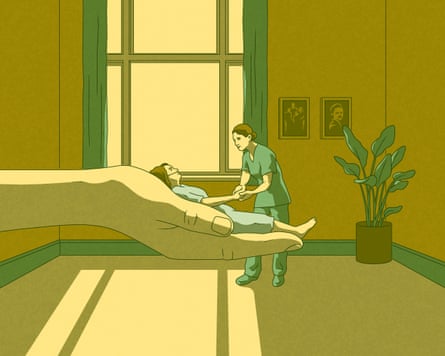
Palliative nurse Jane Turner makes a poignant point in this column: regardless of your belief about assisted dying, every side agrees on the need to radically improve end-of-life care in the UK. Charlie Lindlar, newsletters team
-
I devoured Jess Cartner-Morley’s interview with Celia Birtwell, in which Birtwell talks about her friendship with David Hockney and her marriage to Ossie Clark: “He was spectacular, at the beginning,” says Birtwell – even if he did leave her the day after their wedding, pregnant, to honeymoon in Barbados on his own. Lucinda Everett, newsletters team
-
Some vital tips in this piece by Sarah Phillips on the conversations every couple should have to keep a household running safely and happily – I’ve already pencilled in my first weekly “check-in”. Charlie
-
All of the photographs in this gallery of the Porthcawl Elvis festival are wonderful. But my favourite has to be of Brian, AKA Smurf Elvis, who remixed his costume this year after a decade of attending the largest gathering of Elvis fans in Europe. Lucinda
-
Rob Draper’s look back at how Arsenal’s hiring of Arsène Wenger changed football is brilliantly reported – make sure to share it with your nearest mustachioed graphic designer friend called Sam, Ed or Harry. Charlie
Sport
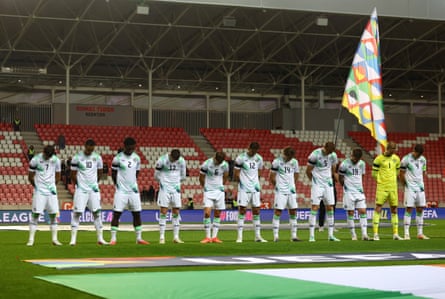
Nations League | Israeli football team captain Manor Solomon has hit out at Ireland after his team’s 3-o loss in a politically charged Nations League game, saying “They hate us and we don’t like them.”
Rugby | In west Wales, fans want to know why the Scarlets and Ospreys, two teams who have won titles and turned out hundreds of Test players, are on the chopping block under the Welsh Rugby Union’s proposal to cut a club by 2028.
Football | The Fifa president, Gianni Infantino, is poised to bow to demands from Uefa and Concacaf to distribute more money from its $6bn cash reserves to member associations.
The front pages
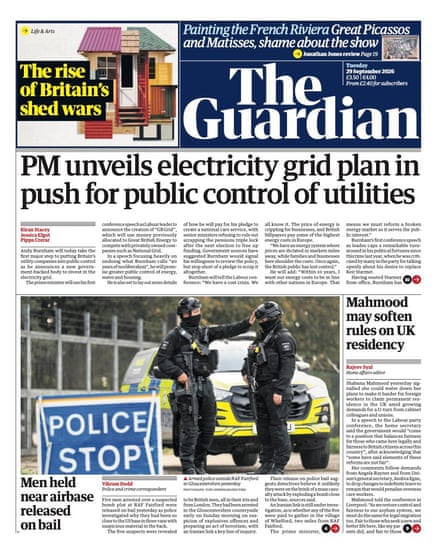
The Guardian splashes on “PM unveils electricity grid plan in push for public control of utilities”. The Mail leads with “PM to vow public control of energy, water and housing” and the Mirror looks at Burnham’s energy prices pledge with “Taking back power”. The Financial Times also reports “Burnham to outline plans for social care, welfare and ‘control’ of utilities.”
The Times goes with “Labour split on prospect of ending triple lock”, the Telegraph has “Burnham signals end of triple lock”, while The i Paper says “End of UK state pension triple lock moves a step closer”. The Sun looks at the RAF terror drama, asking “Plot’s going on, PM?”
Today in Focus

The Pussy Riot activist turned Kremlin informer
In August, Rita Flores, a Russian artist, activist and former member of the Pussy Riot collective, revealed in a video that she had been working as an informant for Russia’s FSB security service, a cooperation she only broke days after fleeing the country. Masha Alekhina, a founding member of Pussy Riot who was jailed for her support of the group and fled the country, tells Helen Pidd about why she does not feel angry at her former comrade in activism.
Cartoon of the day | Ben Jennings
The Upside
A bit of good news to remind you that the world’s not all bad
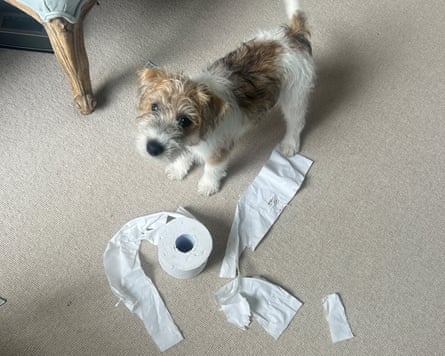
Our weekly series The pet I’ll never forget is always a source of joy. And the story of scruffy little terrier Dennis is no exception.
Sophia Money-Coutts got Dennis in 2024 with her then-boyfriend, but within three months the couple had split. “I was distracted from my sadness by this small, bouncy, intensely disobedient dog,” says Money-Coutts, explaining that he raced after every squirrel, raided her bins, licked a man she was dating during an amorous moment, and “once farted on Jilly Cooper’s sofa”.
Dennis had accompanied Money-Coutts, a journalist, to an interview with the animal-loving novelist, whose response was typically indulgent. “It doesn’t matter a bit, does it darling?” she recalls Cooper crying, clutching Dennis closer to her. “He can do whatever he likes.”
Sign up here for a weekly roundup of The Upside, sent to you every Sunday
Bored at work?
And finally, the Guardian’s puzzles are here to keep you entertained throughout the day. Until tomorrow.
Disclaimer : This story is auto aggregated by a computer programme and has not been created or edited by DOWNTHENEWS. Publisher: theguardian.com




