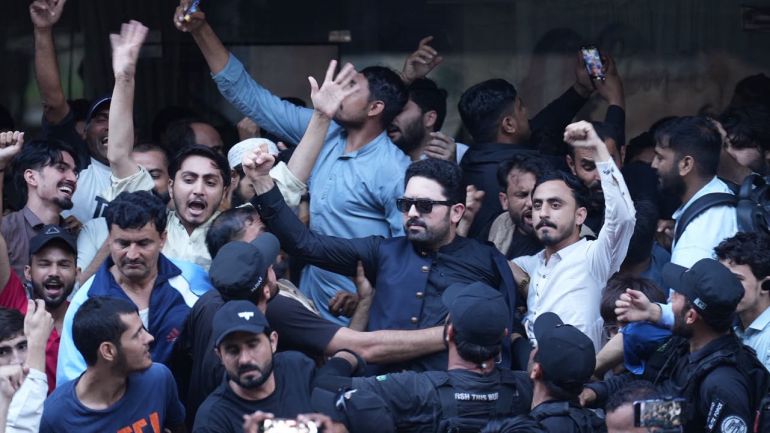
Islamabad, Pakistan – On Wednesday, Sohail Afridi, the chief minister of Khyber Pakhtunkhwa province, sat at the head of a long table in Peshawar, hands clasped in front of him, and opened the 59th meeting of his cabinet.
He was dressed in black and leaned forward as he spoke. When he reached the sharpest lines of his address, his voice dropped and slowed rather than rose.
Recommended Stories
list of 4 itemsend of list
For the past several days, he told his ministers, “plainclothes thugs” had been targeting his workers, officials and elected representatives from his party, the Pakistan Tehreek-e-Insaf (PTI).
Two of Afridi’s provincial ministers were targeted in a single week: One survived an assassination attempt and an abduction attempt. The other was ambushed near a motorway toll plaza and abducted. His whereabouts are still unknown.
“Khyber Pakhtunkhwa will be cut off from the rest of Pakistan,” he told his ministers, adding that all routes into the province were being sealed by the federal government. “The rest of Pakistan will remain open, but no one will be able to enter or leave Khyber Pakhtunkhwa.”
“Is an attempt being made to repeat a tragedy like East Pakistan?” he asked – referring to the secession of Pakistan’s eastern wing in 1971 and its independence as Bangladesh – before rejecting any suggestion of separatism: “We were Pakistanis, we are Pakistanis and we shall remain Pakistanis.”
The crackdown came as PTI was preparing for a march on Islamabad, its biggest mobilisation in nearly two years, to demand the release of party founder and former Prime Minister Imran Khan. The ex-premier has been in jail for more than three years but still commands widespread popularity across the country.
Advertisement
The march was initially scheduled for Sunday. But two days before the protest, after the government of Prime Minister Shehbaz Sharif arrested Khan’s sisters and tried to block entries to the national capital from Khyber Pakhtunkhwa, Afridi announced it had been pushed back by a week.
The decision to start the march on this coming Sunday, he said, was not an act of “surrender” but one driven by “political strategy”.
“I said the long march will happen, come what may,” he said. “So it will, on October 4.”
With Khan behind bars, the 37-year-old Afridi has emerged as the party’s leading mobiliser as it seeks to challenge Sharif’s government, which came to power through controversial elections in 2024, in which the PTI was barred from contesting under its own symbol.
He is the PTI’s senior-most elected leader and the fulcrum around whom its protests for Khan’s release have revolved: addressing cabinet meetings one day, facing abduction claims of his own another.
When the protest is held, he warned, the crowds “will not be under anyone’s control” and would not return home until their demands are met. “On October 5,” Afridi said, referring to the date that is also Khan’s birthday, “we will celebrate a day of victory.”
The other Afridi
Nearly 10 days earlier, the same man had looked nothing like this.
He was in Lahore to condole with the family of a PTI worker and to generate support for the upcoming rally.
On September 14 after police arrested party workers, he climbed into a police van and refused to get out until they were freed. The van initially drove off with him inside before he was dropped off soon after.
Sweat-drenched and dishevelled, he was on the roadside, alleging a conspiracy to abduct him and accusing his political rivals of trying to break up the country.
“Their intention is to divide Pakistan,” he said. “They want to spread division. They want Pakistan to break apart.”
Moments later, addressing his own workers, his tone shifted.
“Stay peaceful,” he told them. “They want to provoke you, spread chaos. You must not do that. Sit calmly.”
Punjab’s information minister, Azma Bokhari, released footage she said showed Afridi boarding the police vehicle voluntarily and dismissed his account of an attempted abduction as “total drama”.
But it is the Khyber Pakhtunkhwa chief minister’s ability to marry those two personas – an executive in the cabinet room and a combative agitator on the streets – that make him a special politician, say analysts.
Advertisement
Mehmood Jan Babar, a veteran Peshawar-based political analyst who has watched him closely, says he finds it hard to place Afridi in one register.
“I see him the way we watch someone who does comedy in films and gets typecast as a comedian. Then suddenly they are a romantic hero, and other times a martial arts expert,” Babar told Al Jazeera. “He is constantly shifting his persona.”
Afridi is the youngest to hold the post in the province’s history, and the first from its former tribal districts.
But as the PTI’s latest campaign to free Khan picks up steam, he is also increasingly assuming a national role.
From Bara to Peshawar
Afridi was born on July 12, 1989, in Bara Tehsil, a district on Khyber Pakhtunkhwa’s border with Afghanistan, which has long been a front line in Pakistan’s fight against rebellion.

He is the third of five brothers from a middle-class family of the Shalobar tribe, and unlike the norm in Pakistani politics, does not have political lineage.
His family moved to Peshawar in 2008 as military operations swept his home district.
He studied economics at the University of Peshawar and, drawn to Imran Khan’s rising party, threw himself into student politics, joining protests against US drone attacks and the case of Raymond Davis, an American contractor who killed two men in Lahore in 2011.
Afridi rose through PTI’s Insaf Students Federation (ISF), becoming its campus president at Peshawar in 2015 and eventually head of its youth wing province-wide.
When Khan was arrested in May 2023 and much of PTI’s leadership went underground, Afridi stayed visible, a loyalty that would matter later.
Hashim Khan Afridi, a friend from Bara who has known him for several years, says he is an unusual fit for the party.
“PTI members have no tolerance for dissent or introspection; they cannot hear criticism,” he told Al Jazeera. “But Sohail is smart, patient and, above all, tolerant of criticism. He listens to people. He has the patience and the ability to communicate well.”
Afridi won a provincial assembly seat from Bara in February 2024, contesting as an independent under the symbol of a grandfather clock because PTI had been barred from using its own symbol, the cricket bat – Khan, its leader, was Pakistan’s greatest cricketer.
In that election, Afridi polled more than 31,000 votes against a rival’s 7,000. Hashim says the margin owed less to Afridi’s own standing than to the wave of anger PTI rode that year.
“Sohail had left the tribal areas long before and spent his formative years in Peshawar. Hardly anybody knew him well enough to vote for him individually,” he said. “It was his PTI affiliation that enabled his victory.”
Former Chief Minister Ali Amin Gandapur brought him into the cabinet. But in October 2025, almost a year after a protest march in November 2024 led to a deadly crackdown on PTI supporters, the party’s leadership confirmed that Khan had personally ordered Gandapur to step aside in Afridi’s favour.
Advertisement
Taimur Khan Jhagra, a senior PTI leader and former provincial minister from Khyber Pakhtunkhwa, framed the appointment as ideological.
“He is not from a political or affluent background but was groomed in PTI’s student politics. Khan has made him chief minister because he strongly believes that non-traditional politicians are more ideological, more in touch with ordinary Pakistanis,” Jhagra told Al Jazeera.
One of Afridi’s cousins says the family learned of his nomination from social media.
“I really don’t know why or how his name was mentioned to Khan,” he told Al Jazeera, requesting anonymity due to familial ties. “All I can say is that this is sheer luck and grace of God.”
An unspoken truce?
Afridi entered office in October 2025 as a combative voice on security.
He rejected federal police equipment as “insulting” and, when asked about military operations in the tribal districts, said he had never supported them and never would.
![Pakistan prime minister Shehbaz Sharif met Khyber Pakhtunkhwa chief minister Sohail Afridi on February 2, 2026 in Islamabad. [Handout/Prime Minister's Office]](https://www.aljazeera.com/wp-content/uploads/2026/02/PMO-office-photo-SA-and-SS-1771964223.jpg?w=770&resize=770%2C546&quality=80)
The remarks drew a sharp public rebuke from Ahmed Sharif Chaudhry, the military’s chief spokesperson, who noted that more than 80 percent of armed attacks in Pakistan at the time were occurring in Khyber Pakhtunkhwa.
“Nobody is talking about their governance,” he said in December last year. “Please grow up. Talk about real issues.”
Thousands of families were displaced from Tirah Valley, Afridi’s own home region, during a winter military operation soon after.
His record since has not matched the early rhetoric, according to a senior party leader, who requested anonymity to speak candidly.
“Here’s a person who, on entering office, criticised the military so intensely,” this leader said. “And then this same person goes completely silent while his own tribespeople are dying daily in drone strikes.”
But Aamer Raza, an assistant professor of political science at the University of Peshawar, says attributing that shift to any capitulation by Afridi would be a simplistic assessment.
Judged purely on governance, Raza said, Afridi’s tenure has been “too short and too tumultuous” to fairly pass any verdict on him. The province’s development work remains mostly limited to Peshawar, where underpasses are under construction, he says.
“The issue is that although he has tried his best, the efforts have looked a bit desperate and without much consequence,” Raza said. “Outside of the last few days, when matters seem to have gone out of hand, his ministers were the ones calling the shots.”
Afridi has held direct talks with senior military officers but came away frustrated.
“It always comes down to relief for Imran Khan, and they tell him that goes above their pay grade,” he said.
The one clear break from confrontation came on February 2 this year, when Afridi met Prime Minister Shehbaz Sharif in Islamabad, a government the PTI does not recognise as legitimate.
“Perhaps as a political worker, I would never have sat there,” he said afterwards. “But I deemed it appropriate for my people and my province.”
When fighters attacked a police compound in Kohat on September 18, killing at least 21 people, most of them police, Afridi visited the district. He met victims’ families and announced compensation beyond the province’s standard martyrs’ package, calling for a shift in the country’s strategy in fighting armed groups after what he called 22 years of a failed approach.
It was the kind of balance – empathy for security officials killed in operations, coupled with calls to move away from a military-first strategy in combating armed groups – that analysts say is increasingly rare in Pakistani politics.
Advertisement
The road to the march
By August, with every legal channel exhausted to get relief for the imprisoned Khan, Afridi announced a march to Islamabad for September 27.

It was to be PTI’s second march since Khan’s imprisonment on August 5, 2023, and was announced at a rally in Peshawar marking three years since Khan was first jailed.
Within days, PTI’s Central Information Secretary Sheikh Waqas Akram said the party’s national leadership had not been consulted on the date. Then, on August 18, the Supreme Court ordered Khan transferred to Shifa International Hospital within 48 hours, with a medical board that included his sister, Dr Uzma Khan, and his personal physician, Dr Faisal Sultan.
The government defied the order. In the early hours of August 21, Khan was taken not to Shifa but to the government-run Pakistan Institute of Medical Sciences.
That evening, at a news conference in Islamabad, Afridi sat for nearly 20 minutes without speaking while Uzma described the night.
Khan, she said, had a message for him: “He specifically told me, tell Sohail to speed it up.”
Afridi’s fury, when he spoke, was unmistakable. “This is contempt of the judges. This is contempt of the Supreme Court,” he said, warning that Pakistan risked becoming “a banana republic” if judges could not enforce their own orders.
What followed was an escalating confrontation, much of it outside his province.
In September, Sindh authorities blocked his convoy into Karachi despite an earlier welcome from Bilawal Bhutto Zardari, the chairman of Pakistan People’s Party, which leads the Sindh province.
“They have no control over their own chief minister, or is someone else running the government?” Afridi asked at a toll plaza outside the city.
As he pushed for the march in his role as chief mobiliser for the party by continuing his canvassing in Punjab, the personal attacks on him mounted.
On September 14, the Federal Constitutional Court admitted a petition from Sher Afzal Marwat, a former PTI leader expelled from the party in 2025, arguing that Gandapur’s resignation was coerced by Khan when he was himself constitutionally disqualified following his imprisonment, and that as a result, Afridi’s own election was void.
The same day, an antiterrorism court ordered Afridi’s passport blocked, and subsequently, the Islamabad High Court barred provincial governments from using state resources for the September 27 march, warning that any office holder who violates citizens’ rights in the capital risks being found to have breached the Constitution and his own oath of office.
Interior Minister Mohsin Naqvi has not ruled out imposing governor’s rule in Khyber Pakhtunkhwa. Information Minister Attaullah Tarar has told Afridi directly to leave office if he cannot deliver for the province.
The imposition of governor’s rule would involve the removal of the elected government, and Islamabad ruling Khyber Pakhtunkhwa directly through the provincial governor – who is appointed by the federal government.
Asad Umar, a former PTI secretary-general and federal minister who left the party in 2023, dismissed Tarar’s remarks as “something of a joke”.
He argued the constitutional grounds for governor’s rule do not exist and that even this government is “not foolish enough” to impose it given Khyber Pakhtunkhwa’s security situation.
Jhagra, the senior PTI leader from Khyber Pakhtunkhwa province, was more defiant.
“Let the federal government impose governor’s rule if they want. We are not in this struggle for government,” he told Al Jazeera.
On September 20 and 21, Khan’s three sisters, Aleema, Uzma and Noreen, were detained in Lahore under Punjab’s public order law and moved to Kot Lakhpat jail.
A month after Uzma had relayed Khan’s instruction to Afridi to “speed up” the movement for his release, the Khyber Pakhtunkhwa leader’s role in the PTI’s future is now even more central. He isn’t the party’s formal leader, or a central PTI office holder. But he’s the one the party and its supporters turn to, in deciding how and when to push ahead with the march now set for October 4. And he’s the only party chief minister, with the resources and ability to mobilise numbers needed to make the party heard.
Whose party is it?
Despite Afridi’s rising national profile, the PTI continues to struggle with a leadership vacuum in Khan’s absence.
![Sohail Afridi sitting with Gohar Ali Khan (left), PTI’s chairman in Imran Khan’s absence [Courtesy of Sohail Afridi Official Facebook page]](https://www.aljazeera.com/wp-content/uploads/2026/09/787993190_2022418015081107_8999475816895560644_n-1790283786.jpg?w=770&resize=770%2C513&quality=80)
“The only person who, under any circumstances, can keep this party on one page is Imran Khan, whether he’s inside jail or outside it,” PTI Central Information Secretary Sheikh Waqas Akram told Al Jazeera. “All this party needs to unite is Imran Khan’s confidence.”
With Khan cut off, no one has filled the space he occupied, and analysts say the party has fragmented around him.
Raza, the academic and analyst, says the same dynamics extend to the party’s most senior figures.
Gandapur, he said, has largely withdrawn from active politics citing illness, while his brother has publicly mocked Afridi’s efforts to lead the movement.
Aleema Khan, meanwhile, before her arrest, had taken an increasingly outsized role in shaping party policy, according to Raza.
Babar goes further, arguing Khan’s own decision-making inside prison has become unreliable.
“Whoever used to get time with him in jail with their version of events, he believed them. Then someone else would come, presented their side, and he took that seriously too, even contradicting what the previous group told him,” he told Al Jazeera. “This trust deficit exists at the senior level within the party, but it also confuses workers on the street.”
Afridi himself, Babar said, has never had the chance to test that judgement directly.
“I don’t think Sohail Afridi will be able to secure Khan’s release unless Khan himself arrives at a firm decision. For any final decision, party leaders still seek permission from Khan, and they lack confidence. How can they act? Sohail, in fact, hasn’t even managed to meet Khan as yet.”
Umar disputes that any of this amounts to a structural crisis, and also rejects the criticism that Afridi has neglected his province.
Central leadership, he added, has been largely stable, with PTI Chairman Gohar Ali Khan still chairman, Secretary-General Salman Akram Raja still in place and Akram still information secretary.
“There’s actually been reasonable consistency in leadership,” he said, arguing Afridi’s own authority as chief minister is not seriously in doubt.
The inner circle
On one point, though, there is little disagreement: Getting hold of Afridi is difficult.
![Sohail Afridi speaking at Islamabad's Khyber Pakhtunkwa House during a meeting with journalists on May 14, 2026. Provincial information minister Shafi Jan is sitting on Afridi's right. [Abid Hussain/Al Jazeera]](https://www.aljazeera.com/wp-content/uploads/2026/09/PXL_20260514_122618268.PORTRAIT-1790283971.jpg?w=770&resize=770%2C580&quality=80)
Afridi runs the province through a small circle of aides, party insiders say, and answers to almost no one outside it.
Even Raja’s calls have reportedly gone unanswered for three or four days at a stretch, and recent friction with allied opposition leaders Mahmood Khan Achakzai and Allama Nasir stemmed from the same pattern, both trying to reach him and not hearing back.
One senior party figure, speaking on condition of anonymity, described Afridi as “overawed by the size of responsibility on his shoulders,” and said his inner circle consists, more or less, of whoever came up with him through PTI’s student wing in Peshawar.
For seven months, Al Jazeera, too, sought an interview with Afridi through his office, his advisers, his party and people close to him – without success.
Surprisingly, during a press meet-and-greet in May in Islamabad alongside a cluster of other journalists, Afridi was animated, direct and generous with his time, exactly as he appears in the news conferences and rallies.
That contrast, a man constantly visible on camera and consistently unreachable for a one-on-one conversation, is consistent with what people around him describe.
What winning looks like
Everything Afridi has done since early August is built towards the upcoming march demanding Khan’s release.
What would success in the march look like? That’s a question the PTI has struggled to answer.
Its own senior figures, when pressed, describe not one version of victory but several, each pulling in a different direction.
For Umar, a top confidant of Khan when the party was in power, the answer is vague by design – to allow the PTI to calibrate its approach based on how the government responds.
But he does not believe PTI’s supporters would accept a token concession, such as a temporary hospital transfer for Khan, as a real victory.
Raza is more sceptical still.
![Sohail Afridi has been tasked with being the chief mobiliser for the upcoming PTI rally on September 27 to Islamabad [Courtesy of Sohail Afridi Official Facebook page]](https://www.aljazeera.com/wp-content/uploads/2026/09/820155780_2084442072431927_3105713826038591935_n-1790284448.jpg?w=770&resize=770%2C513&quality=80)
Supporters, wary after the violence of May 2023 and November 2024, may be reluctant to come out in force, he said, adding that any push towards Islamabad “would feel like escalation” that hands the government grounds to clamp down further.
“The best political outcome for PTI and for the province would be if they settle for what they are offered, and then frame that as success,” Raza said.
Jhagra takes the opposite view. “In this environment of unprecedented oppression, continuing to struggle is already a marker of success,” he told Al Jazeera.
Khan’s popularity, he argued, “hasn’t dropped one iota in four years; it has only increased.”
Akram had a different parameter for success.
“Large numbers of people coming out, and remaining peaceful, that is the criterion for success,” he said. “If they don’t come out in large numbers, then, frankly, this becomes a non-starter. There’s no other measure of it that matters.”
Afridi, though, it appears, has not waited for his party to agree on what winning means.
He has said, during his recent speeches in Khyber Pakhtunkhwa’s Hangu city and elsewhere, that he will personally lead the march whatever happens on the day, treating the question of outcome as secondary.
“The greater the tyrant, the bigger the coward he truly is,” he told his ministers, hands still clasped in front of him, his voice firm but deliberate. “You must not panic, and you must not fear.”
Disclaimer : This story is auto aggregated by a computer programme and has not been created or edited by DOWNTHENEWS. Publisher: aljazeera.com