Updated ,first published
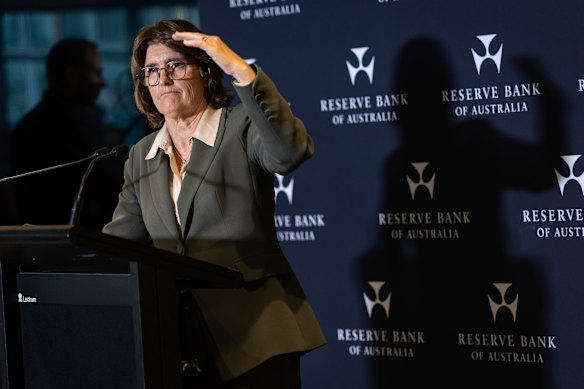
Australian borrowers could face a run of rate hikes after RBA governor Michele Bullock warned an economic downturn may be needed if politicians and businesses failed to shake the nation’s productivity malaise.
The bank lifted rates to a 15-year high of 4.6 per cent on Tuesday and its monetary policy board struck a hawkish tone flagging more increases could be on the way if inflation figures to be released on Wednesday remained “unacceptably high”. While split on previous decisions, the board was unanimous in backing a fourth rate rise this year.
In a blunt message that challenges Labor’s argument that inflation was driven primarily by the war, Bullock said: “Inflation is too high and has been driven by domestic capacity pressures … The inflation impulse from the Middle East conflict is in addition to this.”
Bullock said the AI boom, escalation of the war in Iran, and energy price rises suggested inflationary pressures would persist for “longer than previously expected”, with many businesses increasing – or looking at increasing – their prices as a result of higher costs.
“The Middle East conflict has been a big shock, and it’s made us all poorer in this country. That is a fact,” she said. “But I want to make that clear, this isn’t all about the Middle East conflict.”
Bullock conceded the latest rate hike could exacerbate the housing supply crisis by making construction unprofitable. However, she argued a tough approach was needed so that businesses did not embed higher prices.
“If people start saying, ‘You know what, three-point-something is fine or four [per cent inflation] is fine’ … then that is a circumstance in which I think you might need to have quite a dramatic slowdown,” Bullock said, emphasising that the bank did not want to create a recession.
The rise in the cash rate will add $115 per month to the average mortgage and feed into voters’ perceptions of an affordability crisis. Australians who have jumped from the major parties to One Nation have regularly cited financial hardship as a motivator for the switch when polled.
The core reason the bank hiked, Bullock said, was that there was too much pent-up demand in an economy that could not sustain it because productivity had cratered under successive governments. Bullock declined to get into a blame game on who was responsible for that slump.
“The bottom line is that productivity is doing nothing,” she said, urging governments to cut regulation and business leaders to embrace frontier technologies.
“I know we talk about productivity a lot, but it’s so important if we want the economy to be able to grow and create jobs.”
Treasurer Jim Chalmers said on Tuesday that it was abundantly clear that war in the Middle East had “turbocharged” inflation.
“[But] we do take responsibility for our part of the fight against inflation. That’s why we will continue to manage the budget in a responsible way,” he said.
Opposition Leader Angus Taylor described Tuesday as a “dark day” for mortgage holders. “This is avoidable,” Taylor said.
“The current interest rates are a result of Labor’s actions. We know that this is a government that is spending too much.”
Bullock was at pains to say that interest rate rises helped beat inflation by making the dollar stronger and imports cheaper, not just by making mortgage payments higher.
Bullock expressed some optimism that the four rate hikes might be enough to combat price pressures, saying she was confident the bank’s settings were now restricting demand.
Australia now has one of the highest official interest rates set by a central bank among Western economies, surpassing the US (where official rates are 4 per cent) and UK (3.75 per cent).
The last time Australia’s cash rate was above 4.5 per cent was October 2011. However, the amount of outstanding mortgage debt has more than doubled since then. The total value of residential mortgages in 2011 was $1.05 trillion, but that has since climbed to $2.51 trillion.
Last month the unemployment rate reached 4.6 per cent, the highest rate in nearly five years. Bullock said the labour market was still strong in historical terms.
The economy grew by 2.1 per cent last financial year, but gross domestic product per person rose by a more subdued 0.7 per cent. The Reserve Bank is forecasting growth to slow to 1.5 per cent in the year to June 2027.
Higher interest rates will hit a housing market already weakened by higher borrowing costs and federal tax changes.
AMP chief economist Shane Oliver said the risks of another rate hike remained high.
“The RBA has likely now done enough to weaken demand sufficiently to push inflation back to target by the end of next year,” he said. “But with inflation being above target for five of the last six years the RBA is likely to retain a tightening bias for a while to come. Either way it’s unlikely to start cutting until around August next year.”
EY chief economist Cherelle Murphy said if current circumstances continued, the bank may need to increase interest rates again, “possibly before the end of the year”, to ensure inflation is brought under control.
Cut through the noise of federal politics with news, views and expert analysis. Subscribers can sign up to our weekly Inside Politics newsletter.

 Millie Muroi is the economics writer at The Sydney Morning Herald and The Age covering workplace and economics. She was formerly an economics correspondent based in Canberra’s Press Gallery and the banking writer based in Sydney.Connect via X or email.
 Paul Sakkal is Chief Political Correspondent. He previously covered Victorian politics and won a Walkley award and the 2025 Press Gallery Journalist of the Year. Contact him securely on Signal @paulsakkal.14.Connect via X or email.
From our partners
Disclaimer : This story is auto aggregated by a computer programme and has not been created or edited by DOWNTHENEWS. Publisher: www.smh.com.au