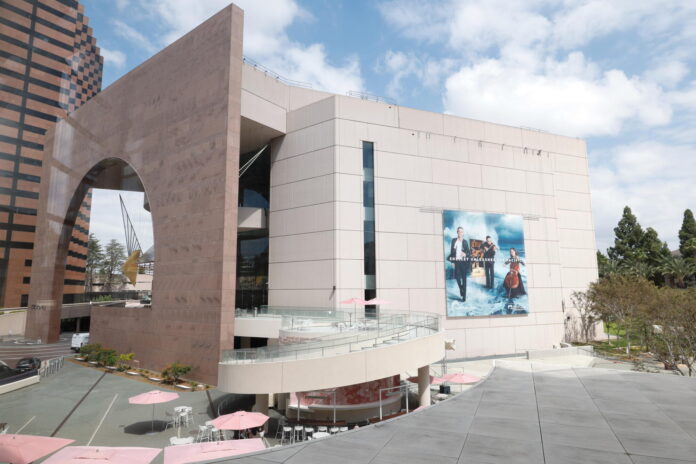
At a time when art feels under attack, the Segerstrom Center for the Arts appears to be thriving. It marked its 40th anniversary this month with a campus-wide celebration that drew more than 5,000 Orange County residents. That number represents a stunning achievement, and did not come without challenges, noted Segerstrom Center President and chief executive Casey Reitz.
In January 2020, Reitz moved from New York to Costa Mesa to start his new job, only to soon find the world — and the center’s many planned performances — shut down by the COVID-19 pandemic. The center went on to lay off 63% of its staff, one of the largest cutbacks among Orange County’s major arts organizations. Reitz was quoted as saying the pandemic had “eradicated 75% of our income.”
Today, the center is back in the black: last year’s tax filings show revenue of $106 million, with expenses of $91.4 million and total assets of $558 million. As Reitz stands inside the foyer of the immaculate Renée and Henry Segerstrom Concert, the view speaks for itself: a collection of striking buildings, a beautiful courtyard and large posters bearing some of the biggest names in performance, including the resident Pacific Symphony. On any given week, a patron can step into one of the theaters and watch a hit Broadway show, attend a jazz or symphony concert, or enjoy a show from a world-renowned dance company.
Segerstrom Hall at the Segerstrom Center for the Arts on a sunny day in September as the institution celebrates its 40th anniversary.
(Carlin Stiehl / For The Times)
The Segerstrom is also heralded for its hospitality; Reitz is particularly proud that the center received an award from Broadway Across America for being voted the most welcoming spot on Broadway tours.
All the joy and buzzing activity arose from humble beginnings.
“Where you’re standing, where you’re looking, was some lima bean farms,” says Reitz. “It takes a very special person to bring such a vision to life.”
The person in question is Henry Segerstrom, the philanthropist and real estate developer who served as the center’s founding chairman when it opened in 1986. At that time, it was called the Orange County Performing Arts Center, but the organization rebranded in 2011 to honor the Segerstrom family, who initially donated a 5-acre parcel of land and remain actively involved to this day.
“I remember the way he articulated his vision when it was just a thought in his head,” said Gaddi H. Vasquez, a board member ambassador who grew up in the area and was friends with Segerstrom. “There were no bounds to what he could envision.”
At the time, Vasquez says, locals had to travel to Los Angeles to see a good show. “Henry and many others felt the time had arrived for Orange County to take on the responsibility of developing its own performing arts destination.”

From left: Casey Reitz, president and chief executive of Segerstrom Center for the Arts, Gaddi Vasquez, Karla Kraft and John Phelan stand inside the lobby of the Renee and Henry Segerstrom Concert Hall at the Segerstrom Center for the Arts. The institution is a mainstay in Orange County as it celebrates its 40th anniversary.
(Carlin Stiehl / For The Times)
From the start, Segerstrom sought to recruit the best leaders he could find. He brought in the Kennedy Center’s general manager Judy Morr as the original programming director and, later, executive vice president of programming. Now retired, Morr says the plan was to model the new organization after what she knew from the Kennedy Center. “I wanted to make sure it was equal, and sometimes we even surpassed that standard,” she says. In addition to theater and music, a big part of Morr’s agenda had to do with her favorite medium: dance.
“I like all kinds of dance, and I would bring in whatever important dance companies there were,” she says. “The experience I love most is great dancing coming from around the world.” She was a particular fan of ballet, and built vital relationships with organizations including the American Ballet Theatre. This led to building the ABT William J. Gillespie School on campus, which trains dancers ages 3 to 18.
While those years consisted of long hours and hard work, Morr says she never considered it a job. “I was just doing what I love and doing it the best I could,” she says. In 2014 Morr received the ultimate honor when the intimate black box space known as Founders’ Hall was renamed the Judy Morr Theater.
Over four decades, the campus grew larger with additional theaters to serve more people, eventually becoming the cultural epicenter of Orange County.

The interior of the Renee and Henry Segerstrom Concert Hall at the Segerstrom Center for the Arts.
(Carlin Stiehl / For The Times)
When Chairman of the board John Phelan moved to the area in 2004, only the 3,000 seat opera-style Segerstrom Hall was in operation.
“They wanted to see how it would evolve over time and they took it in stages,” Phelan says. “After seeing the momentum and response, they moved forward on expanding.”
The main concert hall, which also contains the 500-seat Samueli Theater and the Lawrence and Kristina Dodge Education Center, officially opened in 2006. The Julianne and George Argyros Plaza followed in 2017, the same year the Center for Dance and Innovation opened. Most recently in 2022, the UC Irvine Langson Orange County Museum of Art opened, which now houses over 9,000 objects with free admission.
The museum is part of the center’s goal of giving back to its residents. “We talk a lot about our performances and the art, but the other element equally important to us is our relationship with the community,” says Phelan.
The campus hosts numerous free events, such as its Summer Sounds outdoor concerts and open air movie screenings. There are also outreach programs for the elderly, including a partnership with Alzheimer’s Orange County, which draws on the healing power of the arts. An Adaptive Movement program in the Tuesday Night Dance series incorporates chair choreography and helps adults with mobility issues to participate.

Segerstrom Hall at the Segerstrom Center for the Arts. The campus is home to a rich slate of performance offerings including musicals, jazz concerts and dance shows.
(Carlin Stiehl / For The Times)
The opportunities for young residents are plentiful. Vasquez serves as the chair of the education committee and says the department’s reach extends to more than 300,000 students, teachers and family members every year, often in underserved schools. This includes education programs like Disney Music in Schools and Summer at the Center, which expose kids to the arts and encourage them to perform for friends and family.
Center staff speak passionately about what it means to discover theater at a young age. Board member Karla Kraft recalls seeing “Les Misérables” as a child. Though she’s now a lawyer, her passion for the arts never waned. She tells the story of another board member who was so nervous to speak in public that her mother made her join a theater production at school.
“It helped her open up, it gave her confidence,” Kraft says. “That’s the transformative power of theater, it shows up in ways you don’t always expect.”
Reitz says he personally experiences the impact of the center all the time. He was recently on a flight when a passenger noticed his Segerstrom business card on his luggage tag.
“He told me, ‘I started coming with my mom in the ‘90s and it was meaningful and exciting to me.’ He said the first show he saw was ‘Beauty and the Beast’ and I mentioned how that same show was coming back,” recalls Reitz. “He said, ‘I’ve got to come and bring my kids.’ That’s the kind of thing you dream of — people passing their traditions onto the next generation.”

Segerstrom Hall at the Segerstrom Center for the Arts. The campus maintains a vibrant education department, which hosts classes for people of all ages.
(Carlin Stiehl / For The Times)
Still, much remains to be done. The center recently announced an expanded commitment to Hispanic and Latino arts and culture, welcoming Grammy-winning composer Arturo O’Farrill as its inaugural artist in residence. It also launched ¡Viva! The Spenuzza Series, featuring curated programs honoring Hispanic culture, and it is investing in additional facilities and building more relationships and partnerships, soon to be announced. While there will always be concerns about remaining relevant, securing funding and pleasing audiences, Segerstrom Center leaders say they will always strive to make room for everyone.
“I feel like the arts are a place where people can have common ground and enjoy and celebrate being brought together for a shared experience,” says Kraft. “And I want to make sure that as we go forward, we continue to make it a place that everybody can find something that they love and that inspires them here.”
More to Read
Disclaimer : This story is auto aggregated by a computer programme and has not been created or edited by DOWNTHENEWS. Publisher: latimes.com